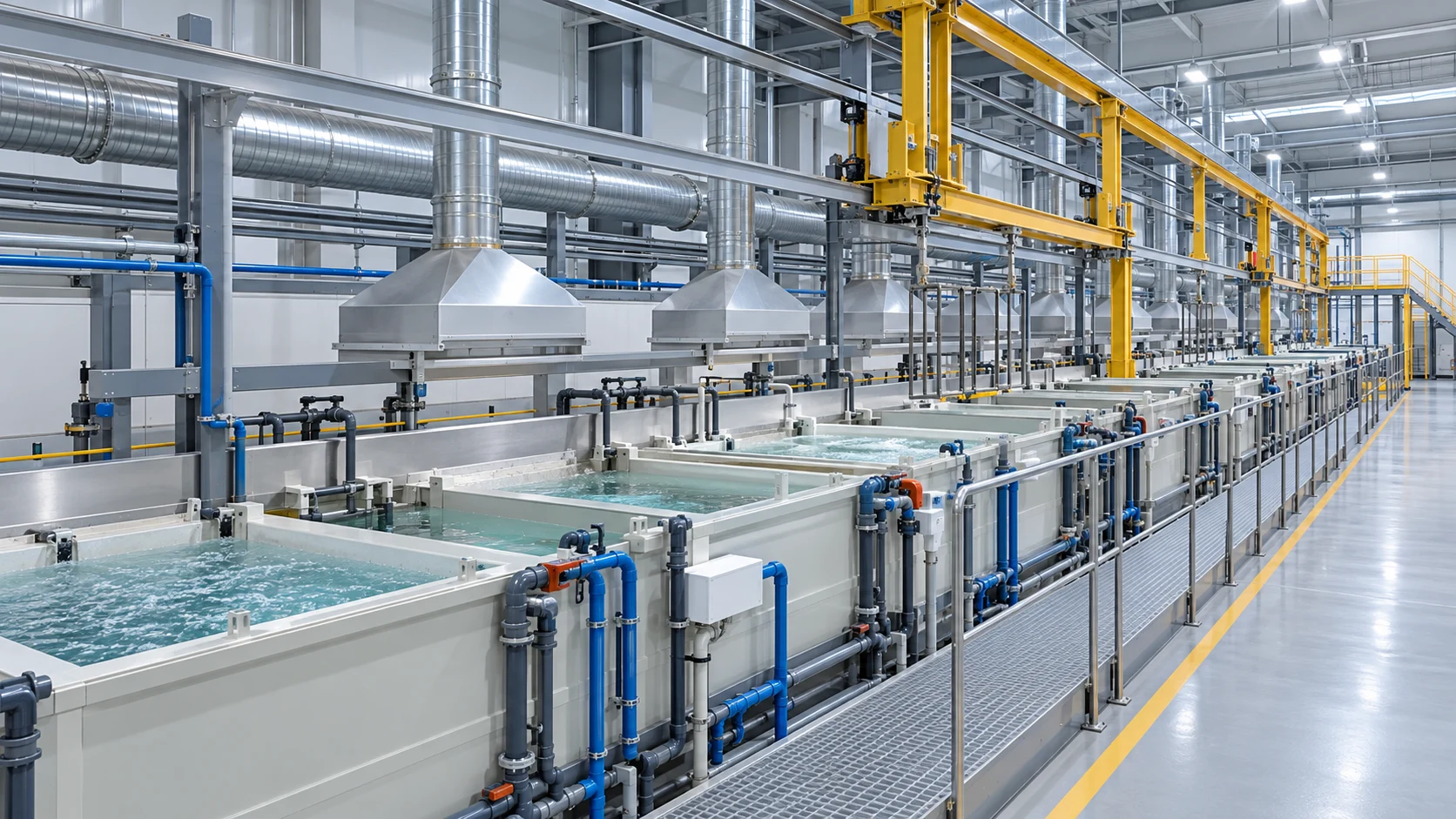
Metalworking facility reference Process selection depends on water quality and project conditions.
Your process challenges
Chemistry matched to real operating conditions.
Identify metal and contaminant forms first, then connect the reaction step with reliable solids separation and sludge handling.
Treatment approach
Segregated Cyanide-Stream Treatment: understand the treatment stages first.
Check dedicated cyanide-stream identification and controlled engineered treatment separately from downstream metal separation. A general workshop image cannot establish a specific oxidation procedure.
Swipe horizontally to view the full diagram.
Identify and segregate cyanide streamsCheck composition and complexed forms
Controlled engineered treatmentAssess against the dedicated process
Downstream metal separationKeep separate from general tank-line descriptions
Monitoring and residual controlConfirm against engineered-system conditions
Check together during selection
Distinguish free cyanide from complexed cyanide and maintain a separate, controlled engineered treatment circuit. Never mix cyanide-bearing water directly with acid. Oxidation routes require off-gas, by-product and residual monitoring.
Compare candidate products below by treatment objective. Evaluate different routes separately; the list does not imply simultaneous dosing.
Segregated Cyanide-Stream Treatment: match requirements to each treatment stage.
Compare treatment objectives, chemical functions and verification criteria stage by stage. Products in the table may be alternatives or serve different stages; they are not necessarily dosed together.
Define influent and objectives first
Share cyanide speciation, metals and complexing agents, the separate treatment process, off-gas requirements and residual monitoring. This helps connect target speciation, reaction and separation and narrow the product and specification range.
Then confirm assessment limits
Distinguish free from complexed cyanide and retain a separate, controlled engineered treatment stream. Cyanide-bearing water must not be directly mixed with acid. Oxidation routes require off-gas, by-product and residual monitoring.
Compare all treatment routesProduct roles, conditions and verification
Segregated Cyanide-Stream Treatment: treatment objectives and product routes
Review only within controlled engineering and professional assessment. Distinguish free from complexed cyanide and assess side reactions. Cyanide-bearing water must not be directly mixed with acid.
View each product's function and conditions
Sodium Hypochlorite
Function:Participates only in a separate oxidation or decomplexation engineering stage assessed by professionals; it is not an ordinary coagulation chemical. Conditions:Define the target species, separate water circuit, reaction, and off-gas/by-product monitoring. This catalogue does not provide hazardous mixing steps.
Hydrogen Peroxide
Function:Participates only in a separate oxidation or decomplexation engineering stage assessed by professionals; it is not an ordinary coagulation chemical. Conditions:Define the target species, separate water circuit, reaction, and off-gas/by-product monitoring. This catalogue does not provide hazardous mixing steps.
Sodium Hydroxide
Function:Establishes the pH/alkalinity conditions needed for the relevant precipitation or controlled oxidation procedure. Conditions:Use the relevant metal/fluoride/cyanide speciation and reaction trials to define the conditions. Meeting pH once does not establish contaminant removal.
View product-specific checks
Sodium Hypochlorite
Segregated Cyanide-Stream Treatment: Available chlorine as mass fraction or g/L; Concentration at delivery; Free alkali; Impurities; Storage and transport time & conditions; Consider cyanide speciation, metals and complexing agents, the separate treatment process, off-gas requirements and residual monitoring.
Hydrogen Peroxide
Segregated Cyanide-Stream Treatment: Active content; Impurities; Actual target contaminants; Catalytic & downstream treatment conditions; Consider cyanide speciation, metals and complexing agents, the separate treatment process, off-gas requirements and residual monitoring.
Sodium Hydroxide
Segregated Cyanide-Stream Treatment: Actual composition & form; Content basis; Water quality; Equipment materials; End-use requirements; Consider cyanide speciation, metals and complexing agents, the separate treatment process, off-gas requirements and residual monitoring.
Compare results using representative water samples or site data, retaining the test methods and operating conditions.
Follow professional engineering documentation. Hydrochloric acid, sulfuric acid and other acid sources are not recommended in this treatment requirement.
View each product's function and conditions
Sodium Hydroxide
Function:Provides alkalinity or neutralizing capacity. Its role differs from rapid pH adjustment and hardness precipitation. Conditions:Maintain the required alkalinity only within a separate, controlled cyanide-treatment system. Acid must not be added directly to cyanide-bearing water.
View product-specific checks
Sodium Hydroxide
Segregated Cyanide-Stream Treatment: Actual composition & form; Content basis; Water quality; Equipment materials; End-use requirements; Consider cyanide speciation, metals and complexing agents, the separate treatment process, off-gas requirements and residual monitoring.
Compare results using representative water samples or site data, retaining the test methods and operating conditions.
Review the medium source, solids content, particle characteristics, return water and equipment. Compare using representative sample trials.
View each product's function and conditions
Polyacrylamide
Function:Polymer bridging and charge effects help build separable flocs. Flocculation does not remove dissolved salts or all COD. Conditions:Define particle and sludge properties, and match preparation, shear and settling/flotation/dewatering trials to the selected grade.
Polyacrylamide Emulsion
Function:Polymer bridging and charge effects help build separable flocs. Flocculation does not remove dissolved salts or all COD. Conditions:Define particle and sludge properties, and match preparation, shear and settling/flotation/dewatering trials to the selected grade.
Polyamine Coagulant
Function:An organic coagulant option that destabilizes colloids before further flocculation and solid–liquid separation. Conditions:Define the sample's charge demand, intended use and downstream process. A polymer name alone does not establish dosage or grade.
Poly(diallyldimethylammonium Chloride)
Function:An organic coagulant option that destabilizes colloids before further flocculation and solid–liquid separation. Conditions:Define the sample's charge demand, intended use and downstream process. A polymer name alone does not establish dosage or grade.
Polyaluminium Chloride
Function:Inorganic salt coagulation creates separable particles and affects downstream sludge production and alkalinity demand. Conditions:Compare pH, alkalinity, effective metal content and representative coagulation trials. Ferrous salts also require defined oxidation and downstream separation conditions.
Polyferric Sulfate
Function:Inorganic salt coagulation creates separable particles and affects downstream sludge production and alkalinity demand. Conditions:Compare pH, alkalinity, effective metal content and representative coagulation trials. Ferrous salts also require defined oxidation and downstream separation conditions.
View product-specific checks
Polyacrylamide
Segregated Cyanide-Stream Treatment: Ionic type & charge characteristics; Viscosity and test concentration/temperature; Residual monomer & test report; Dissolution conditions; Trial evaluation criteria; Consider cyanide speciation, metals and complexing agents, the separate treatment process, off-gas requirements and residual monitoring.
Polyacrylamide Emulsion
Segregated Cyanide-Stream Treatment: Ionic type; Active polymer; Emulsion system; Preparation conditions; Residual monomer; Consider cyanide speciation, metals and complexing agents, the separate treatment process, off-gas requirements and residual monitoring.
Polyamine Coagulant
Segregated Cyanide-Stream Treatment: Composition; Active content & method; Viscosity test conditions; pH; Application trials; Consider cyanide speciation, metals and complexing agents, the separate treatment process, off-gas requirements and residual monitoring.
Poly(diallyldimethylammonium Chloride)
Segregated Cyanide-Stream Treatment: Nominal concentration & test basis; Viscosity & test conditions; Residual monomer; pH; End-use documents; Consider cyanide speciation, metals and complexing agents, the separate treatment process, off-gas requirements and residual monitoring.
Polyaluminium Chloride
Segregated Cyanide-Stream Treatment: Al₂O₃ content; Basicity; Insoluble matter; pH test conditions; Impurity limits for the intended use; Consider cyanide speciation, metals and complexing agents, the separate treatment process, off-gas requirements and residual monitoring.
Polyferric Sulfate
Segregated Cyanide-Stream Treatment: Total iron; Basicity; Insoluble matter; Form; Trial conditions; Consider cyanide speciation, metals and complexing agents, the separate treatment process, off-gas requirements and residual monitoring.
Compare results using representative water samples or site data, retaining the test methods and operating conditions.
Need to compare these routes under your operating conditions?Share influent quality, treatment objectives and the existing process to discuss which products and conditions should be validated first.
Process & product matching
Select a treatment objective to explore suitable products.
Different treatment routes may apply. Open the matching notes for each product to review its role, conditions and purchasing criteria.
Distinguish free from complexed cyanide and retain a separate, controlled engineered treatment stream. Cyanide-bearing water must not be directly mixed with acid. Oxidation routes require off-gas, by-product and residual monitoring.
A chlorine source for suitable disinfection steps in water supply, wastewater and industrial water, compatible with liquid dosing arrangements.
Why this matchesConditional option
Role
Participates only in a separate oxidation or decomplexation engineering stage assessed by professionals; it is not an ordinary coagulation chemical.
Conditions
Define the target species, separate water circuit, reaction, and off-gas/by-product monitoring. This catalogue does not provide hazardous mixing steps.
Before purchase
Segregated Cyanide-Stream Treatment: Available chlorine as mass fraction or g/L; Concentration at delivery; Free alkali; Impurities; Storage and transport time & conditions; Consider cyanide speciation, metals and complexing agents, the separate treatment process, off-gas requirements and residual monitoring.
An oxidant option for specified oxidation, decolorization and engineered disinfection steps, matched to the contaminants and reaction route.
Why this matchesConditional option
Role
Participates only in a separate oxidation or decomplexation engineering stage assessed by professionals; it is not an ordinary coagulation chemical.
Conditions
Define the target species, separate water circuit, reaction, and off-gas/by-product monitoring. This catalogue does not provide hazardous mixing steps.
Before purchase
Segregated Cyanide-Stream Treatment: Active content; Impurities; Actual target contaminants; Catalytic & downstream treatment conditions; Consider cyanide speciation, metals and complexing agents, the separate treatment process, off-gas requirements and residual monitoring.
A common alkali raw material for pH adjustment, certain metal-precipitation steps and specified cleaning or regeneration procedures.
Why this matchesConditional option
Role
Establishes the pH/alkalinity conditions needed for the relevant precipitation or controlled oxidation procedure.
Conditions
Use the relevant metal/fluoride/cyanide speciation and reaction trials to define the conditions. Meeting pH once does not establish contaminant removal.
Before purchase
Segregated Cyanide-Stream Treatment: Actual composition & form; Content basis; Water quality; Equipment materials; End-use requirements; Consider cyanide speciation, metals and complexing agents, the separate treatment process, off-gas requirements and residual monitoring.
Select a suitable PAM for clarification, settling, thickening and sludge dewatering, matching flocculation behavior to the water, particles and equipment.
Why this matchesConditional option
Role
Polymer bridging and charge effects help build separable flocs. Flocculation does not remove dissolved salts or all COD.
Conditions
Define particle and sludge properties, and match preparation, shear and settling/flotation/dewatering trials to the selected grade.
Before purchase
Segregated Cyanide-Stream Treatment: Ionic type & charge characteristics; Viscosity and test concentration/temperature; Residual monomer & test report; Dissolution conditions; Trial evaluation criteria; Consider cyanide speciation, metals and complexing agents, the separate treatment process, off-gas requirements and residual monitoring.
An organic coagulant option for colloid destabilization, clarification and separation in certain oily water systems.
Why this matchesConditional option
Role
An organic coagulant option that destabilizes colloids before further flocculation and solid–liquid separation.
Conditions
Define the sample's charge demand, intended use and downstream process. A polymer name alone does not establish dosage or grade.
Before purchase
Segregated Cyanide-Stream Treatment: Composition; Active content & method; Viscosity test conditions; pH; Application trials; Consider cyanide speciation, metals and complexing agents, the separate treatment process, off-gas requirements and residual monitoring.
For raw water and wastewater coagulation, compare active components, basicity and water-sample trials against clarification and phosphorus-removal requirements.
Why this matchesConditional option
Role
Inorganic salt coagulation creates separable particles and affects downstream sludge production and alkalinity demand.
Conditions
Compare pH, alkalinity, effective metal content and representative coagulation trials. Ferrous salts also require defined oxidation and downstream separation conditions.
Before purchase
Segregated Cyanide-Stream Treatment: Al₂O₃ content; Basicity; Insoluble matter; pH test conditions; Impurity limits for the intended use; Consider cyanide speciation, metals and complexing agents, the separate treatment process, off-gas requirements and residual monitoring.
A polymeric iron coagulant option for clarification, phosphorus removal and sludge treatment support.
Why this matchesConditional option
Role
Inorganic salt coagulation creates separable particles and affects downstream sludge production and alkalinity demand.
Conditions
Compare pH, alkalinity, effective metal content and representative coagulation trials. Ferrous salts also require defined oxidation and downstream separation conditions.
Before purchase
Segregated Cyanide-Stream Treatment: Total iron; Basicity; Insoluble matter; Form; Trial conditions; Consider cyanide speciation, metals and complexing agents, the separate treatment process, off-gas requirements and residual monitoring.
Confirmed available
Let’s review this combination
Try another objective or product type, or send us your operating conditions.
Industry references describe general uses. Product specifications, certifications and application results require the corresponding supplier documentation.
PURCHASING QUESTIONS
More questions, answered.
How should I select water-treatment products for Segregated Cyanide-Stream Treatment?
Free cyanide, complexed cyanide and coexisting metals require different conditions. Segregate streams and obtain an engineering assessment first.
What information helps select products for this application?
Cyanide species, metals and complexants, dedicated process, off-gas and residual monitoring requirements.
How are the suitable product and grade confirmed?
Distinguish free from complexed cyanide and retain a separate, controlled engineered treatment stream. Cyanide-bearing water must not be directly mixed with acid. Oxidation routes require off-gas, by-product and residual monitoring. No universal dose or treatment result is implied. Product options may serve primary, supporting, conditional or alternative roles. This page gives no generic dosing steps, mixing proportions or removal guarantee.
ENVO CHEMICAL
Discuss your water treatment needs
Share your application, current product or purchasing requirements to discuss a suitable supply option.
Selection, purchasing & documentsShare what you know


 Base chemicals