
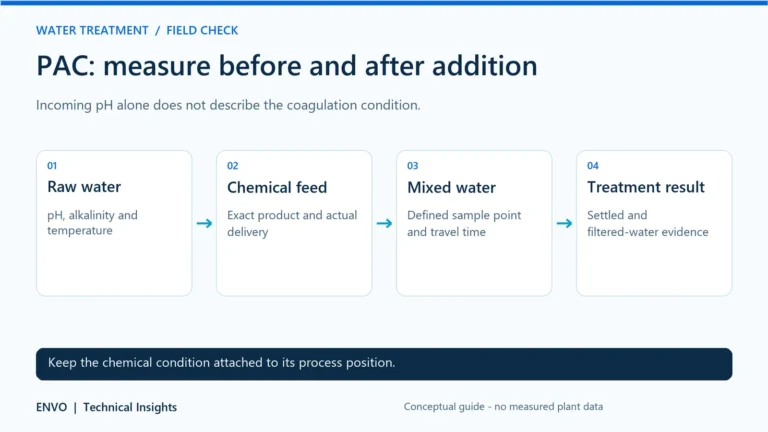
A raw-water pH result alone cannot explain the conditions after PAC addition. When coagulation becomes weak, pair the incoming-water record with measurements at the actual coagulation step. Include alkalinity, chemical delivery and the time represented by each sample before deciding that a different coagulant is needed.
Separate pH from buffering capacity
pH and alkalinity describe different properties. Two waters can have similar pH readings but respond differently to chemical addition. Pennsylvania DEP's operator training material treats alkalinity, pH and temperature as separate coagulation-control observations. This is why an unchanged incoming pH does not establish an unchanged treatment condition.
Use PAC here to mean polyaluminium chloride, also written PACl, rather than powdered activated carbon. Record the exact supplied formulation. Basicity, concentration and accompanying chemistry vary between products, so a general chemical-family name cannot determine the pH response of the material in your tank.
Measure at defined process positions
Mark the raw-water location, chemical addition point and mixed-water sampling position. Note other additions, including acids, alkalis and recycled water. Compare samples from the same operating period, allowing for the time needed for water to travel between positions. Ask the laboratory or operator to identify the methods and instrument checks used.
| Record | Why it matters | Common interpretation error |
|---|---|---|
| Raw-water pH and alkalinity | Describes the incoming chemical environment | Treating pH as a direct substitute for alkalinity |
| Mixed-water pH at the defined point | Shows the condition after the relevant additions | Using a distant or time-mismatched sample |
| Actual PAC delivery and product identity | Connects the observed response to the supplied chemical | Assuming pump setting equals delivered chemical |
| Settled and filtered-water outcomes | Checks performance beyond the mixing vessel | Choosing a condition only because the floc looks large |
Test the explanation before adding another variable
Prepare a trial sheet that keeps the original water, product and mixing procedure identifiable. Separate a dose comparison from a pH-condition comparison. If both are changed together, the result cannot show which change mattered. Record additions and measurements in their actual sequence, not as an end-of-day reconstruction.
A useful comparison can show that a previously successful product still works under the earlier mixed-water conditions, or that the incoming water has changed. It can also expose a feed-delivery discrepancy. These are different outcomes and call for different follow-up questions. None can be established by the supplier’s nominal grade label alone.
Include the complete treatment objective
Health Canada's aluminum guidance emphasizes that coagulation optimization has several objectives and that reducing aluminum residual must not compromise pathogen or organic-matter removal. Use the objectives and requirements that apply to the actual plant. Do not select a generic pH value from a product brochure and treat it as an approved plant operating limit.
For a drinking-water application, a controlled test should retain the required downstream checks and operating safeguards. For industrial water, define the quality needed by the next process. The relevant endpoint could include filtration behavior or a downstream sensitivity that a settled-water turbidity result does not describe.
Questions buyers ask about PAC and alkalinity
Does higher-basicity PAC eliminate the need to check alkalinity?
No. Product chemistry can change the response, but incoming-water conditions, other additions and the treatment objective still matter. Request the actual grade documents and evaluate the mixed-water result rather than relying on a family-wide assumption.
Should a weak result be corrected by increasing PAC immediately?
First determine whether the record describes a chemistry change, a chemical-delivery problem or an equipment issue. Any operating adjustment belongs within the plant’s approved procedure. An unstructured increase can obscure the original cause and make the next comparison harder.
Send a useful PAC selection brief
Include paired pH and alkalinity records, water temperature, product technical documents, feed evidence and the relevant downstream results. Explore polyaluminium chloride and raw-water clarification, or send the records to ENVO. Specify whether the enquiry concerns replacing a current grade or understanding a new water condition.
Related technical guides
- PAC Basicity and Al2O3: Read the Specification, Not the Color
- Cold-Water PAC Trials: Separate Floc Formation from Settling
Sources and scope
- Ontario, Design Guidelines: Treatment and Chemical Application
- Health Canada, Aluminum Guideline Technical Document (March 2021)
Sources checked on 30 October 2026. The comparison framework and illustration are original ENVO editorial material. They are not a plant case study, a product performance guarantee or a substitute for the applicable product label, operating procedure and local requirements.
