
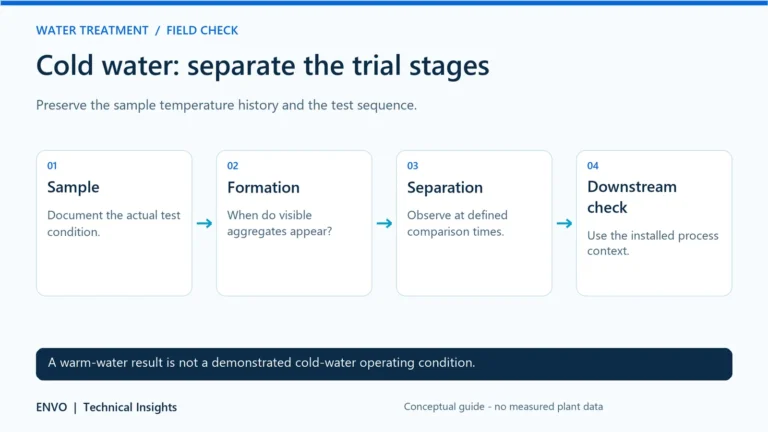
A winter PAC trial should answer whether the problem is floc formation, settling or downstream separation. A warm laboratory sample and an unchanged settling timer can hide the conditions causing a plant upset. Start by preserving the identity and temperature history of the water being compared.
Define what changed with the season
Record source, temperature, turbidity, pH, alkalinity and the operating flow during the event. Include recent source blending, chemical deliveries and equipment changes. A seasonal label such as “winter water” is too broad to show whether two tests used comparable feed water.
The Ireland EPA clarification manual describes temperature as relevant to mixing and settling behavior. Health Canada's aluminum guidance also discusses temperature-dependent coagulation conditions. These references support a controlled seasonal review; they do not justify a single winter PAC dose, mixing speed or pH value for every plant.
Keep the cold-water test representative
Document how the sample is held and how its temperature changes during preparation and testing. Record the test temperature at meaningful points rather than labeling the jar only with the raw-water temperature. Keep the product, preparation procedure, addition sequence and observation method traceable.
Use the plant’s validated jar-test procedure as the baseline. When reviewing a change to that procedure, identify the question it is meant to answer. A longer observation period can show something different from an increased chemical addition; changing both at once prevents a clear interpretation.
| Observation stage | Useful comparison | What remains uncertain |
|---|---|---|
| Immediately after the defined mixing steps | When visible aggregates form | Whether they will separate in the installed process |
| At fixed observation times | Settling pattern and supernatant quality | The result under a different hydraulic loading |
| After an appropriate filtration check | Downstream particle and residual behavior | Long-term filter-run performance without a plant trial |
| During the controlled plant comparison | Measured outcomes at recorded temperature and flow | Transferability to another season or water source |
Distinguish slow separation from inadequate coagulation
Compare the formation timeline with the separation timeline. If useful aggregates form but the observed settling behavior differs, the next question is not identical to a test in which formation itself is poor. Include the installed clarification method: a settling jar is not a complete model of a flotation plant or a membrane pretreatment system.
Do not select a condition from one unusually clear sample. Compare repeated observations, method consistency and the outcomes that matter downstream. Retain records of temperature drift and any deviations. They may explain why an apparently successful bench condition did not reproduce at full scale.
Plan a seasonal operating review
Agree on the baseline and the allowed trial changes with the responsible operator and process team. Identify the delay between a chemical-feed change and the downstream sample. Keep the required water-quality safeguards in place. A trial should produce a documented decision, including the conditions under which it was evaluated.
Use a concise conclusion: which stage changed, which evidence supports that finding and which explanation is still untested. Avoid describing a product as universally “winter-proof.” A supplier discussion is stronger when it describes a defined water and process than when it repeats a broad seasonal marketing claim.
Questions about cold-water PAC trials
Should the sample be warmed so the test is easier to repeat?
A warmed test answers a different question. If temperature is being investigated, preserve and document the intended condition using an appropriate procedure. Any warm comparison should be clearly labeled as a separate comparison.
Does a longer settling time prove that a grade is unsuitable?
Not alone. Consider formation, separation method, hydraulic conditions and the required downstream result together. A grade-selection decision needs a process-relevant comparison rather than one observation time.
Prepare the next discussion
Send the temperature log, jar-test sequence, current grade documents and plant results. Explore PAC grades and raw-water clarification, or share a seasonal trial brief with ENVO.
Related technical guides
- PAC Coagulation: Check Post-Dose pH and Alkalinity
- PAC Basicity and Al2O3: Read the Specification, Not the Color
Sources and scope
- Ireland EPA, Coagulation, Flocculation and Clarification manual (2002)
- Health Canada, Aluminum Guideline Technical Document (March 2021)
Sources checked on 30 October 2026. The comparison framework and illustration are original ENVO editorial material. They are not a plant case study, a product performance guarantee or a substitute for the applicable product label, operating procedure and local requirements.
