

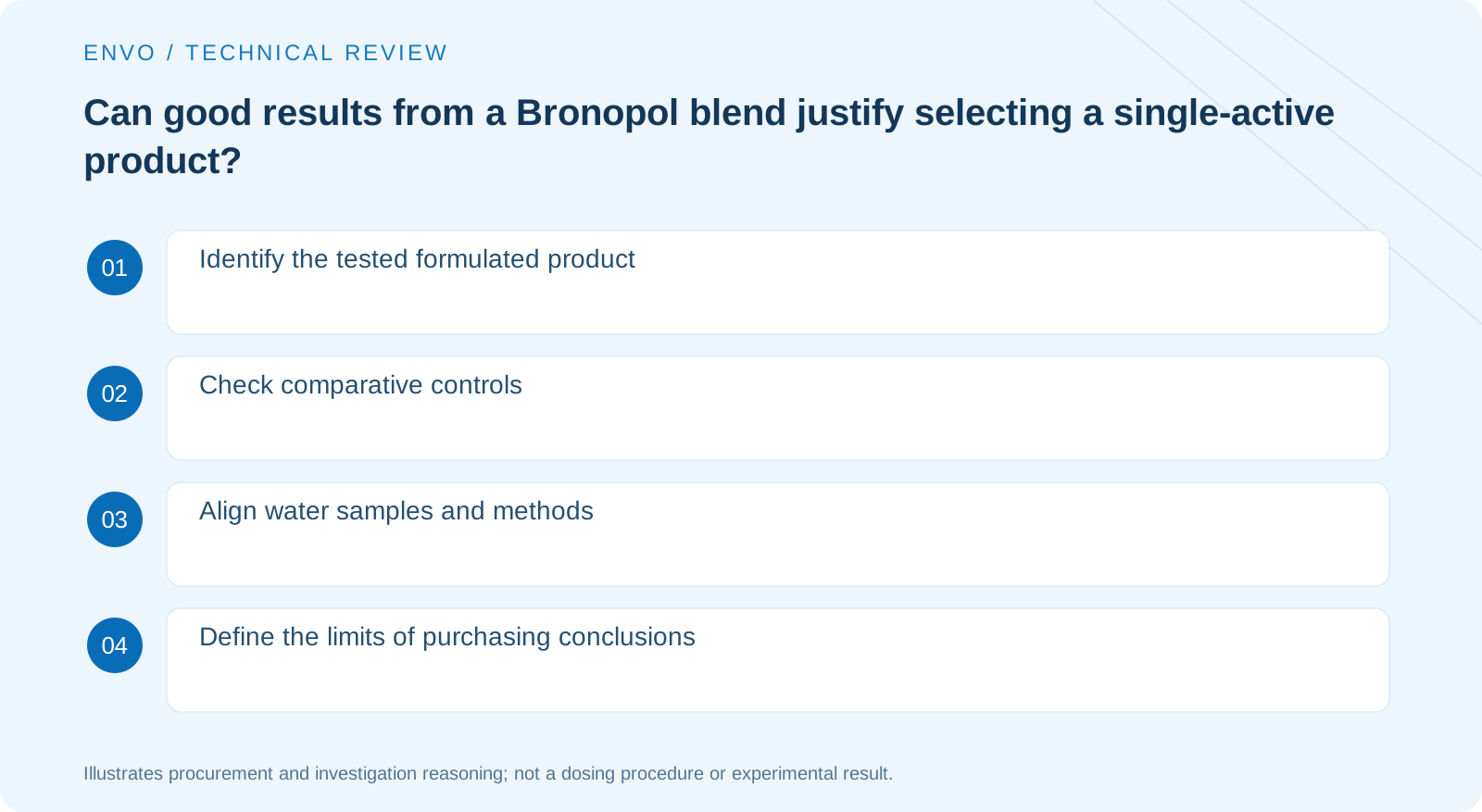
Identify the product actually tested in the report
Check the model, active ingredients and batch in the report to establish whether it concerns Bronopol alone or a product combined with CMIT/MIT, DGH or other constituents. LANXESS cooling-water literature lists these routes separately, so Bronopol in a name does not mean the report evaluates it alone. If a supplier provides only a product-family brochure, request the tested model and corresponding technical description instead of filling in the missing formulation identity yourself.
Turn synergy claims into testable questions
A blend may be designed for a specific objective, but superiority over a single agent requires assessment with the same target and comparable conditions. Ask whether single-agent controls exist, what comparison basis is used and how components are identified. Without these conditions, the information may describe the blend itself but cannot establish individual contributions or support automatic calculation of a supposed synergy multiplier.
Results from different water samples cannot be ranked directly
A blend tested in clean water is not directly comparable with a single agent tested in white water containing many process additives. Organize water samples, temperature, contact window, method and target organisms, marking differences first. If both work under different conditions, the supported conclusion is evidence for each within its tested conditions, not a universal winner based on the highest kill rate.
Build the sample-trial plan around unanswered questions
If customers are concerned with foam, stability or process quality, include those in the next validation rather than repeatedly measuring one microbial endpoint. Distinguish raw-material testing from commercial-product testing. The actual blend carries manufacturing, documentation and use requirements; users should not reproduce a commercial product’s effect by mixing on site from public reports.
Use precise wording for purchasing conclusions
A supported statement may specify that a particular model met agreed observation objectives in a defined water type and conditions, listing untested combinations separately. Do not claim identical Bronopol results against every organism or turn third-party brand trials into ENVO cases. Attach relevant reports and actual operating conditions to inquiries and ask suppliers to explain corresponding products and evidence, translating promotional wording into specific selection criteria.
Technical information for a purchased blend should accurately identify the entire product. If the customer needs Bronopol raw material, blend-performance curves cannot replace evidence for the single active. Claims of synergy, acceleration or longer protection require review against the corresponding comparative design; they cannot be inferred merely from combining two actives. Where such comparisons are unavailable, describe the formulation and potential assessment uses accurately without inventing each component’s contribution.
Explore further
Can documentation for bronopol alone be used for any product containing it?
It helps explain components only; it cannot replace evidence of compatibility and quality for the complete blend.
Can we blend a trial product ourselves using a published ingredient list?
No. Actual formulated products involve formulation, safety and use requirements and need corresponding professional design and validation.
References
This article draws on publicly available technical information. Third-party sources do not establish ENVO product approvals, field testing or project experience. Confirm each use against actual supply documents and site conditions.