

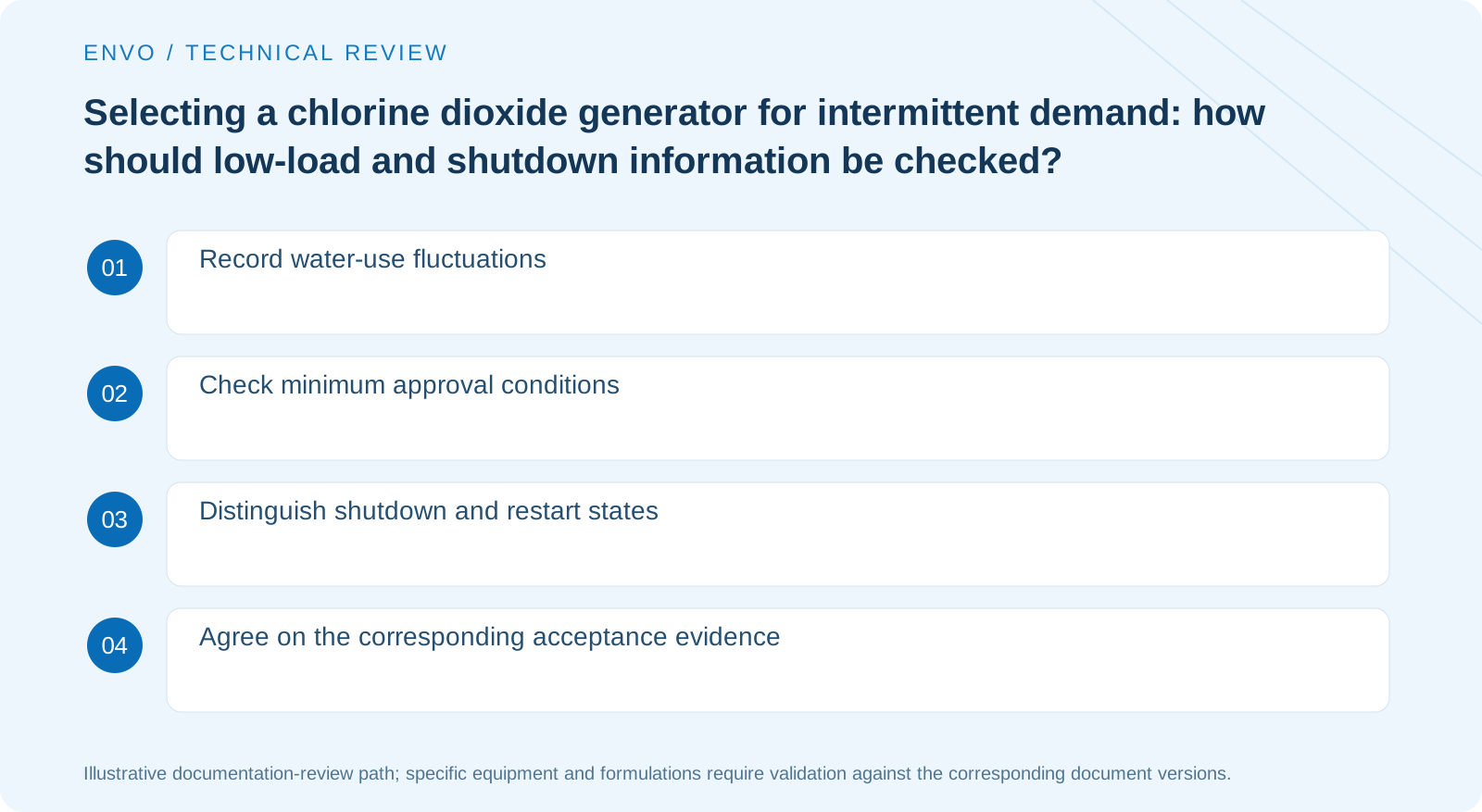
Provide the equipment supplier with an actual demand curve
Record normal, low-load, peak and supply-paused conditions, including their duration and transitions. Average daily demand alone may conceal intermittent equipment demand. Do not invent precise forecasts; identify unmeasured areas needing site records. Explicit uncertainty gives proposal designers a better selection basis than assuming uniform round-the-clock operation.
Check turndown capability and minimum conditions for the specific model
ProMinent’s CDVd manual includes minimum output and specific operating conditions, demonstrating that maximum capacity does not describe the entire operating range. This reference concerns the structure of equipment documentation; its parameters must not be transferred to other generators. Quotations should identify the exact model, configuration, control mode and approved range and explain whether the project’s minimum demand is covered. If it is not, the engineering team must propose a suitable solution; buyers should not independently relax the limits.
Record different shutdown causes separately
Recovery after planned shutdowns, supply interruptions, faults and maintenance may require different confirmations. Request current equipment-provider descriptions of states, responsibilities and recovery-validation requirements without rewriting startup steps in a generic article. Automatic recovery does not mean every scenario needs no human confirmation. Actual logic should follow the overall engineering design and approved instructions and connect with site management.
Define acceptance arrangements before requesting quotations
Acceptance plans should define operating states to validate, observation targets, recording methods and responsibility for unfinished items, with qualified personnel following equipment requirements. Compare suppliers’ explanations of low-load and interruption behavior alongside rated output. One successful normal run cannot cover untested transitions, and equipment records cannot replace end-use water-quality evidence. Document these separately.
Retain defined limits for future demand changes
Handover documents should retain the confirmed water-demand range, equipment configuration and approved version for later review when branches, shifts or consumption change. Procurement conclusions should state current coverage and changes requiring reassessment. Customers can then avoid restarting every inquiry while also recognizing that spare rated generator capacity does not automatically cover any lower or more intermittent demand.
Explore further
Is average daily water consumption sufficient for generator selection?
Low-load, peak, suspension and switching conditions also need to be understood.
Can equipment parameters from an article be used directly?
This article provides no operating parameters. Use approved information for the actual model.
References
This article draws on publicly available technical information. Third-party sources do not establish ENVO product approvals, field testing or project experience. Confirm each use against actual supply documents and site conditions.