

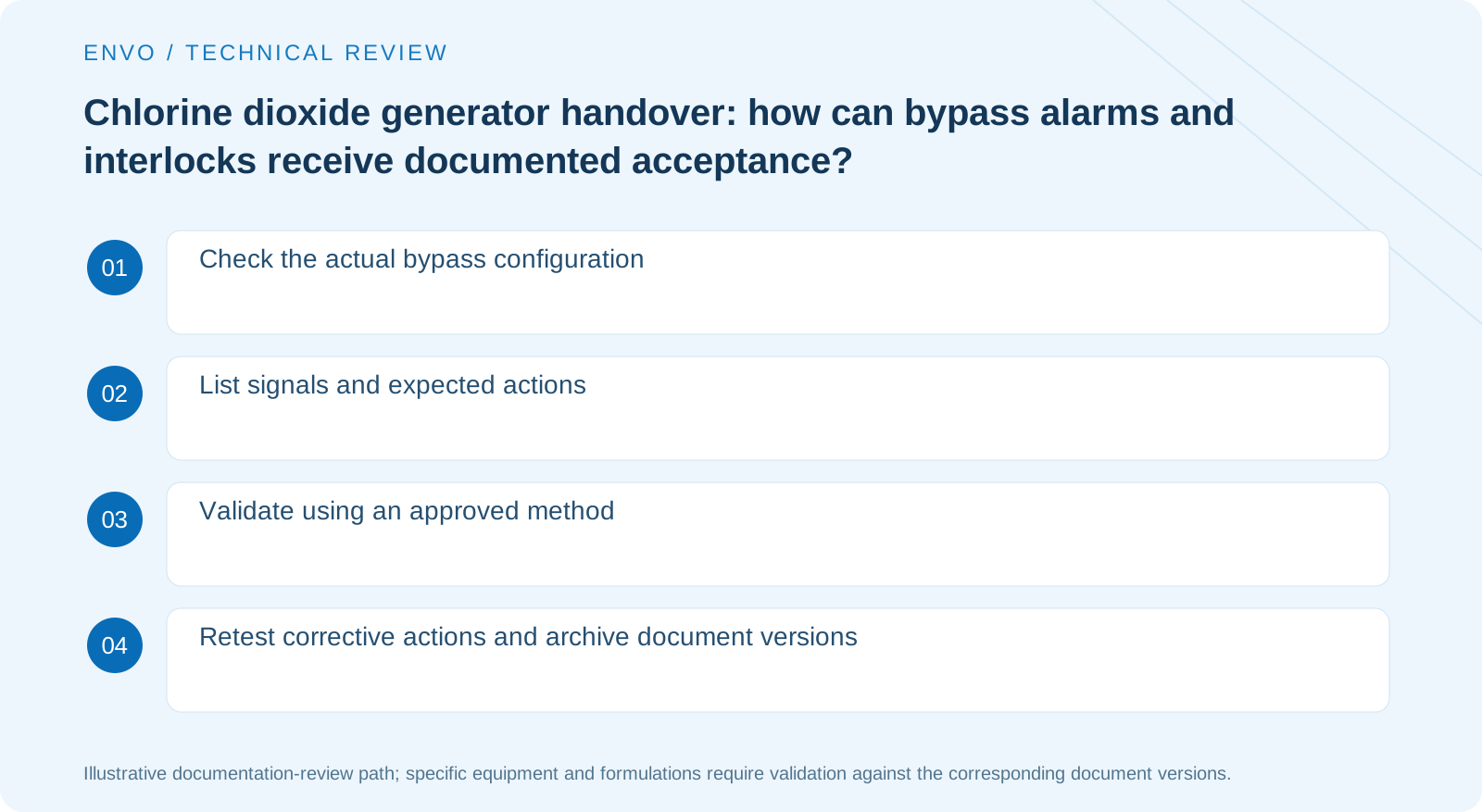
First confirm the supplied configuration and protection scope
Collect the generator model, hardware and software versions, bypass configuration and as-built drawings. Some components may be supplied by the engineering contractor; buying the main unit does not establish that every protective feature is included. ProMinent equipment instructions specifically identify bypasses and related safety facilities, showing that these belong within system design. Third-party manuals identify documentation to check; they do not prove installation at the customer’s site or by ENVO.
State the expected response for each signal
Acceptance checklists can separately record input conditions, controller displays, alarm outputs, protective actions, notification recipients and restart authority. Establish the intended design and its supporting document rather than merely checking for a red indicator light. Engineering configurations differ, so another model’s logic cannot simply be copied. Mark undocumented functions as pending confirmation by equipment and engineering personnel.
Have qualified personnel perform approved tests
Use equipment-provider-approved test methods and record actual configuration and results. This article supplies no fault-simulation procedures and never supports disabling protection, bridging signals or creating hazards during operation. Buyers and users should ensure traceable records, clear test boundaries and completed anomaly follow-up. Qualified technical teams determine site methods and conditions.
Track nonconformities through retesting
If displays, outputs or protective actions differ from expectations, record the function, version, observed facts and corrective responsibility, retaining retest evidence after correction. Do not mark unfinished items passed or replace site results with verbal manufacturer explanations. Acceptable output from the main unit does not offset an unverified interlock; they address separate engineering questions.
Make setting changes traceable after handover
Archive approved control-logic descriptions, settings versions, access controls and maintenance contacts. When sensors, control programs or bypass configurations change, identify acceptance checks requiring repetition. Cleared alarms or equipment resets do not establish that causes are resolved; continue tracking under the site system. This document chain connects safety functions, routine maintenance and procurement scope so customers can see what the system actually delivers.
Explore further
Does seeing an alarm light mean the interlock has passed acceptance testing?
Not enough; check expected protective behavior and corresponding test records.
Can purchasing staff simulate faults themselves?
Qualified personnel should follow manufacturer-approved methods without bypassing protections.
References
This article draws on publicly available technical information. Third-party sources do not establish ENVO product approvals, field testing or project experience. Confirm each use against actual supply documents and site conditions.