

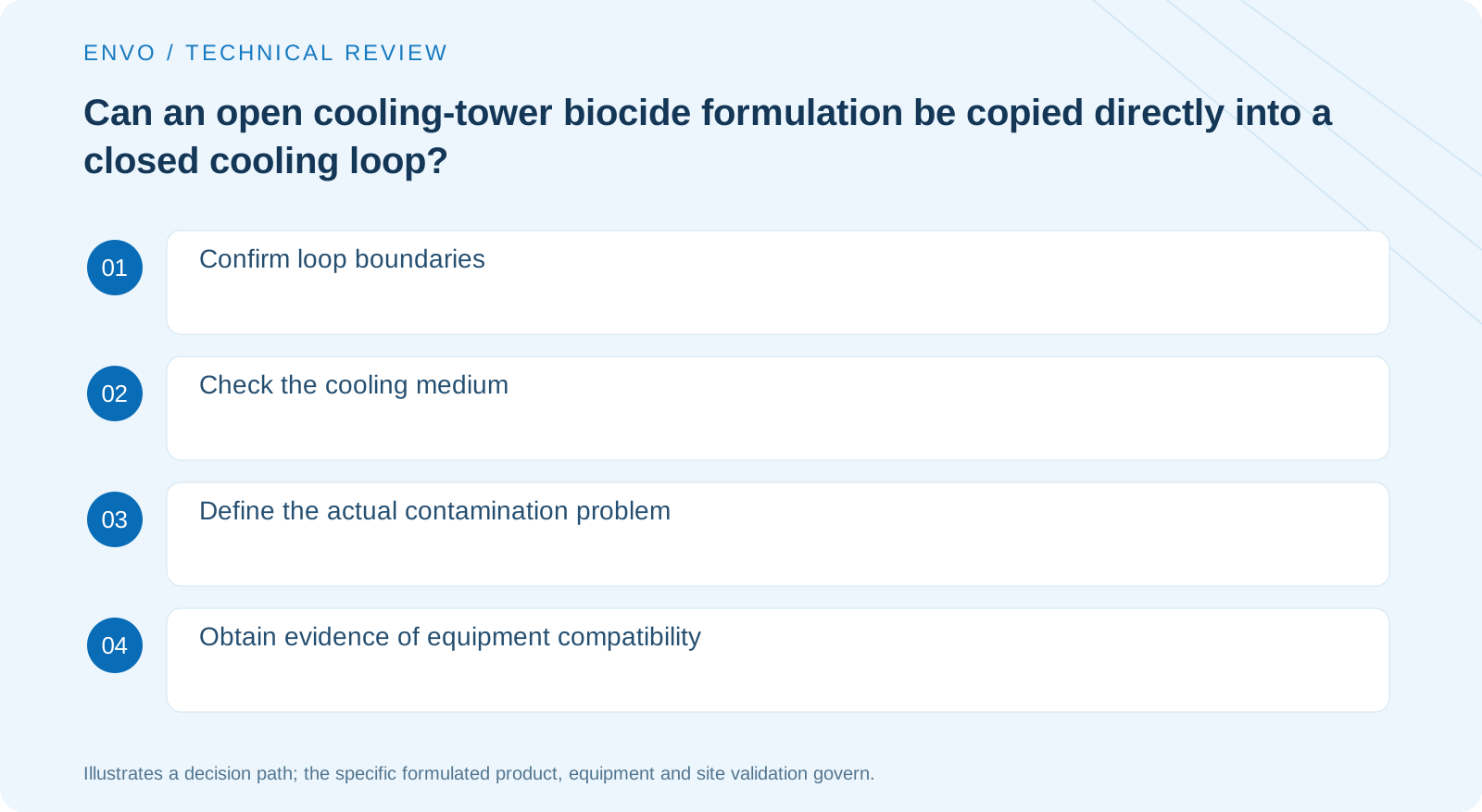
Check whether the system is truly isolated
Map the main equipment, plate heat exchangers, open tanks and makeup-water equipment to establish microbial-entry and water-exchange routes. Some nominally closed systems still have open interfaces or maintenance makeup water. Clear boundaries are more reliable than conclusions based on the system’s abbreviated name.
Collect equipment and coolant information
If glycol or other coolants or dedicated additives are present, the equipment supplier must confirm compatibility of the candidate formulation. A cooling-tower ingredient list cannot replace equipment approval. Seals, metals and fluid performance may all be critical acceptance conditions.
Redefine contamination and operating parameters
Diagnose closed circuits around the deposits, corrosion or microbial problems actually present. Interpret results alongside sampling locations and residence conditions rather than changing the entire treatment program after one sample. Aeration or blowdown conditions available in open towers may not exist in closed systems.
Specify exclusions before purchasing
Specify coolant properties that must not be affected, equipment warranty boundaries and operating-maintenance restrictions before comparing complete formulations. Public cooling-water catalogs are only a starting point for candidates. Without evidence for the specific closed circuit, obtain dedicated confirmation rather than interpreting broad industrial use as suitability for all cooling equipment.
Identify each loop to prevent transferring a treatment program between systems
Give each circuit a clear identifier, recording whether it is open, makeup source, coolant name, principal materials, equipment supplier and permitted chemical treatment. If a plate heat exchanger isolates a circuit from an open tower, show that boundary clearly. Tower-side conclusions cannot be transferred directly to the closed coolant side. What customers call ‘one cooling system’ may contain several distinct water environments.
If a candidate has documentation for open cooling towers but lacks evidence for closed circuits, the next step is to verify the exact circulating medium and equipment approval. If documents cover a type of closed system but the actual coolant differs, that difference still requires confirmation. If the circuit arrangement is unclear, first recover the equipment documentation. Marketing phrases such as ‘low corrosion’ and ‘low foam’ do not resolve all three gaps.
Record the components and functions that must remain unaffected, such as specified equipment seals or coolant functions, and have specialists use these to establish acceptance criteria. Purchasing staff can help ensure complete information but should not approve an entire circuit using a resistance table for a single material. File records separately for each independent circuit so operators can quickly find the relevant conditions.
Explore further
Do closed systems necessarily require no microbial management?
Not necessarily; it depends on contamination pathways, media and actual operating conditions.
Can a cooling-tower label be applied directly to a liquid-cooling circuit?
No. Evidence of compatibility with the equipment and complete fluid is required.
References
This article draws on publicly available technical information. Third-party sources do not establish ENVO product approvals, field testing or project experience. Confirm each use against actual supply documents and site conditions.