

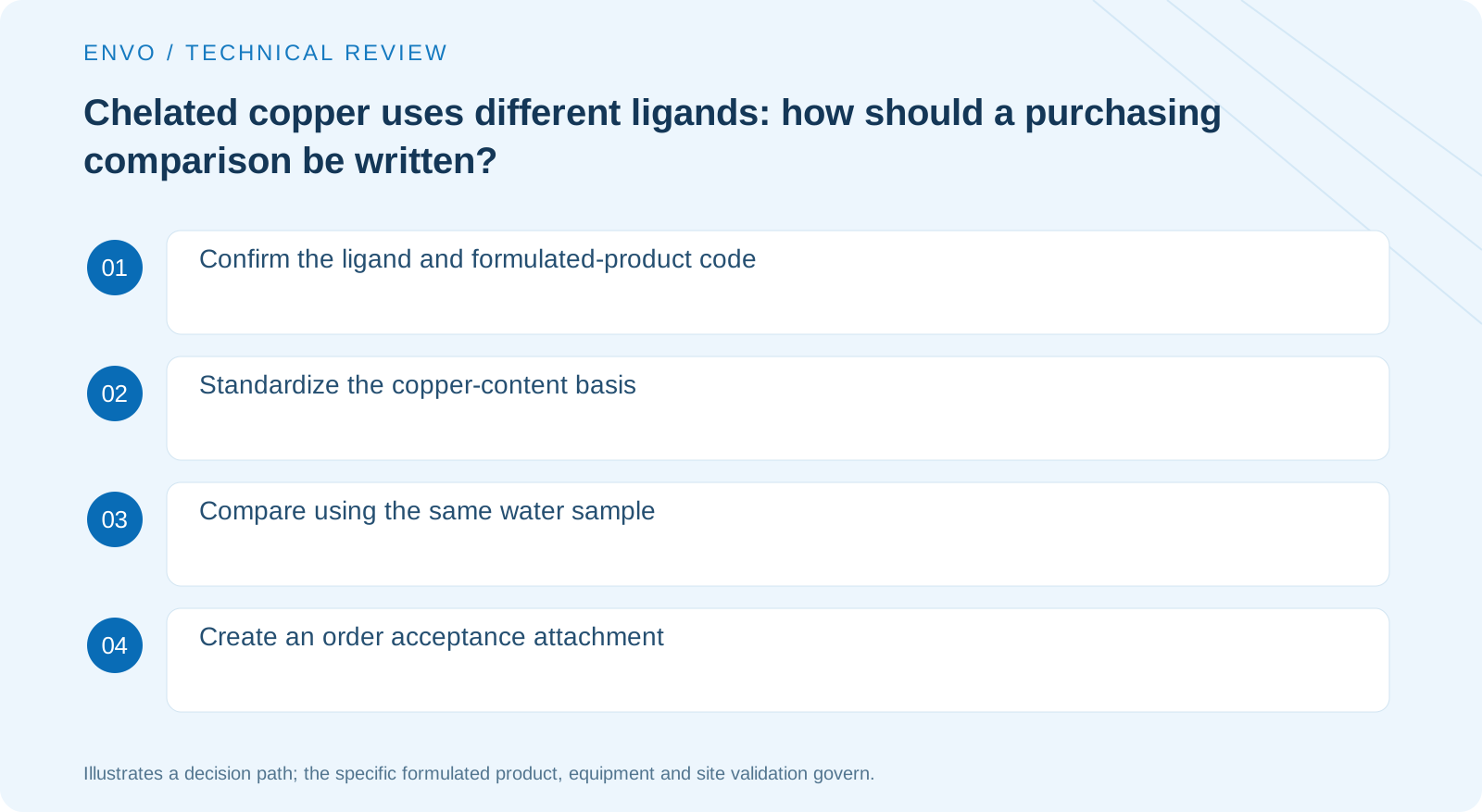
Identify the formulated product before considering its marketing name
Request the full label and technical documentation, checking consistency among product code, manufacturer and registration information. SePRO’s public example shows that chelated copper may use an ethanolamine system, but does not establish identical ligands in all chelated-copper products or transfer that brand’s permitted uses to other formulations.
Compare copper-content reporting bases as well as values
List elemental copper equivalent separately from compound or complex content, recording the mass basis and test method. If the supplier reports only ‘total actives,’ ask which ingredients it includes. Procurement can use a consistent copper basis to screen quotation differences, but cannot infer identical ecological performance or use rates from it.
Use water quality as a condition for formulation comparison
Comparative tests should use the same water sample and retain information on pH, alkalinity, organic matter and target algae. The value of ligand design must be demonstrated in the specific water quality; advertised stability cannot replace field validation. If two samples were tested in water collected in different seasons, investigate the water-quality background before directly ranking the results.
Deliver a traceable set of requirements
Include product identity, copper analysis, appearance stability, storage and transport conditions, and use documentation as order attachments. Different regions may use different label versions, so record the applicable region and document date when purchasing. List matters requiring further verification explicitly rather than allowing terms such as ‘concentrated’ or ‘new formulation’ alone to become acceptance criteria.
Retain distinctions that cannot be combined when comparing formulations
Divide complexed-copper quotations into three small tables: identity, quality and application. Identity covers product code and ligand description; quality covers copper-content expression, methods and guaranteed specifications; application covers the specific water body, target algae and label restrictions. Suppliers may define confidential formulation information, but must still provide sufficient product identification and use conditions. ‘Proprietary technology’ cannot replace every check.
Even if two documents show the same copper equivalent, examine full formulations and labels. Solid and liquid products also need separate receipt and metering assessments. If site trials used different waters, retain their results separately rather than directly ranking the apparently better sample. Identifying noncomparable factors is more useful than forcing every product into one overall ranking.
For repeat purchases, also record the originally approved model and document version. When a formulation is revised, first check changes in ingredients, guaranteed parameters or uses, then decide whether previous validation remains applicable.
Explore further
Is a greater degree of complexation always better?
There is no universal ranking independent of water quality and use; compare evidence for complete formulations.
Can another brand’s label be copied?
No. A label applies only to its corresponding formulated product and scope.
References
This article draws on publicly available technical information. Third-party sources do not establish ENVO product approvals, field testing or project experience. Confirm each use against actual supply documents and site conditions.