

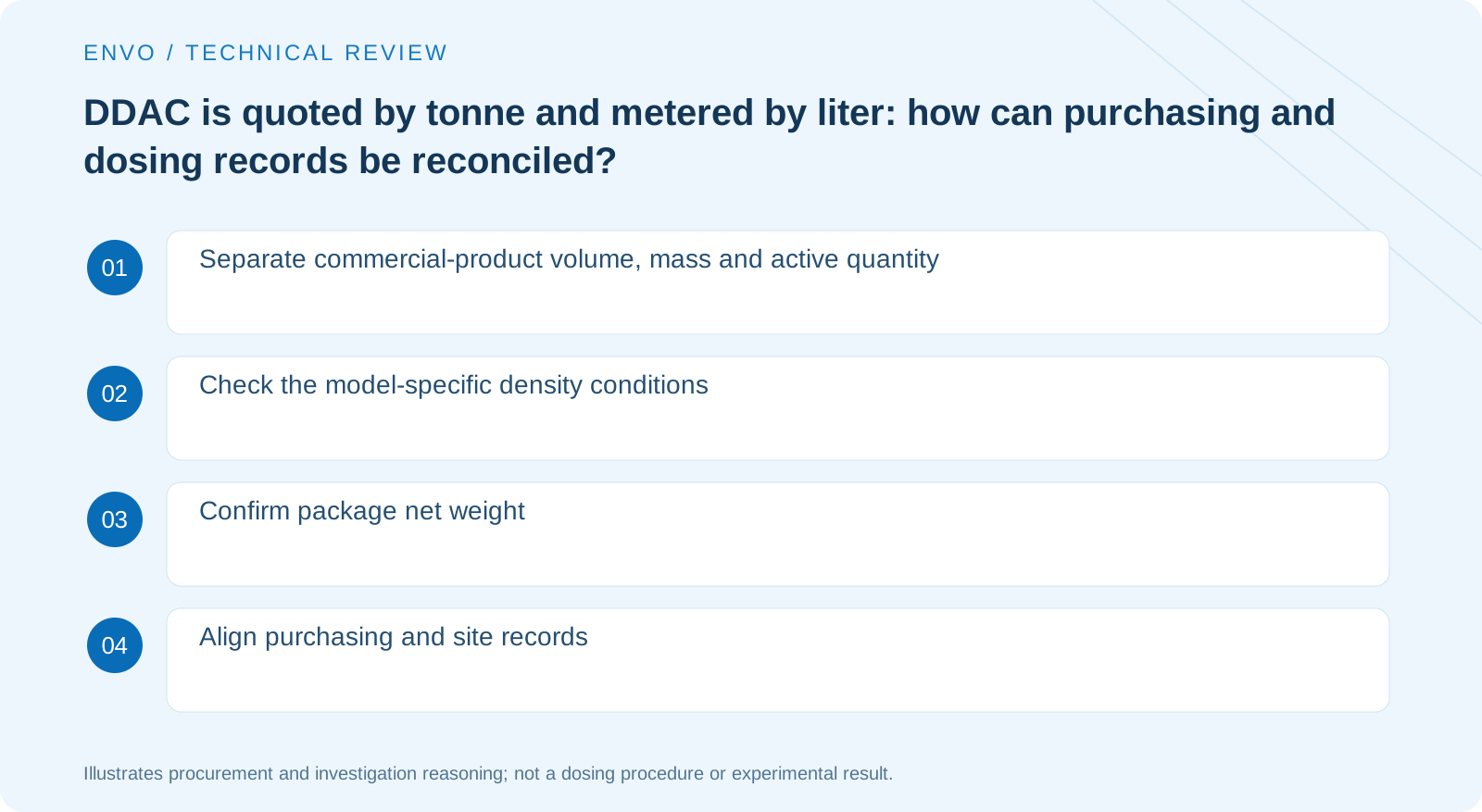
State commercial-product quantity and active quantity separately
Contract net weight describes the quantity of product delivered, active content describes its agreed composition, and site volume records describe the volume delivered by metering equipment. These must be linked under defined conditions; one tonne of product is not one tonne of DDAC active ingredient. Historical DDAC labels illustrate the distinction between product and active ingredient, but their values belong to those products and cannot be inserted into ENVO’s current specifications or customer calculations.
Use density evidence for the specific commercial product
Density must come from valid documentation for the actual model or agreed testing, with temperature and units stated. Different formulations, carriers and specifications cannot share a default value. If only typical density is available, confirm its adequacy for metering. Retain sources and rounding rules in calculations so purchasing, warehouse and operating staff can verify them and avoid conflicting quantities for the same batch.
Separate package net weight from container volume
Nominal container capacity is neither actual product net mass nor fully usable volume. Acceptance should check labeled net mass, quantities, packaging and weighing records rather than estimate from fill height. Investigate suspected shortages using agreed methods, not one photograph, and do not rewrite supplier batch data to reconcile accounts.
Investigate site metering differences separately
Pump settings do not directly equal delivered mass. Qualified site personnel should verify metering and records under equipment procedures, accounting for chemical changes, equipment condition and operation. No universal calibration or dosing steps are provided here. Procurement needs reliable calculation inputs, not mathematical conversions that conceal uncertainty in actual equipment delivery.
Establish shared quantity fields for all departments
Orders and inventory records should separately retain product net weight, package count, active-content basis, density source and site metering units. State whether expected demand means product quantity or active requirement, listing delivery location and packaging separately. This creates a common basis for commercial comparison and stock planning. Higher content or lower price per volume alone cannot establish lower total operating cost.
If warehouse inventory is counted by package, also retain each package’s nominal net weight and actual acceptance records to avoid combining different pack sizes. When the site uses liters and finance settles in tonnes, a shared, verified conversion basis with its conditions is more reliable than forcing the accounts to balance with estimates at month-end.
Explore further
Does one tonne of DDAC solution equal one tonne of active substance?
No. Distinguish products by the actual definition of their active content.
Can the previous supplier’s density value be used indefinitely?
Recheck after a product or specification change; do not assume equivalence.
References
This article draws on publicly available technical information. Third-party sources do not establish ENVO product approvals, field testing or project experience. Confirm each use against actual supply documents and site conditions.