

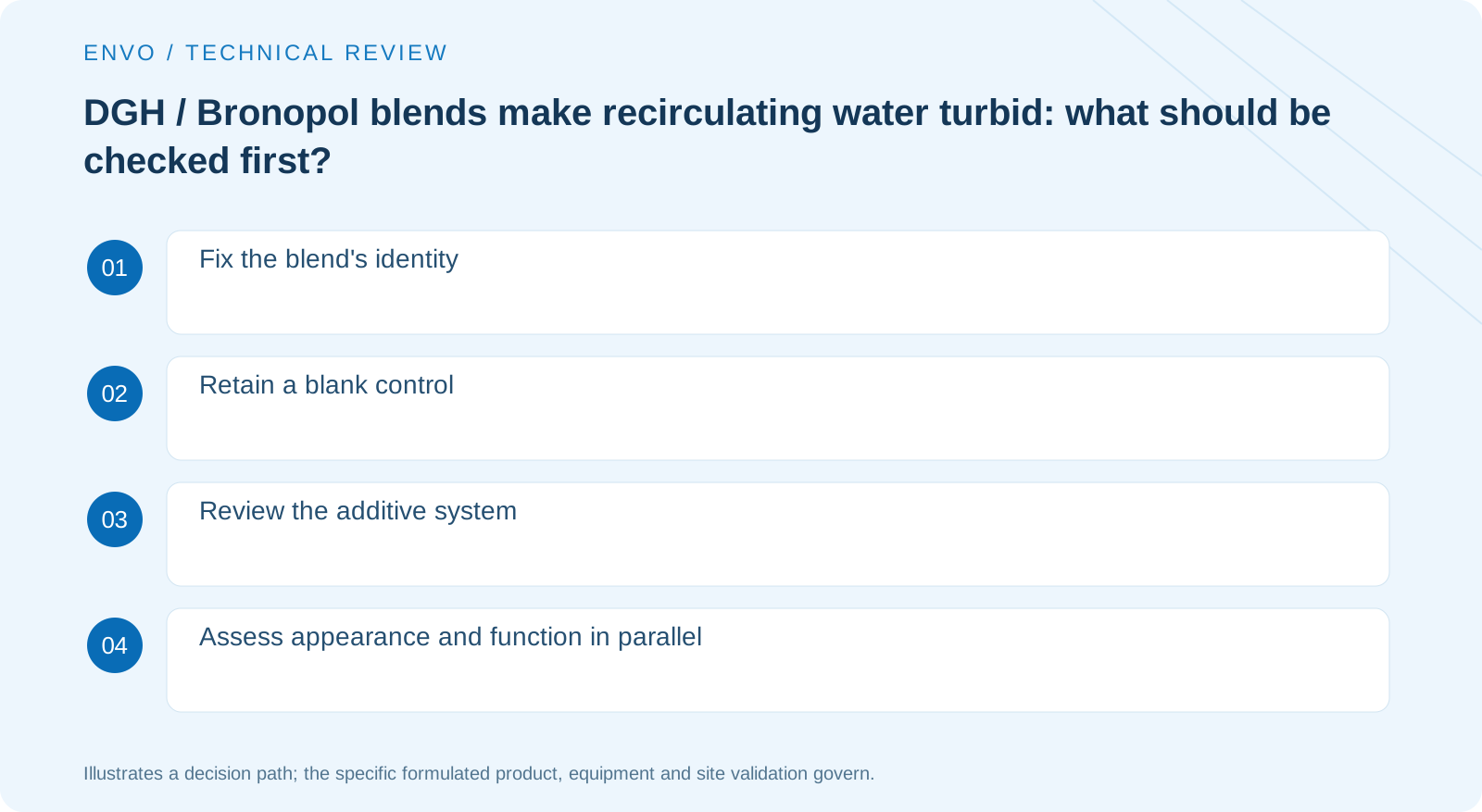
First identify the specific blend
The combination name DGH and Bronopol does not identify all other ingredients or their proportions. LANXESS cooling-water literature lists this technical approach, but the specific product model being purchased still requires complete documentation. Begin the investigation with a clear identity for the formulated product rather than treating identically named products from different suppliers as the same sample.
Retain the blank water sample
Observe untreated actual water, the existing chemical system and the complete formulated product under assessment separately, with controls designed by professional testing personnel. If the raw water itself settles on standing, do not attribute all sedimentation to the new product. Recording when cloudiness appears and whether layering accompanies it helps distinguish different phenomena.
Check the substances with which it interacts in actual water
DGH is a treatment approach requiring attention to cationic compatibility, so documentation should include anionic corrosion and scale inhibitors, polymers and suspended solids. Water conductivity alone does not describe the complete system. Do not combine reagents on site to find an answer; use the actual additive list for controlled compatibility validation.
Assess appearance and function separately
Actual microbial control needs assessment even without cloudiness. When cloudiness occurs, also examine its effects on heat transfer, filtration and blowdown. Final acceptance criteria should include process performance rather than appearance alone. If compatibility cannot be demonstrated, restrict the application scope or select a validated candidate; do not conceal the problem with higher dosing.
Organize the cloudiness investigation into comparable sample groups
Distinguish raw water, water under the current program and water after candidate-product contact, recording sampling times and states. Professionals should design groups; customers provide actual additive and water context rather than mix unknown substances on site. Use consistent lighting and backgrounds for photographs to avoid visual comparison errors.
If raw water develops the same deposits, investigate existing particles and quality. Changes only in the full additive system suggest interaction review; abnormalities in candidate concentrate before use belong to quality and storage/transport review. These are different paths, not all product nonconformity. One clear beaker does not establish complete compatibility.
Link final records to process impacts, such as filtration load, actual deposit locations and equipment restrictions. If appearance changes but the impact is unconfirmed, retain that uncertainty in the conclusion. If a critical function is unacceptable, stop expanding the application scope and seek an evidence-supported alternative.
Explore further
Does cloudiness establish that a product has deteriorated?
No. Distinguish raw-water particles, formulation quality and interactions within the system.
Is providing only the antiscalant name sufficient?
Preferably include the exact model, current use conditions and available composition information.
References
This article draws on publicly available technical information. Third-party sources do not establish ENVO product approvals, field testing or project experience. Confirm each use against actual supply documents and site conditions.