

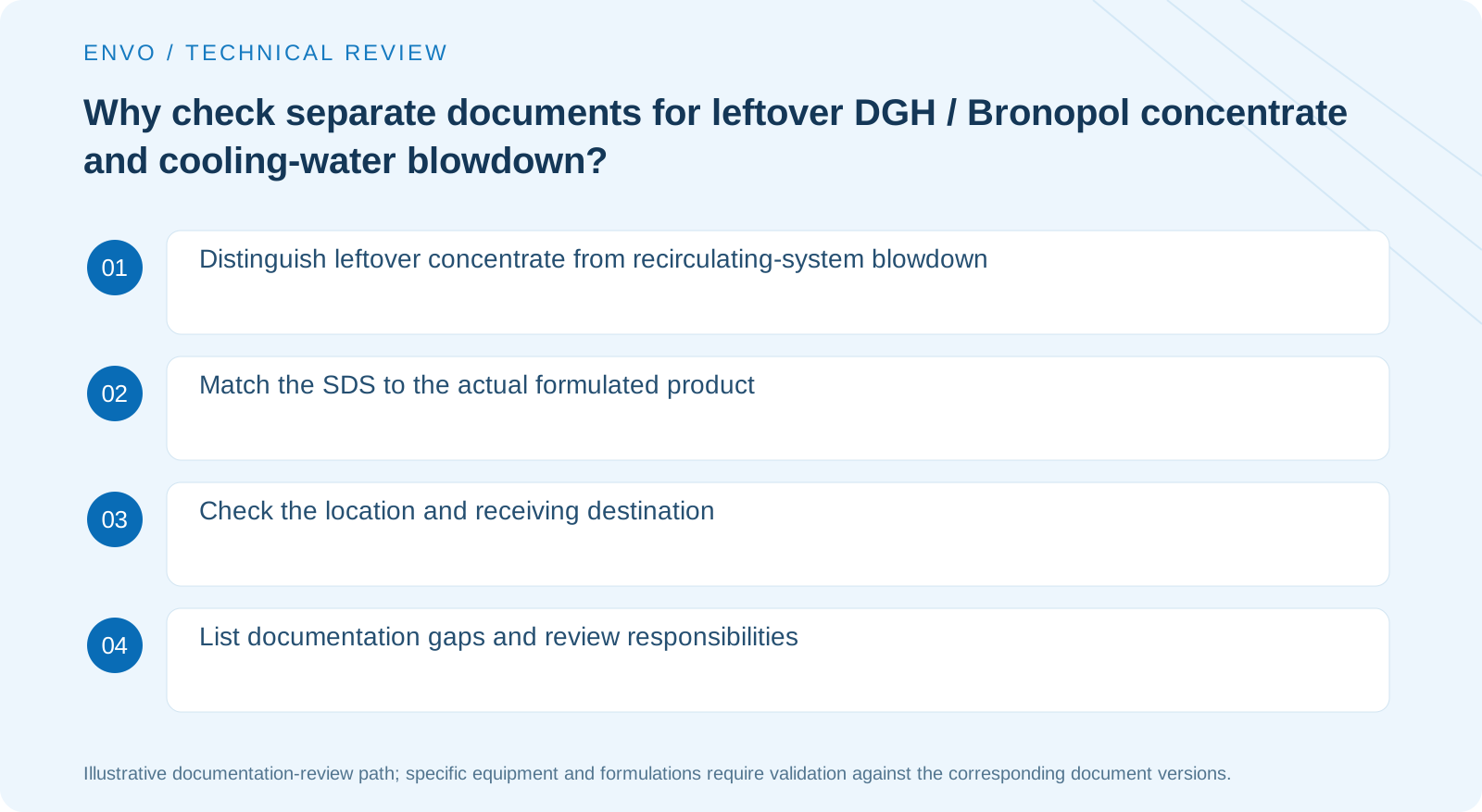
First determine exactly what remains
Record unused concentrate, used recirculating water and other site residues separately, identifying their source, exact product code, batch and any added materials. Identical names do not establish identical composition or condition, and a product label on a container does not prove that its contents remain the original formulated product. Procurement records provide facts for suppliers and site environmental personnel. Without testing and regulatory evidence, do not independently classify residues or decide how to discharge or treat them.
Obtain the SDS for the actual formulated product
LANXESS lists a cooling-water product combining DGH and Bronopol, demonstrating a commercial formulation route. Its name, however, cannot replace documentation for another supplied product. CCOHS guidance on SDSs separates product identity, hazards and management information into different sections. Check that documentation matches the actual product name, version and supplier. Separate SDSs for the two raw materials are insufficient to identify the complete blend and its remaining constituents; obtain missing information from the actual supplier.
Do not interpret disposal information as discharge authorization
CCOHS explains that SDSs may contain ecological and disposal information while noting that the information may not cover a specific workplace. A general statement therefore cannot independently determine the destination of this project’s residues. Distinguish supported product information, items without data and conditions requiring site input; ‘not provided’ does not mean ‘no impact.’ This article addresses document review and does not provide neutralization, dilution or discharge methods. Actual decisions belong to the personnel responsible for those duties.
Create a separate water-flow record for recirculating-system blowdown
Cooling-system blowdown documentation should state the facility location, actual water circuit, chemicals used together, monitoring information and receiving destination. EPA industrial-wastewater pages distinguish discharge requirements from entry into municipal sewage systems in the United States, illustrating how facility activities and the receiving system affect required information. These arrangements must not be treated as universal rules. Check local requirements and actual permit or receiving conditions; obtaining a product SDS does not complete the entire blowdown review.
Specify documentation deliverables and responsibilities at the quotation stage
The procurement checklist can separately identify the formulated product SDS, missing information on remaining material, site discharge conditions and the responsible reviewer. The supplier explains the exact product documentation, while users and relevant professionals review it against site and destination conditions, maintaining links between documents. Review affected items if the formulation, discharge destination or additional chemicals change. This makes quotations and delivery documentation address more than a chemical name and lets customers identify information gaps before arrival, rather than discovering afterward that documents cannot support actual management.
Explore further
Can Section 13 of an SDS replace a discharge permit?
No. Product documentation and discharge requirements for the specific facility and receiving endpoint must be checked separately.
Can SDSs for two raw materials replace the SDS for the formulated blend?
That cannot establish the complete formulation. Obtain documents matching the actual product supplied.
References
This article draws on publicly available technical information. Third-party sources do not establish ENVO product approvals, field testing or project experience. Confirm each use against actual supply documents and site conditions.