

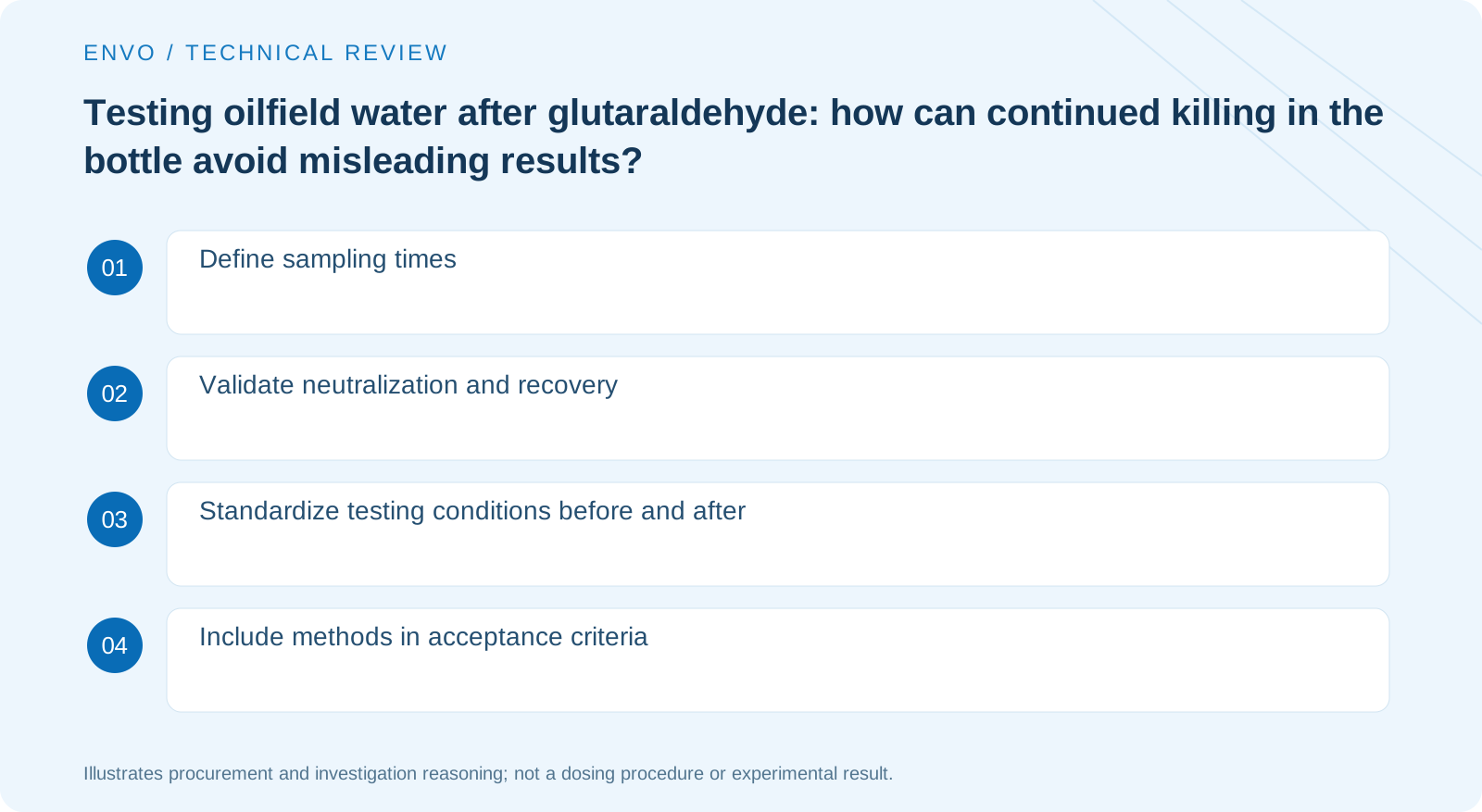
First establish which time the test result represents
The target is usually water quality at sampling, not its condition several hours into transport. LANXESS oil and gas literature discusses combining microbial testing with treatment programs; buyers should ask the testing plan to explain how continued treatment in the sample bottle is prevented. Counts from different sampling procedures are not directly comparable, and lower values after longer transport cannot prove better efficacy. If sampling and laboratory receipt times are absent, complete those records first.
Have the laboratory validate neutralization and recovery
Provide the laboratory with the intended formulated glutaraldehyde product, expected residual range, salinity and sample matrix so it can choose an appropriate method and validate neutralization and its effect on microbial recovery. No neutralizer ratios are provided here. Incorrect neutralization or growth inhibition by the neutralizer itself weakens conclusions. Reports should include necessary controls, not just post-treatment numbers, and identify targets outside the method’s scope. A negative result cannot support a claim that no microorganisms exist.
Use comparable conditions before and after treatment
Use corresponding sampling locations, times, preservation and analytical conditions, noting site flow, temperature and chemical status. If the pretreatment sample comes from a tank and the post-treatment sample from another branch, explain that spatial difference. Different detection technologies may measure different targets; interpret culture counts, molecular tests and process indicators according to their respective meanings. For blended sources, the sampling stage also affects whether results can apply elsewhere.
Investigate the method behind abnormal data before judging the product
A result suddenly below all previous records warrants checks of blanks, controls, sample storage and analytical range before announcing a breakthrough. Higher post-treatment counts likewise require ruling out sample contamination, changed locations or inconsistent methods. Arrange appropriate retesting of unexplained results while retaining original anomalous values. Deleting anomalies deprives later procurement decisions of essential context.
Include test methods in technical acceptance criteria
Acceptance agreements should specify parameters, methods, sampling plans and anomaly verification instead of leaving bacterial reduction as an unlimited promise. Raw records help distinguish method problems, insufficient chemical delivery and recontamination. Include current testing procedures with inquiries so specialists can identify whether product specifications, trial design or sample submission needs improvement. Another finished product’s antimicrobial description supports a technical route, not validation of this sample and batch.
Sampling records should separately state site collection time, sample-treatment start and laboratory analysis time. A report containing only the final issue date cannot explain changes during waiting. For external testing, site and laboratory should agree methods and acceptance conditions beforehand rather than changing handling criteria after disappointing results and introducing new uncertainty.
Explore further
Do lower laboratory results always indicate better site conditions?
Not necessarily. Effects such as continued in-bottle reactions and assay inhibition need to be ruled out.
Can another chemical’s neutralization method be copied?
Do not copy it directly; validate its applicability to the actual formulated product and water sample.
References
This article draws on publicly available technical information. Third-party sources do not establish ENVO product approvals, field testing or project experience. Confirm each use against actual supply documents and site conditions.