

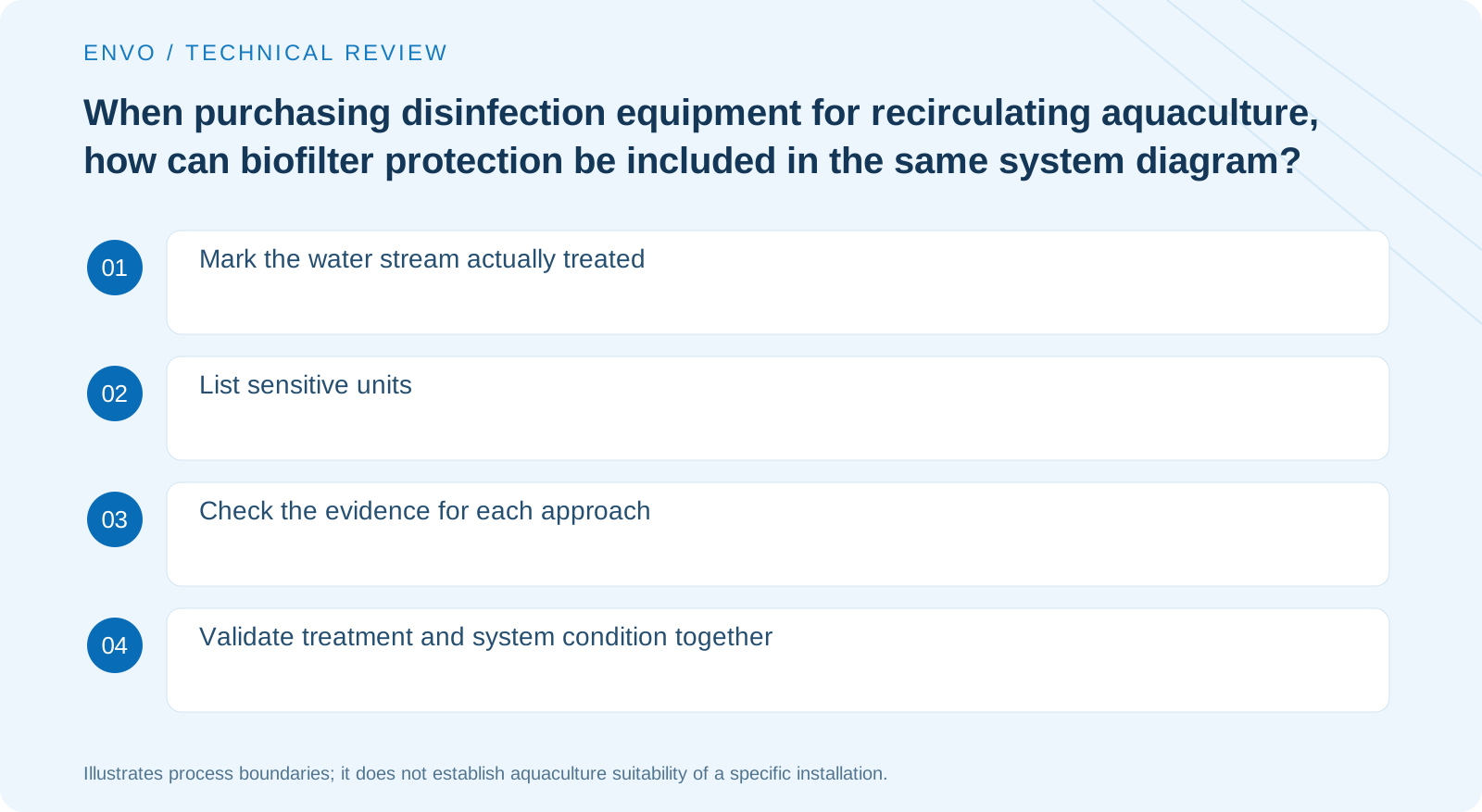
Mark the water stream the equipment actually treats
Use existing drawings to identify inlet, side-stream, return, overflow, isolation and discharge points, noting whether water routing changes between operation and maintenance. A supplier’s quoted treatment flow may be device throughput, while the operator’s figure may be total recirculation flow; these are not inherently equal. Mark each flow’s measurement location and whether the water passes through solids removal to establish the process task served by the equipment.
Use sensitive-unit requirements as design inputs
List the cultured species, life stages, salinity and biofilter locations, and have the facility and system designer define permissible water-quality limits. Do not leave these details as notes added after purchasing. WOAH disinfection planning emphasizes joint review of objectives, conditions and risks. In recirculating systems, animal exposure and downstream treatment-unit stability should be separate review items; general antimicrobial activity of one chemical cannot establish suitability for the entire system.
Clarify the evidence needed for UV and ozone separately
UV purchasing inquiries can address validated capability under actual water conditions, monitoring and maintenance. Ozone proposals also require the system provider to assess mass transfer, subsequent residuals and by-product management. The two approaches cannot be compared using one generic percentage. If a supplier provides only clean-water equipment results, request an explanation of differences from the current recirculating water and the items still requiring validation. Specific control thresholds come from the intended use and equipment documentation; this page provides no universal stocking values.
Observe both outcomes through system testing
Record the treatment barrier’s target indicators alongside the biological treatment unit’s operating indicators, with the project team defining the trial plan and abnormal-condition exit criteria. During system fluctuations, trace water-circuit changes, equipment maintenance and load changes rather than checking only indicator lights or a running display. The final procurement conclusion should specify applicable water circuits, operating ranges and interface responsibilities. Unconfirmed interfaces must remain items for validation, rather than promises that all animals and biofilters are already protected.
Explore further
Why must the sidestream proportion or return location be provided?
This information establishes how equipment-treated water returns to the system and directly affects whether individual-unit results can explain whole-system performance.
Can the equipment supplier be shown only a water sample?
Water-circuit and operating conditions are also needed. A water sample alone cannot show connections between equipment, animals and biological-treatment units.
References
This article draws on publicly available technical information. Third-party sources do not establish ENVO product approvals, field testing or project experience. Confirm each use against actual supply documents and site conditions.