

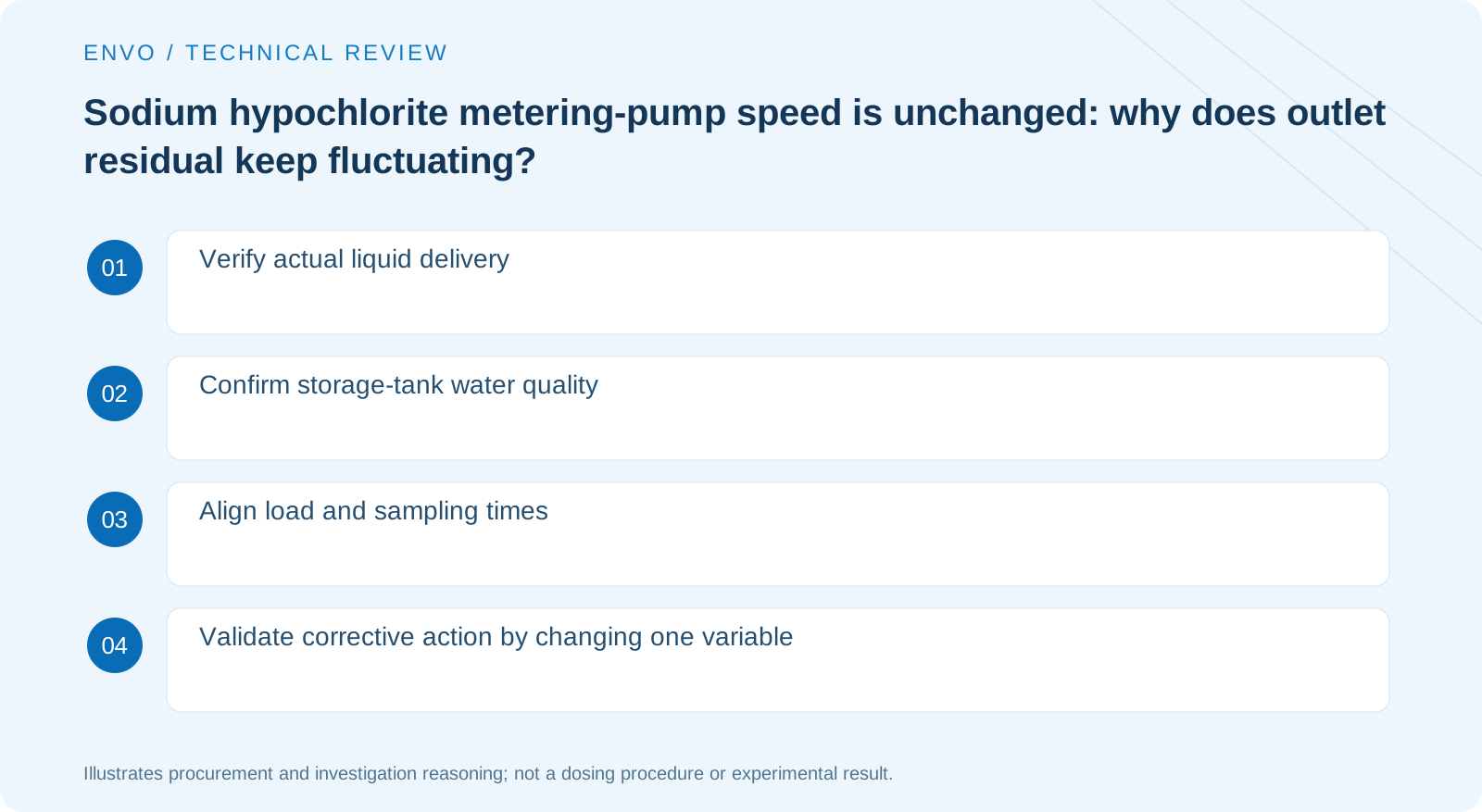
Separate pump setpoints from actual liquid delivery
Record controller commands, pump-operation feedback and actual liquid-delivery verification, checking components under the equipment manual. Qualified maintenance personnel should assess blockages, suction conditions and supply-state changes. Higher speed must not conceal unresolved equipment problems. A screen setpoint without delivery evidence cannot establish that chemicals actually enter treatment water as intended.
Also inspect actual conditions inside the storage tank
Check recent delivered concentrations, storage duration, old/new batch mixing and tank turnover. Sodium hypochlorite may change during transport and storage, so equal delivered volumes may not contain equal active quantities. Confirm actual quality under analytical and management procedures rather than infer concentration from color, odor or remaining volume.
Include influent load and testing delays in the timeline
Link treatment flow, key influent indicators and effluent test times, accounting for hydraulic travel time from dosing to sampling. When influent changes abruptly, checking only instantaneous pump speed can mistake normal system response for chemical failure. CDC’s chlorine-disinfection explanation emphasizes contact with water contaminants; actual water changes should therefore inform operating judgments.
Change only clearly defined variables in each validation round
Correct verified instrument or equipment faults first, then have process personnel define validation conditions. Avoid simultaneously changing concentration, controls and sampling locations. Retain before-and-after records for each round and locate the problem within supply, equipment, conditions or testing. These relationships make inquiries more effective than simply saying the chemical is unstable.
Use staged diagnosis to avoid changing multiple parameters at once
First verify the actual product and metering-equipment records, then correlate makeup water, treatment load and downstream sampling to identify where changes occur. If product assays and delivery records remain stable while endpoint readings change, prioritize further investigation of water quality and flow conditions rather than immediately changing suppliers. Conversely, if chemical delivery is unstable under the same water conditions, have the equipment or operating manager verify metering. Record the time and reason for every adjustment; changing chemicals, pump settings and sampling methods simultaneously makes their individual effects difficult to identify. Follow site procedures for actual control actions; this article provides no remote pump-speed or dose recommendations. The final report should distinguish eliminated factors from those still requiring confirmation and preserve raw data, providing a reusable diagnostic starting point for subsequent fluctuations.
After verification, update units and analytes in sampling and instrument records so the next shift does not continue using an incorrect measurement basis.
Explore further
Does fluctuating chlorine residual mean sodium hypochlorite is unsuitable for automatic dosing?
This cannot be inferred. First confirm that solution supply, materials, operating conditions and monitoring form a complete control system.
Is simply increasing pump speed the quickest troubleshooting method?
Unverified adjustments should not replace diagnosis. Qualified site personnel must handle abnormalities under established procedures.
References
This article draws on publicly available technical information. Third-party sources do not establish ENVO product approvals, field testing or project experience. Confirm each use against actual supply documents and site conditions.