

Trace product suitability backward from the final contact target
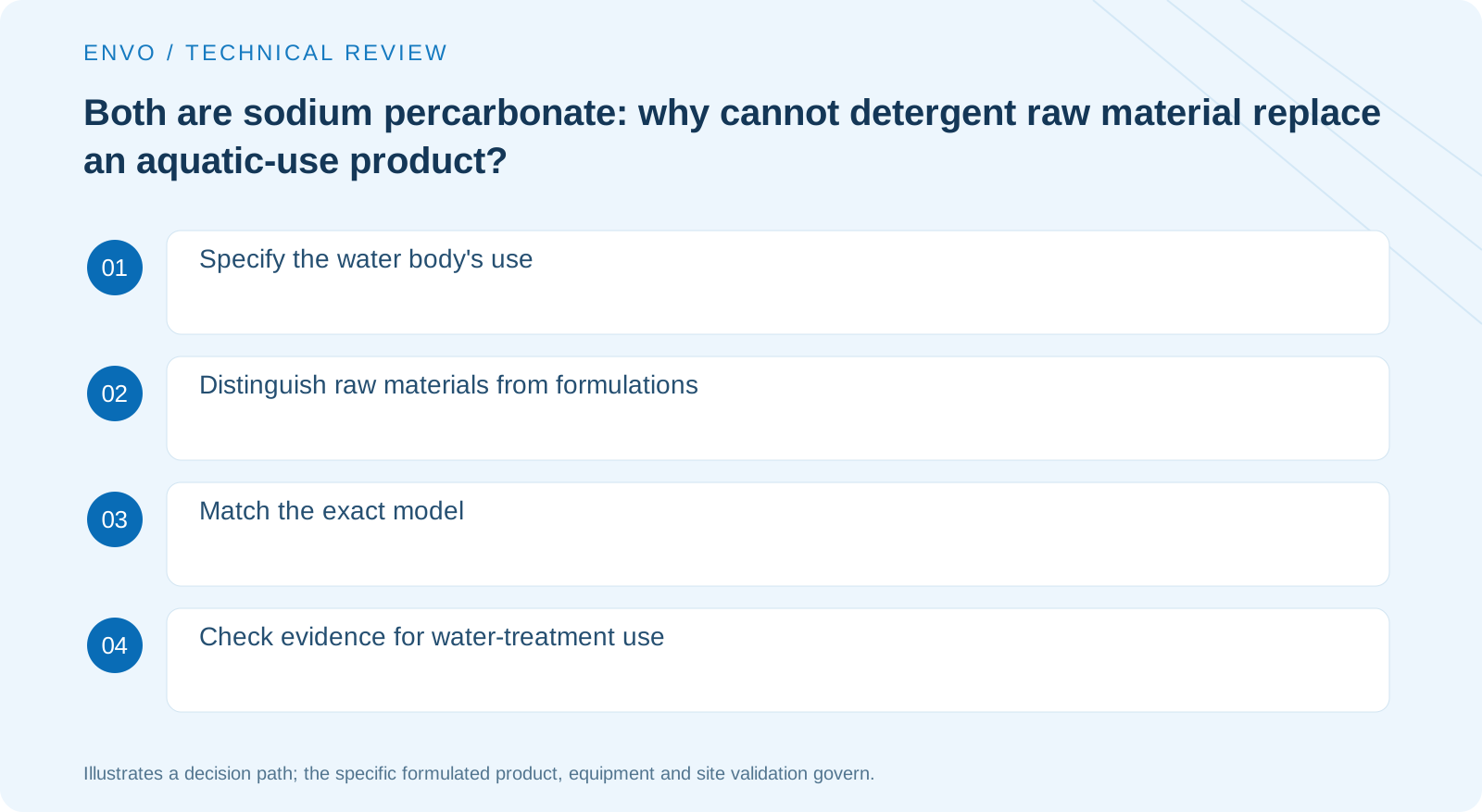
When requesting a quotation, specify whether the use concerns a natural water body, an engineered basin or equipment cleaning, and state whether there are water intakes, fish or aquatic plants. Formulated aquatic-use products and detergent raw materials are evaluated for different purposes. BioSafe’s official product page provides its granular aquatic algaecide, label and SDS separately and can serve as a reference for documentation structure.
Check ingredients and formulation separately
Technical documentation should identify the active ingredient, actual formulation type and intended uses. Detergent formulations may contain other components incompatible with the water in question, while a sodium-percarbonate raw-material report alone cannot describe the performance of a complete aquatic-use formulation. Unidentified excipients should not be dismissed because their content is low.
Do not infer grade from a solid’s appearance
A photograph of white granules cannot distinguish coating systems, impurities, release behavior or use documentation. Receipt acceptance should rely primarily on the exact model, batch number and corresponding report; photographs only assist checks of packaging and abnormal conditions. If the supplier presents a product for another use, request documentation for the intended purchasing model before comparing.
Include application evidence among purchasing deliverables
The final candidate should correspond to a product label, applicable water body, target algae and necessary ecological information. A raw material lacking these may be studied as a raw material, but should not be renamed in the procurement list as a validated water-treatment product. This avoids purchasing inexpensive raw material only to discover that subsequent application and documentation cannot be connected.
Link receipt documentation to the product’s water-treatment identity
Compare packaging labels, quotation models, technical information, SDSs and batch reports side by side to confirm one formulated product. ‘For water use’ in the name should be supported by actual use documentation, not merely printed on supplier-designed packaging. If public source documents belong to another brand, identify them as technical references only; their certification icons cannot serve as evidence for the current product.
Two situations require different responses. If the product has been misidentified as a formulated cleaning product, first correct what is being purchased. If the identity is correct but a particular verification is missing, obtain the missing documentation or arrange an assessment. Do not use the second approach to conceal the first situation of buying the wrong product, and do not judge two products equivalent merely because both are white granules.
The final review should display confirmed and unconfirmed items together. For example, a clear aquatic-use label but insufficient ecological information for the current water body may justify retaining a candidate without concluding suitability. This is more accurate than presenting every white sodium-percarbonate raw material as a complete water-treatment formulation.
Explore further
Can higher purity replace an application-specific formulated product?
Purity alone is insufficient. The complete formulation and evidence for its intended use still need checking.
Can a photograph establish a water-treatment grade?
No. Verify documents for the specific model and application.
References
This article draws on publicly available technical information. Third-party sources do not establish ENVO product approvals, field testing or project experience. Confirm each use against actual supply documents and site conditions.