

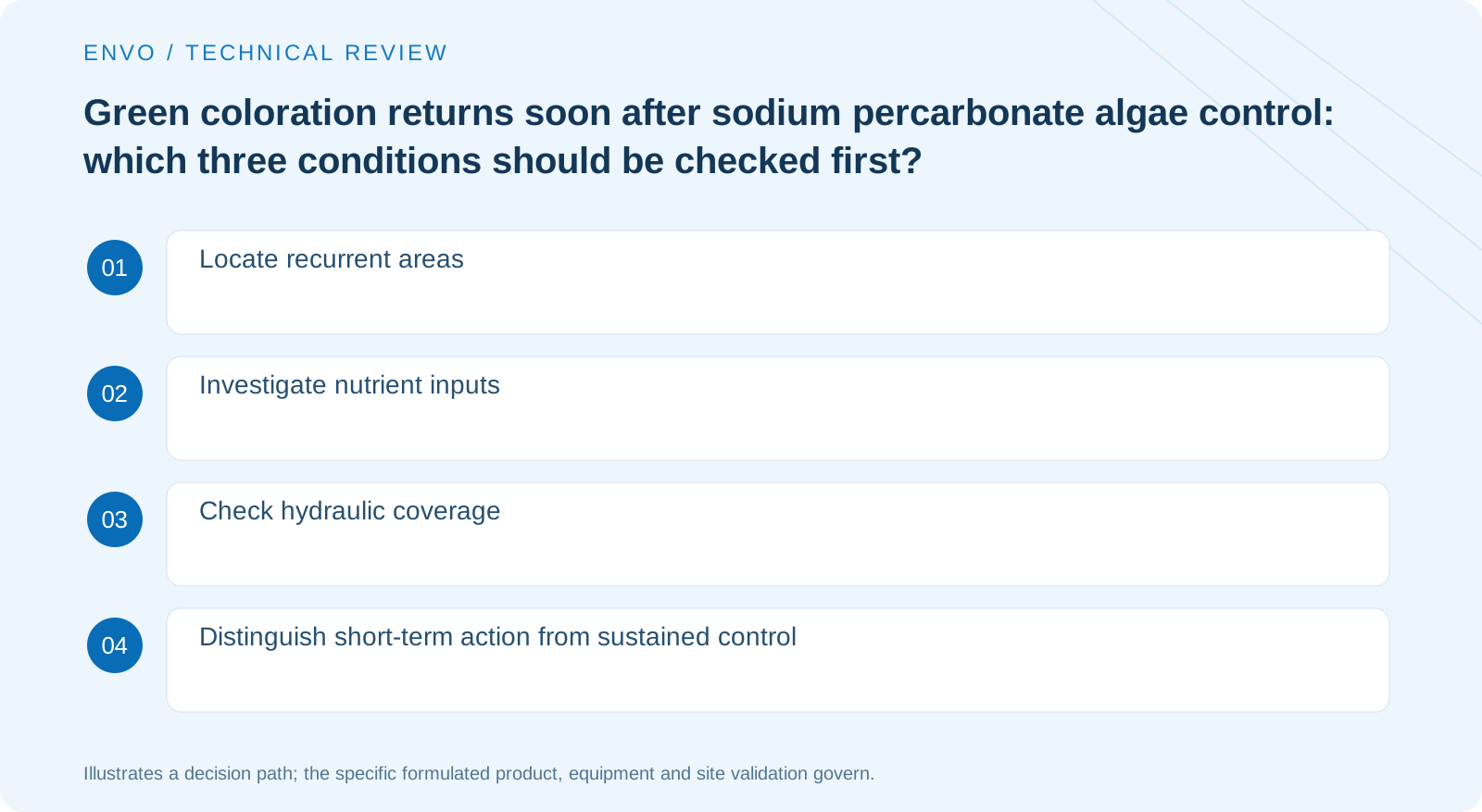
Map recurrence locations
Record whether regreening occurs along the bank, in return-water corners, in shallows or near the inlet, and compare this with the initial treatment area. ‘It turned green again after a few days’ is insufficient to distinguish surviving algae, reintroduction and continuing favorable growth conditions. Photographs from fixed positions support trend records but cannot replace algae identification or water-quality testing.
Check external inputs as well as chemical dose
Determine whether makeup water, rainwater, surface runoff or cleaning discharges introduce nutrients. EPA bloom-control materials emphasize the limitations of different controls; a single chemical treatment does not automatically resolve a continuing nutrient load. Identifying changes in inputs first helps establish whether recurrence is linked to external conditions.
Check circulation and treatment coverage
Dead zones, short-circuiting and local algal clumps can produce different actual contact conditions. Review flow directions, operating periods and treatment records together for uncovered areas. A clearer central area does not establish that the entire system received the same treatment, and a dose used elsewhere should not be transferred directly to the current system.
Design comparable verification trials
If water-treatment products still need comparison, professionals should design limited label-specific assessment tracking algae, quality and non-target effects. Define endpoints and follow-up periods and report short-term change and recurrence separately. The final decision may improve hydraulics, reduce inputs or adjust combined controls rather than always switch to higher-concentration chemicals.
Create an observation calendar that can explain recurrence
An observation calendar can record the treatment area, fixed photo locations, algae species or abundance indicators, recent rainfall, makeup water, cleaning discharges and changes in water circulation. Keep observation locations and methods as consistent as possible and note uncontrolled conditions. The calendar need not invent a complete dataset: retain gaps as gaps to prevent later assumptions from being entered as facts.
Recurrence near incoming water suggests investigating external inputs; recurrence in low-flow areas suggests coverage and hydraulics; simultaneous whole-water changes require weather, nutrients and treatment-boundary assessment. These prioritize investigation, not diagnosis from location alone. Product-quality investigations still require specific batch and method evidence.
Link corrective measures to the next observation, stating whether the change concerns hydraulics, input management or product procedures. Changing one interpretable factor at a time helps establish its contribution. Where several conditions change together, state that the entire effect cannot be attributed to one chemical.
Explore further
Does renewed green growth necessarily mean sodium percarbonate is ineffective?
Not necessarily. Distinguish treatment coverage, reintroduction and continuing favorable growth conditions.
Can comparison rely only on transparency?
Clarity is only one observation and should be assessed alongside algae and actual water quality.
References
This article draws on publicly available technical information. Third-party sources do not establish ENVO product approvals, field testing or project experience. Confirm each use against actual supply documents and site conditions.