

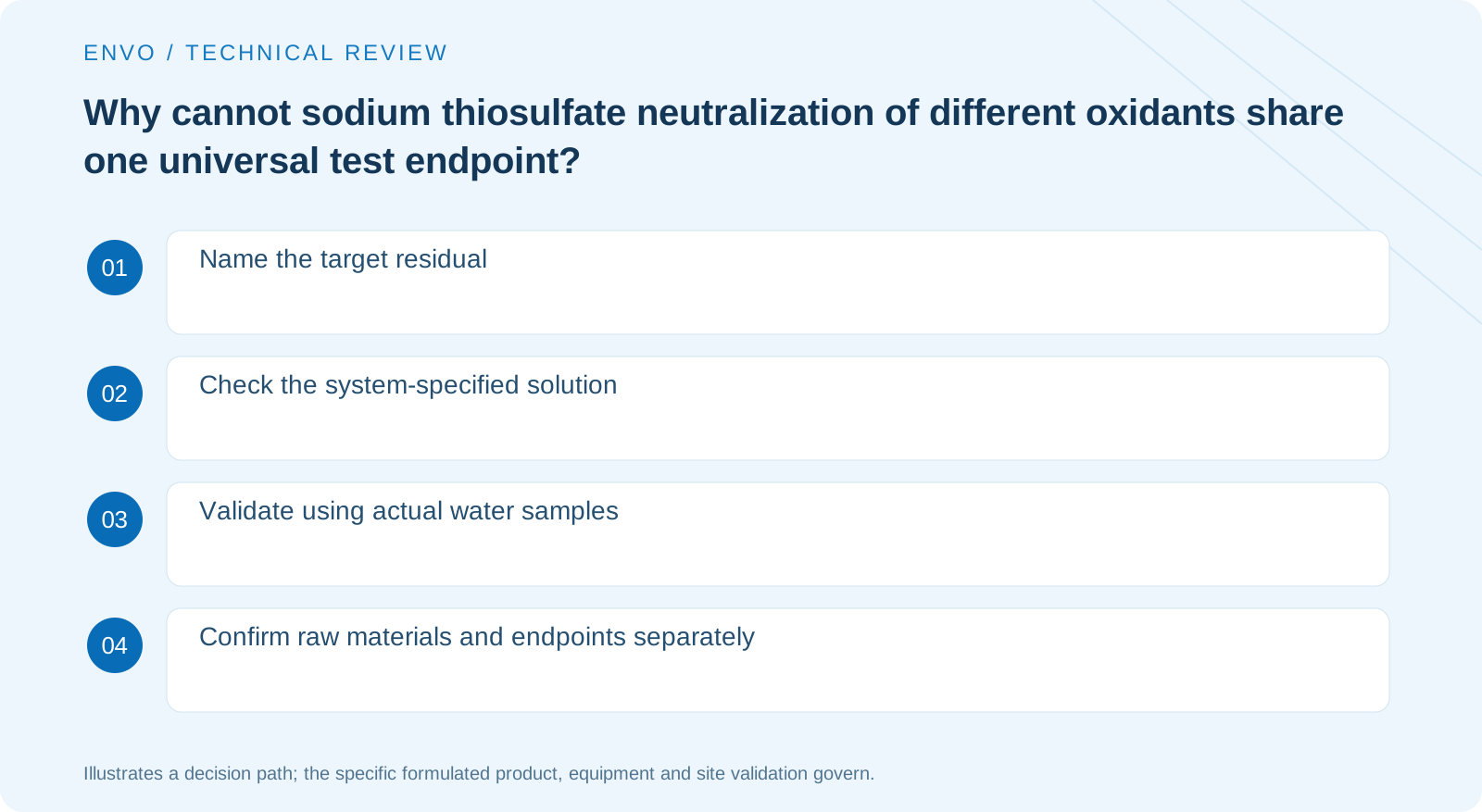
Give the residual a precise name
Define ‘oxidant residual’ as the actual target substance and result-expression basis in the system rather than use a vague zero-residual requirement. Analytical methods may respond differently to mixed systems. Only after defining the target can testing be judged to answer the downstream concern.
Check whether the system specifies a treatment solution
Particularly for approved equipment or specialized water-treatment systems, check the specified neutralizing agent, controls and validation scope. IMO’s ballast water management framework addresses the complete system; reducing activity alone does not make a raw material a universal substitute for every system.
Check whether trial and site conditions match
Use actual water samples and the real candidate formulations in professionally designed validation, recording analytes, interference and contact conditions. Do not extend results for a single substance in pure water directly to complex saline or organic-containing samples, or treat disappearance of color as proof that all quality objectives are met.
Document acceptance conditions
Raw material acceptance covers precise identity and active components; system acceptance covers target residuals and relevant downstream water quality. State these two sets of conditions separately in the technical specification to prevent unclear issues recurring in later procurement. Without sufficient evidence, do not derive universal doses or equal-dose relationships between systems.
Give completion of neutralization a precise analytical meaning
In the requirements form, list the known oxidizing treatment in the source water, sensitive downstream materials or processes, and planned test methods separately. Do not automatically assign unknown blend components to a particular chlorine-residual measurement. If the supplier cannot explain the method’s coverage, mark it for verification. More precise test names make it easier to determine whether laboratory support is needed.
Where several interferences are possible, analysts should explain method suitability and quality controls. A low instrument reading may indicate only a low concentration of its target, not other substances. Buyers must not combine detection limits from unrelated methods or present one total-oxidant result as proof that every component meets requirements.
Final acceptance should distinguish tested criteria, uncovered criteria and system-approved conditions. If results cannot answer downstream-equipment questions, correct the testing plan before comparing raw materials. A neutralizing raw material’s quality report addresses identity and specifications only; the actual endpoint requires assessment in the corresponding water and use conditions. Keep these evidence types linked while preserving their distinct roles.
Explore further
Does a zero total-oxidizing reading mean every problem is resolved?
This depends on method coverage and downstream requirements and cannot be generalized.
Can a ballast-water system use any replacement neutralizer?
Check the specified model, approval scope and system requirements.
References
This article draws on publicly available technical information. Third-party sources do not establish ENVO product approvals, field testing or project experience. Confirm each use against actual supply documents and site conditions.