

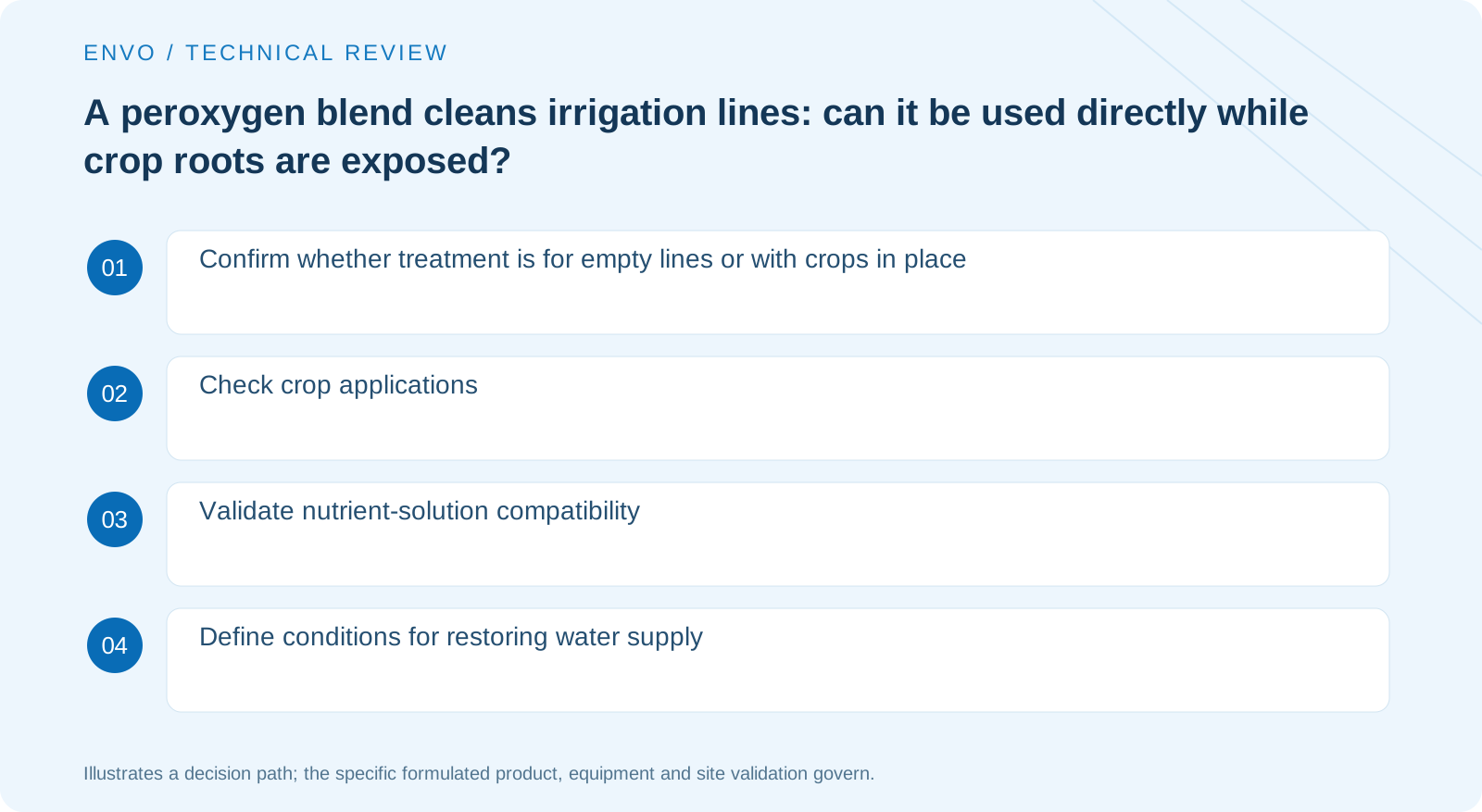
First distinguish the two duties
Cleaning empty water lines focuses on pipes and deposits; with crops present, roots, nutrient solution and growth stage also require assessment. ‘Agricultural water-line disinfection’ in an inquiry can blur these tasks. Specify the treatment state and whether treated water enters the root zone directly.
Check whether the label covers the actual target
Check the crops, uses and restrictions for the exact formulation. Surface or equipment-cleaning documentation does not establish suitability for irrigation with crops present. PNW irrigation-water treatment materials connect water-mold pathogen control with specific treatment approaches, underscoring that chemical names alone are insufficient.
Include nutrient-solution and root-zone information in validation
Record water source, nutrient-formulation context and circulation pattern, with agricultural specialists designing appropriate evaluation. In addition to microbial control, examine crop and nutrient-system parameters. Do not promise ‘no phytotoxicity’ without clear evidence, and especially do not infer absolute safety merely from decomposition products.
Specify conditions for restoring water supply
For empty-line treatment, use product and equipment procedures to confirm flushing, residual testing and return to use after cleaning. Treatment with crops present requires its own specific evidence. The two conclusions are not interchangeable and should be named separately in purchasing documents to prevent use of the wrong site procedure.
Make irrigation validation address the crop’s actual needs
Separate requirements into waterline and crop tasks. The first covers pipes, emitters and deposits; the second covers crop, stage, substrate and nutrient solution. Map returns and solution tanks. Effective empty-line cleaning supports that cleaning task only and cannot establish tolerance of crops in place.
Trial comparisons should separately record flow through drip-irrigation lines, target water-quality parameters and crop observations. If line performance improves but abnormalities appear in the root zone, do not report only the improvement. A temporary absence of visible crop abnormalities also does not mean all growth effects have been assessed. Personnel familiar with the crop and formulation should determine the observations and timing so product selection matches actual production conditions.
Procurement conclusions can specify support for shutdown empty-line cleaning, verified treatment with crops present, or further validation needed. Preserve facility-hygiene-only limits in supplier documents. Recheck changed crops, nutrient solutions or sources instead of extending an initial trial to every horticultural system.
Explore further
Can all waterline products contact roots?
No. Empty-line cleaning and use with crops present require separate confirmation.
Does chlorine-free guarantee no effect on crops?
No. Evidence for the formulation, crop and actual conditions is still required.
References
This article draws on publicly available technical information. Third-party sources do not establish ENVO product approvals, field testing or project experience. Confirm each use against actual supply documents and site conditions.