

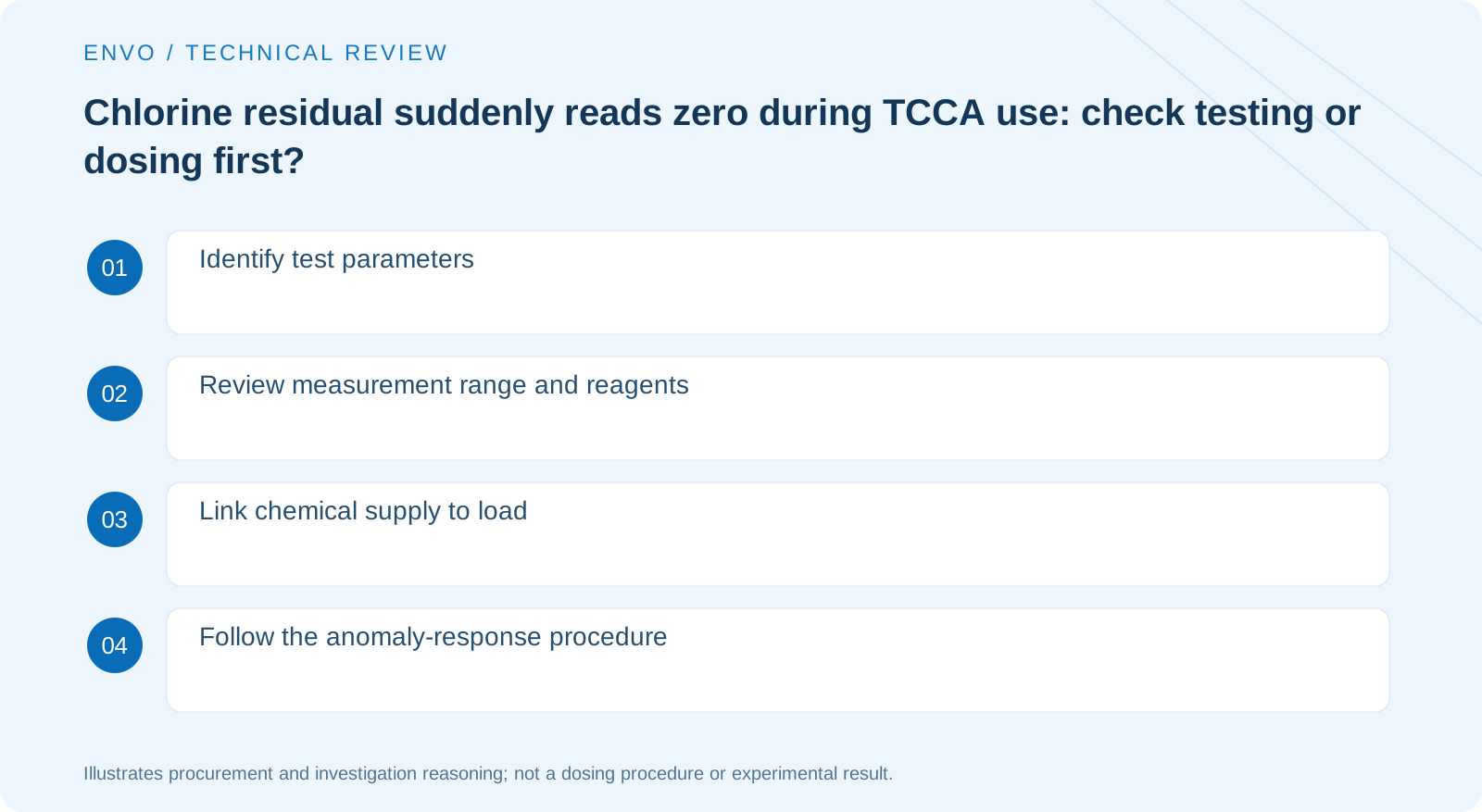
First confirm which chlorine measurement is being read
Clearly identify free chlorine, total chlorine or calculated combined chlorine in records; do not directly compare colors from different reagents. Record instrument model, reagent batch, expiry and sampling point, and check whether samples exceed the method’s range. CDC notes that higher chlorine concentrations can bleach some DPD tests, producing falsely low or zero readings. Pale color alone does not establish a need for further dosing.
Perform traceable verification
Use verification methods permitted by instrument and reagent instructions, with qualified personnel applying another valid method where needed. Do not assume unvalidated dilution factors or compare long-stored samples with immediate site readings. Retain original and repeat readings and operating times, identifying whether discrepancies arise from range, reagents, sampling or instrument condition.
Confirm an actual deficiency before investigating its cause
Compare valid readings with remaining tablets, feeder condition, usage load and makeup water. Anomalies after major replenishment or peak opening periods warrant assessment of volume and demand changes; anomalies coinciding with a batch change warrant material and equipment-suitability checks. Include pH and cyanuric acid in pool records. The same number does not represent identical treatment capability under every pool condition.
Establish clear site handover rules
Testing, maintenance and procurement staff should record facts separately before jointly deciding action. Public-pool opening status must follow local requirements and established incident procedures; a purchasing article cannot replace site safety judgment. A short workflow stating when to retest, who confirms and when to escalate is more reliable than simply adding chemical whenever a reading is zero.
Resolve zero-reading uncertainties through cross-checks
Record water-sample locations, test times, reagent batches and instrument condition before and after the anomaly, and compare the reading with an independent check under equivalent conditions. The check should be performed by personnel competent in the relevant method. A zero result does not by itself establish that pool water contains no chlorine, nor does awareness of color bleaching establish that the concentration must be excessive. If two methods disagree, first explain their measurands and applicable ranges before deciding subsequent management actions. Retain original anomalous values; do not enter estimates merely to make records appear continuous. Associations with a particular time, location or reagent change can help distinguish testing problems from actual water-quality changes. Resume normal management on the basis of site procedures and reliable testing, rather than ending the investigation because of odor, water color or one apparently normal reading.
Explore further
Which should be trusted when test strips and instruments disagree?
First compare the parameters measured, ranges, expiry dates and method conditions. Instrument price or display precision alone cannot decide which result is valid.
Does a deeper color always mean greater accuracy?
No. Results must fall within the method’s valid range; abnormal color or fading should be checked under the method instructions.
References
This article draws on publicly available technical information. Third-party sources do not establish ENVO product approvals, field testing or project experience. Confirm each use against actual supply documents and site conditions.