

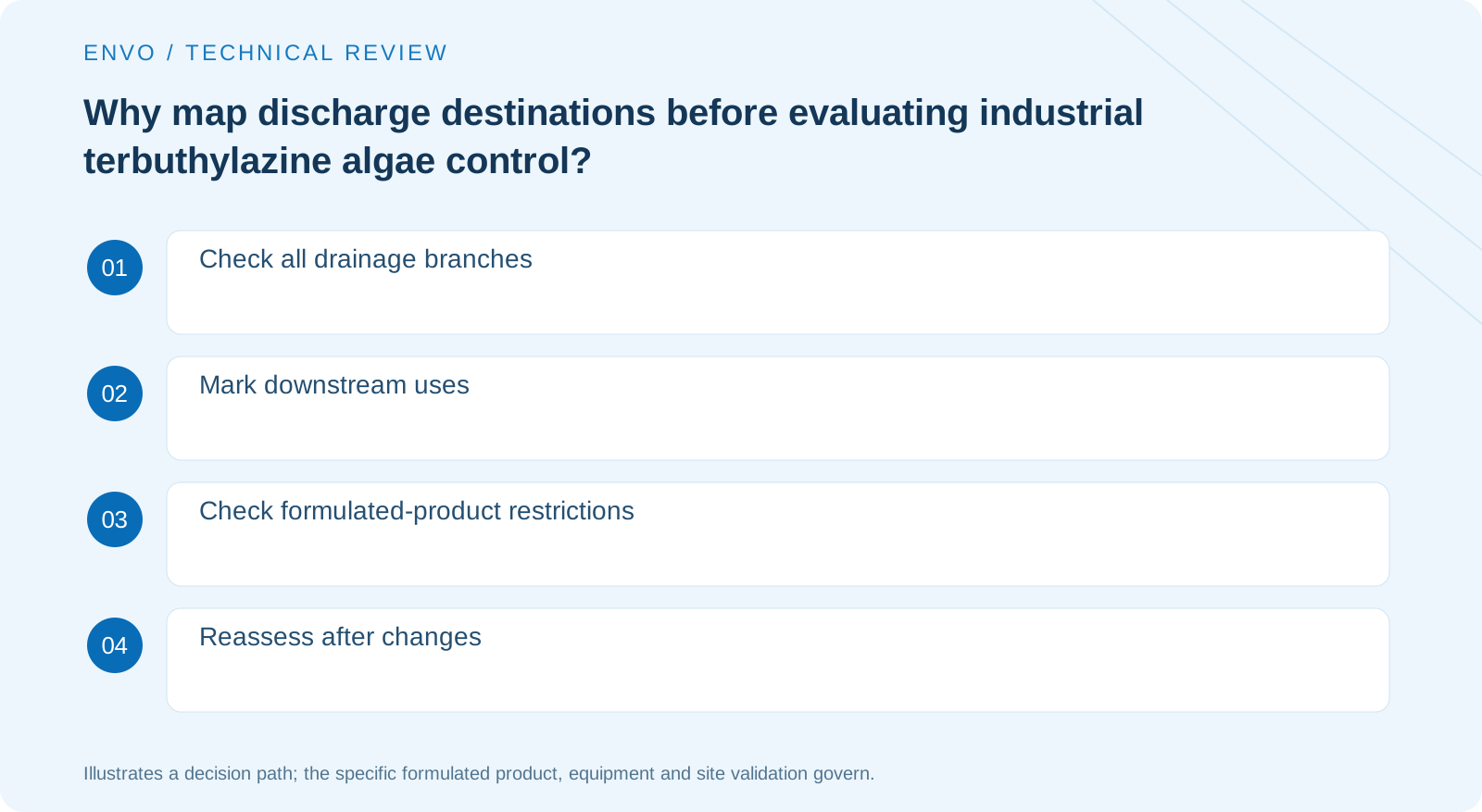
Distinguish a nominally closed system from actual external discharge
Collect flow paths for makeup, blowdown, overflow, maintenance drainage and emergency collection. Calling a system closed does not mean it has no discharge paths. Draw normal and abnormal conditions separately to help identify exposed receptors absent from procurement information.
Identify each downstream use
For each drainage branch, record its destination, subsequent treatment and final use; do not assume that ‘going to the wastewater plant’ resolves every issue. Where downstream uses include irrigation or drinking-water-related applications, specifically check formulated-product restrictions and evidence of suitability. Use limitations in historical EPA materials must not be removed and the remaining text presented as a universal recommendation.
Require suitability conclusions to cover the complete waterline
If the supplier’s technical response addresses only algae control inside the cooling tower, confirm whether it also accounts for the discharge destination. Upstream efficacy testing cannot replace downstream environmental assessment. If the current formulated-product label is unclear, the destination unknown or restrictions conflicting, remain at the documentation-review stage rather than selecting a model.
Use changes to trigger reassessment
Plant modifications may convert blowdown to reuse or change receiving waters and makeup-water sources. Purchasing files should record the evaluated flow-routing version and trigger rechecking when circuits change. This prevents experience from an old project from remaining a general justification after conditions change.
Use a water-flow table to identify hidden conflicts between uses
For routine blowdown, maintenance drainage, overflow and reuse, list each origin, treatment unit traversed, final destination and responsible manager. Clearly mark uncertain underground connections or connections altered by past modifications as awaiting confirmation. The absence of a visible discharge outlet does not establish the absence of a discharge route; appropriate personnel should verify drawings against actual flow paths.
If a branch enters an irrigation system, check that use separately. If it enters a public receiving water body, check the corresponding environmental and formulated-product restrictions. Even if it remains within a designated industrial circuit, the current label and engineering conditions still require confirmation. A flow diagram is not an approval document; it helps technical assessment include all exposed receptors.
After modifications, seasonal reuse or changes to discharge agreements, clearly label old diagrams as historical and reopen affected assessments. This prevents personnel from automatically extending a previous industrial-system purchasing decision to a newly introduced water use.
Explore further
Is assessment unnecessary if discharge goes to a wastewater treatment plant?
Subsequent treatment, discharge conditions and formulated-product restrictions still require confirmation.
Does the absence of external discharge establish project suitability?
Current labeling, materials and other exposure conditions also need checking.
References
This article draws on publicly available technical information. Third-party sources do not establish ENVO product approvals, field testing or project experience. Confirm each use against actual supply documents and site conditions.