

List the full additive background
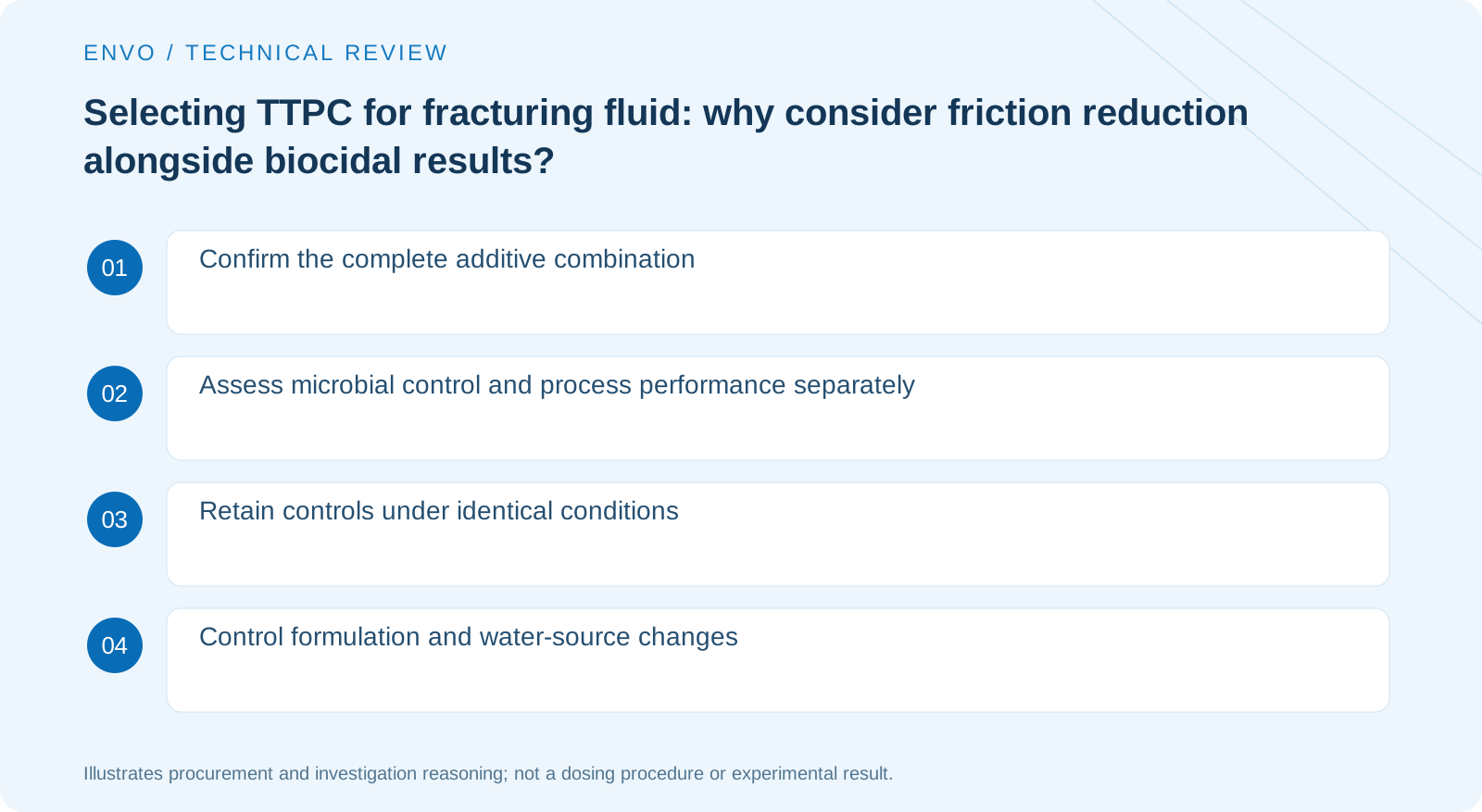
Record actual models of friction reducers, other polymers, salts and proposed biocidal products rather than only categories such as anionic or quaternary phosphonium. LANXESS energy literature discusses interactions between certain biocidal treatments and friction reducers, indicating the need for system-specific review. It does not establish that all TTPC products necessarily conflict with all friction reducers or that a brand change automatically resolves the issue. Actual formulations and operating conditions are the review targets.
Design two separate assessment tracks
Microbial assessment verifies the control objective, while process assessment checks site-relevant friction reduction, rheology or other performance. Both need conditions representative of the actual formulation and appropriate controls, such as no-biocide or current-program controls. Passing one test does not offset failure of another critical criterion. A report showing only reduced counts without process results provides partial evidence, not validation of the complete program.
Observe appearance, but assess more than appearance
Turbidity, flocs or phase separation can prompt investigation, but lack of visible change does not establish absence of process effects. Assess performance using methods selected by qualified personnel and record temperature, water matrix, sample batch and measurement conditions. Do not improvise mixtures of concentrated chemicals on site to assess compatibility. A small-bottle photograph cannot support promises of compatibility with every water-treatment additive.
Limit extrapolation through change control
Changes in friction-reducer model, water source or TTPC formulation may make previous trials unrepresentative of the current project. Retain validated combinations and conditions rather than generalizing one successful combination to an entire family. When anomalies occur, compare change timing with operating records before site specialists select verification tasks. Do not attribute every performance decline directly to microbes or one chemical.
Express the communication objective as two requirements
Inquiries should identify both the microbial problem to control and process parameters to preserve, with necessary shareable formulation information. Confidential matters can use controlled documents or mutually agreed testing without publishing a full formulation. Final procurement conclusions should list applicable combinations, validated parameters and untested conditions, clarifying supply scope and technical responsibilities rather than comparing only active content and tonne price.
For friction-reduction results, retain the actual method and operating conditions and avoid directly ranking figures from different test rigs. If the supplier can provide only one category of performance data, identify this as preliminary screening. Before purchasing, fill the other evidence gap relevant to the project’s critical objectives instead of substituting the marketing word ‘compatible.’
Explore further
Does the absence of precipitation establish compatibility with a friction reducer?
No. Actual process performance must still be checked.
Can the original report still be used after changing the friction reducer?
Assess whether the change affects original validation conditions; they cannot automatically be carried forward.
References
This article draws on publicly available technical information. Third-party sources do not establish ENVO product approvals, field testing or project experience. Confirm each use against actual supply documents and site conditions.