

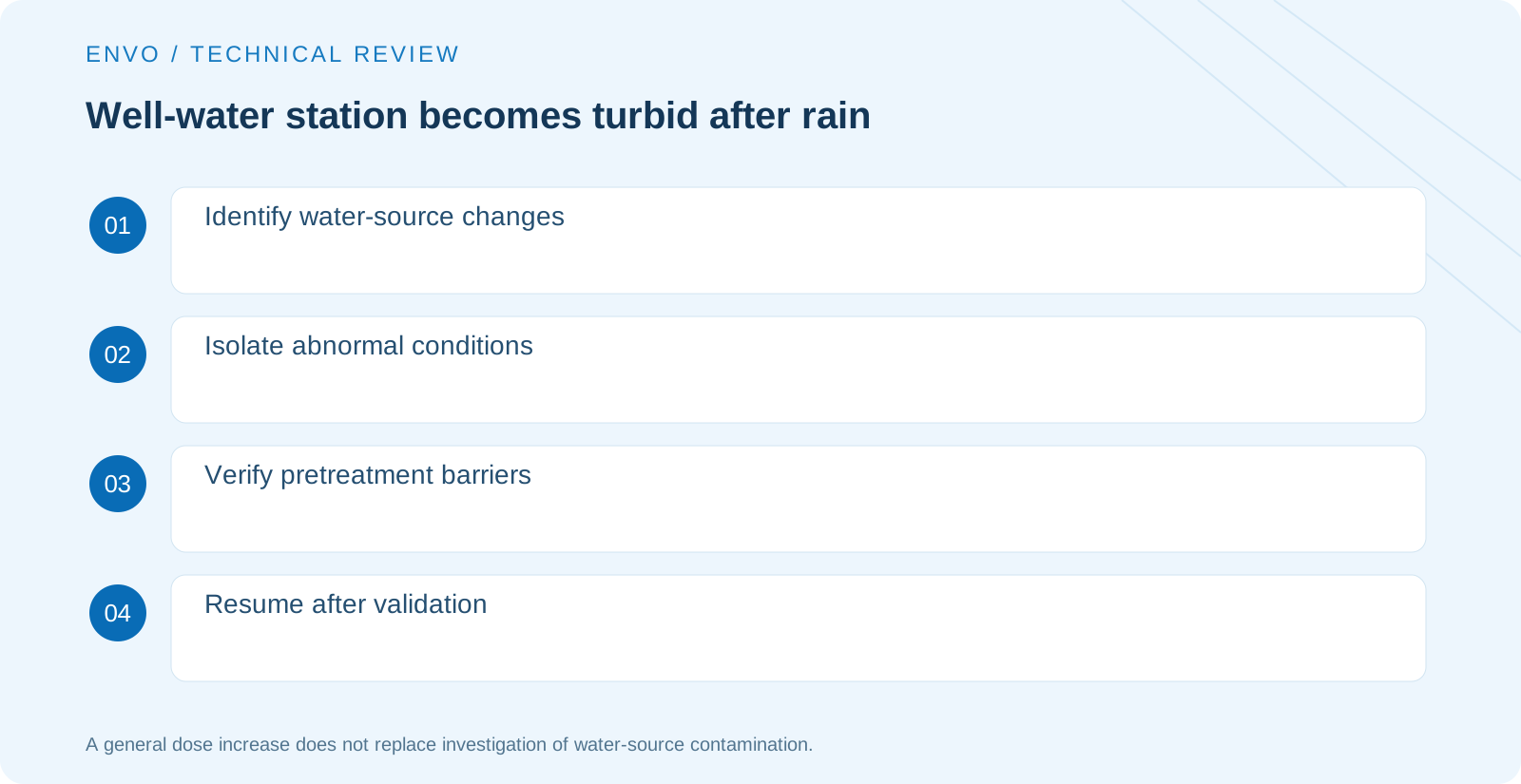
Retain the time and extent of changes
Record the sequence of rainfall, water-level changes, pump starts, turbidity anomalies and user feedback. Sampling should at least distinguish source water, post-pretreatment and final water rather than merge locations into one trend. If flooding, chemical ingress or sewage intrusion is suspected, follow authority guidance on isolation and alternative supply. Sensory checks or improvised dosing cannot establish source usability.
First determine whether the original treatment conditions still apply
WHO treatment guidance discusses the link between particle removal and disinfection; CDC emergency guidance also separates turbid-water treatment from subsequent disinfection. Water stations should determine whether existing filtration and disinfection units remain within confirmed operating ranges. Review filter differential pressure, bypass status, wash records and effluent changes rather than assuming original conditions still apply because the disinfection indicator light is normal.
Record equipment checks separately from water quality checks
Normal equipment operation does not establish compliant incoming water. Maintenance staff check filters, seals, sampling lines and power; testing personnel verify water quality as planned. Combine both evidence streams in one incident record. A filter-replacement work order without post-restart quality information cannot explain disinfection performance. Conversely, one passing sample cannot conceal bypasses or structural defects.
Establish clear assessment criteria before resumption
Inquiries or technical consultations should include pre- and post-incident water quality, wellhead and treatment arrangements, equipment models and management requirements. The goal is to identify barriers needing improvement and restoration validation, not one bottle solving every rainy-season problem. Resume supply under competent-authority requirements and water-station confirmation procedures, adding ongoing monitoring if needed. This page gives no universal well-water dose.
Distinguish temporary repairs from rainy-season improvements
After an incident, distinguish measures that restore current operation from those that reduce the impact of future incidents. Replacing damaged parts is a defined repair task; assessing wellhead protection or treatment capacity may require engineering investigation. Do not mark both complete in the same box. Keep concise records of rainfall events so responsible teams can identify repeated problems under similar conditions. Recurrence should trigger reassessment of existing arrangements rather than simply increasing the quantity of chemicals purchased for each emergency.
Explore further
Can drinking-water use resume immediately when the water becomes clear?
No. Appearance reflects only some changes; restoration requires corresponding water-quality verification and abnormal-event procedures.
Can temporarily switching to a stronger oxidant replace filtration?
This cannot justify replacing pretreatment. First establish particle and other contamination issues and equipment applicability conditions.
References
This article draws on publicly available technical information. Third-party sources do not establish ENVO product approvals, field testing or project experience. Confirm each use against actual supply documents and site conditions.