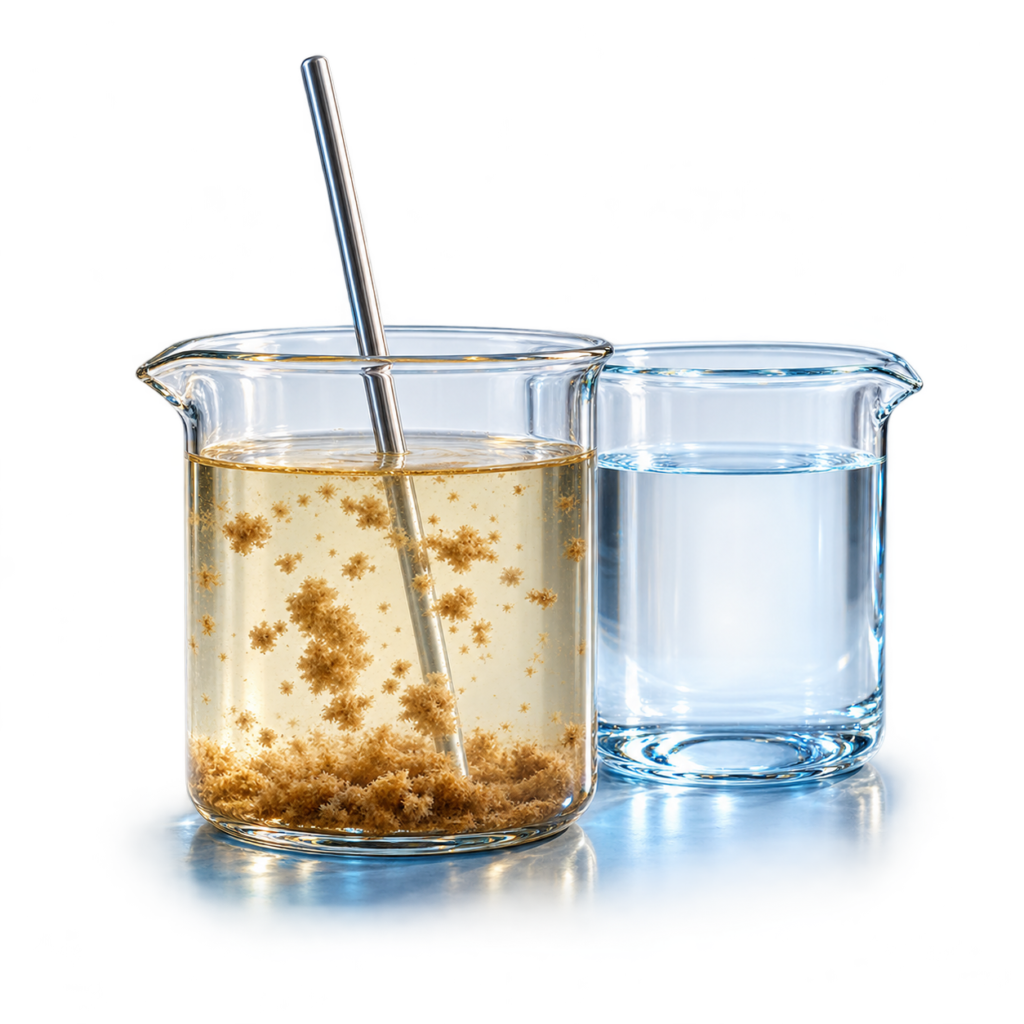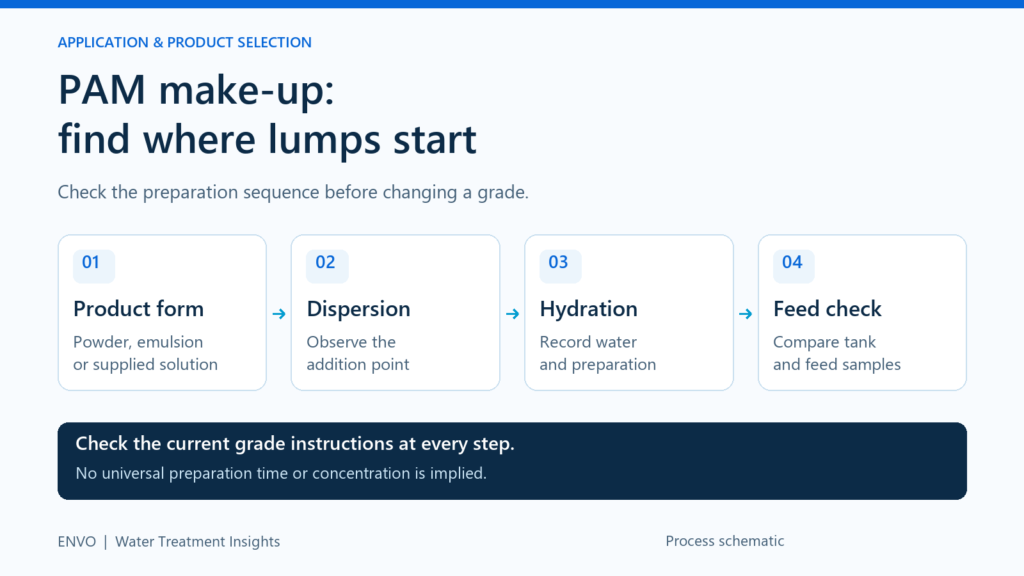
Start with the preparation sequence. If a PAM solution contains lumps, record where they first appear: at powder addition, during hydration, in storage, or at the feed point. Then check the current grade instructions and repeat a controlled preparation. This gives a supplier something testable, rather than treating every visible lump as proof that the polymer grade is wrong.
Separate dispersion from hydration
A powder must first contact water as separate particles; those particles then hydrate. The CNRS Laboratoire du Futur description of polymer-powder dissolution distinguishes wetting from the subsequent swelling stage. A clump with a swollen exterior can therefore be a preparation problem, even when the outside looks hydrated. This physical explanation does not identify an ENVO grade or diagnose an individual batch.
For a practical check, keep the powder identity, water source and preparation recipe unchanged while observing each stage. Photograph the addition point and a small sample of the finished solution. Label the images with the time and preparation conditions. Avoid drawing a conclusion from a photograph without its operating record.
Confirm the commercial form before comparing recipes
Powder, inverse emulsion and a supplied aqueous solution need different preparation instructions. A recipe borrowed from another commercial form is a poor baseline. Kemira’s flocculant overview identifies powder and emulsion formats and emphasizes suitable dissolution equipment. Use that distinction to ask the right question; obtain the actual make-up instructions for the product being supplied.
- Record the full grade name, batch and physical form.
- Identify whether the recipe is expressed on delivered-product or active-polymer content.
- Check the final solution quantity and the units used for concentration.
- Keep preparation instructions separate from the final process dosing requirement.
For the calculation basis, see product weight versus active-polymer dose.
Use the first observation to narrow the next check
| Observation | What to inspect next | Useful record |
|---|---|---|
| Clumps appear as powder enters water | Addition pattern, wetting equipment and local mixing | A short video of the addition point and the measured powder feed |
| Separate particles remain after preparation | Preparation conditions and the grade’s hydration instructions | Water temperature, elapsed time and representative solution sample |
| Fresh solution looks acceptable; later samples differ | Holding time, storage conditions and contamination routes | Preparation time, use time and observations from the same batch |
| The tank sample looks acceptable; the feed behaves differently | Sampling position, transfer path and actual pump delivery | Samples from both locations and a feed-system record |
This table identifies checks, not guaranteed causes. More than one preparation or equipment issue can occur at the same time.
Repeat one controlled preparation
MT AquaPolymer’s powder-flocculant instructions identify polymer type, preparation-water quality, temperature and agitation efficiency as factors affecting dissolution. Its published recipes belong to its own products. They should not be adopted as a universal ENVO concentration, temperature or preparation time.
- Choose one current grade and its written supplier instructions.
- Use measured product and water quantities, with the concentration basis written down.
- Record the water source, temperature, addition method and preparation times.
- Inspect comparable samples at the same points in the preparation sequence.
- Change one identified variable for the next comparison, within the supplier and equipment instructions.
If an abnormality persists under the agreed preparation conditions, retain the batch identification and observations for a focused supplier review. Do not mix several grade changes with several equipment changes and then attribute the result to one product.
Questions buyers often ask
Should I immediately increase mixing speed?
Check the product instructions, impeller and equipment limits first. A speed value alone does not describe the mixing conditions, and it does not show whether the original problem is poor wetting, incomplete preparation or a later transfer issue.
Can I use the same recipe for every PAM grade?
Confirm it for the selected grade and commercial form. A useful comparison records the recipe and operating conditions alongside the observed result.
Prepare a focused product enquiry
Send the current technical sheet, batch identification, preparation recipe, water information and a short record of where the problem begins. Explore PAM supply options or discuss a preparation problem with ENVO. An agreed preparation check is a better starting point than requesting an unspecified replacement grade.
Sources and scope
- CNRS Laboratoire du Futur, Polymer powder dissolution: wetting, dilution and shear: general physical mechanism.
- Kemira, Chemical flocculants: commercial forms and preparation equipment.
- MT AquaPolymer, Powdered Polymer Flocculants, How to use: manufacturer-specific preparation factors.
Sources checked on 27 October 2026. The diagnostic sequence and record table are ENVO’s editorial guidance; they do not establish a batch defect, supplier specification or guaranteed treatment result.