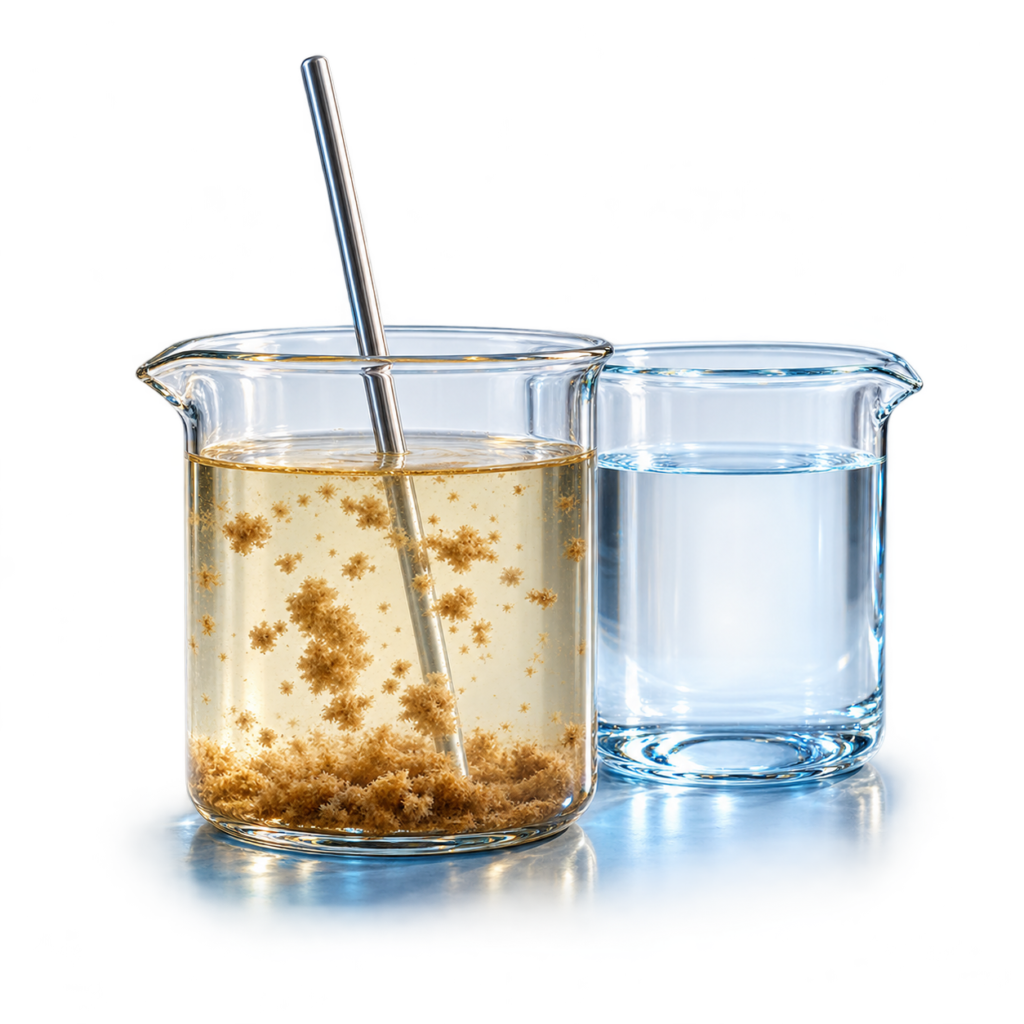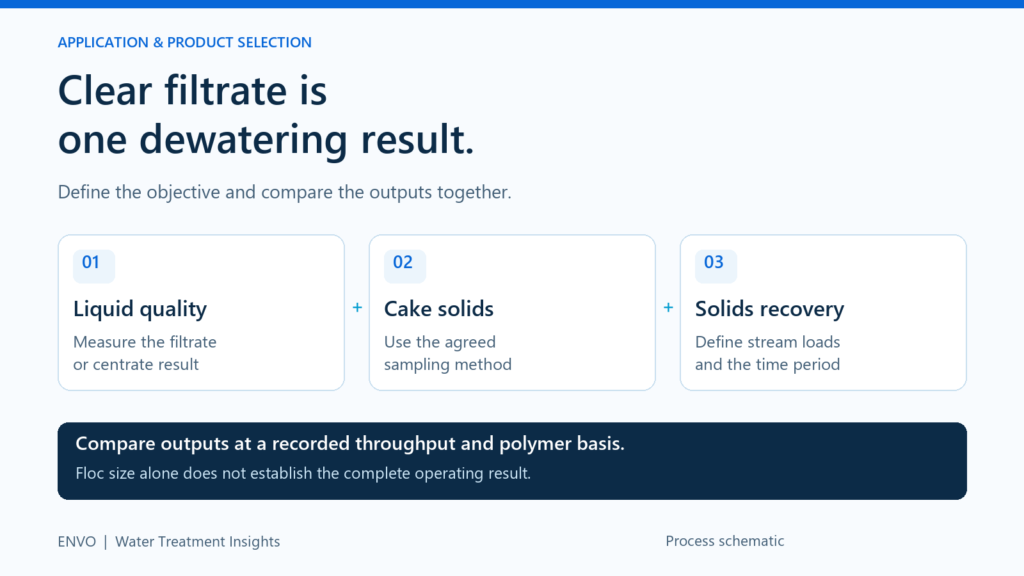
A clear filtrate is one observation, not the complete dewatering result. If the filtrate looks clearer but the cake remains wet, compare cake solids, solids recovery, throughput and the relevant operating conditions together. Before selecting a replacement polymer, agree which result the trial must improve and how it will be measured.
Separate appearance from the operating objective
Floc appearance can help screen a conditioning change, but the dewatering step produces the result the plant has to manage. The U.S. EPA’s 1991 sludge-treatment inspection guidance, Section 11.2, evaluates conditioning through the dewatering output, including moisture, filter-media behavior, cake release and filtrate or centrate solids. This is historical process guidance, not a current ENVO performance specification.
Write a short acceptance statement before the trial. For example: compare cake dry solids at a defined throughput while recording solids losses and chemical consumption. Replace that example with the site’s own objective and agreed methods; it is not a proposed acceptance value.
Use a balanced trial record
| Result | What to measure or define | What a visual check cannot establish |
|---|---|---|
| Cake dryness | Representative cake sample and the agreed solids method | A large floc does not quantify the cake’s dry-solids content |
| Liquid quality | Filtrate or centrate result, sampling point and method | A clear-looking sample does not provide a measured solids concentration |
| Solids recovery | Relevant feed and outlet solids loads over the same period | Liquid concentration alone does not describe the total mass lost |
| Capacity and consumption | Throughput, operating settings and polymer basis | A good result at a different load is not a like-for-like comparison |
Where a mass comparison is needed, calculate each stream’s solids load from its measured flow and solids concentration using consistent units. Include all relevant outlets. A percentage should not be reported as “capture” without defining the streams, period and calculation boundary.
Record the conditions behind the result
- Feed: sludge source, sample time, solids result and any known process change.
- Chemical: grade, batch, preparation recipe and the dose basis.
- Conditioning: addition location and the relevant mixing or contact arrangement.
- Equipment: unit type, throughput and settings recorded under the site’s procedure.
- Output: cake, liquid-stream and operating observations from the same trial period.
Kemira’s flocculant guidance relates polymer choice and dosing to sludge conditioning and dewatering. The New York State DEC operator toolbox also emphasizes site-specific polymer selection and testing. These references support a plant-specific comparison rather than a universal grade or dose recommendation.
Choose the next comparison from the unresolved question
If liquid quality improves but cake solids do not, keep both results in the record. Check whether the load, preparation or operating settings also changed. If a liquid result worsens, compare both its concentration and the stream flow before concluding that the same mass of solids is being lost.
Then agree one focused comparison with the responsible operator or process specialist. Keep the other recorded conditions as comparable as practicable. If several conditions must change together, record that explicitly and avoid attributing the outcome to the polymer alone.
For product comparisons, use a consistent delivered-product or active-polymer basis. For preparation concerns, check the current make-up instructions before assuming that a different polymer grade is required.
Questions buyers often ask
Does the largest floc identify the best dewatering polymer?
It is a screening observation. Accept the product against the agreed dewatering results and operating conditions, using the selected equipment and measurement methods.
Should I send only a cake photograph to request an alternative?
Include it, but add the feed information, current product, preparation and dose records, equipment type and measured outputs. A photograph cannot define all the conditions needed for a useful comparison.
Turn trial records into a useful enquiry
Share the result you need to improve, the current technical sheet and a completed before/after record. Explore sludge thickening and dewatering applications and PAM options, or send ENVO your trial requirements.
Sources and scope
- U.S. EPA, Guidance for NPDES Compliance Inspectors: Inspection of Sludge Treatment Unit Processes, November 1991, Section 11.2: historical conditioning evaluation guidance.
- Kemira, Chemical flocculants: polymer forms and sludge-dewatering context.
- New York State DEC, Wastewater Treatment Plant Operator Toolbox: plant-specific selection and testing context.
Sources checked on 27 October 2026. The comparison table and trial-record sequence are ENVO’s editorial guidance. No plant result, percentage improvement or guaranteed ENVO product performance is claimed.