

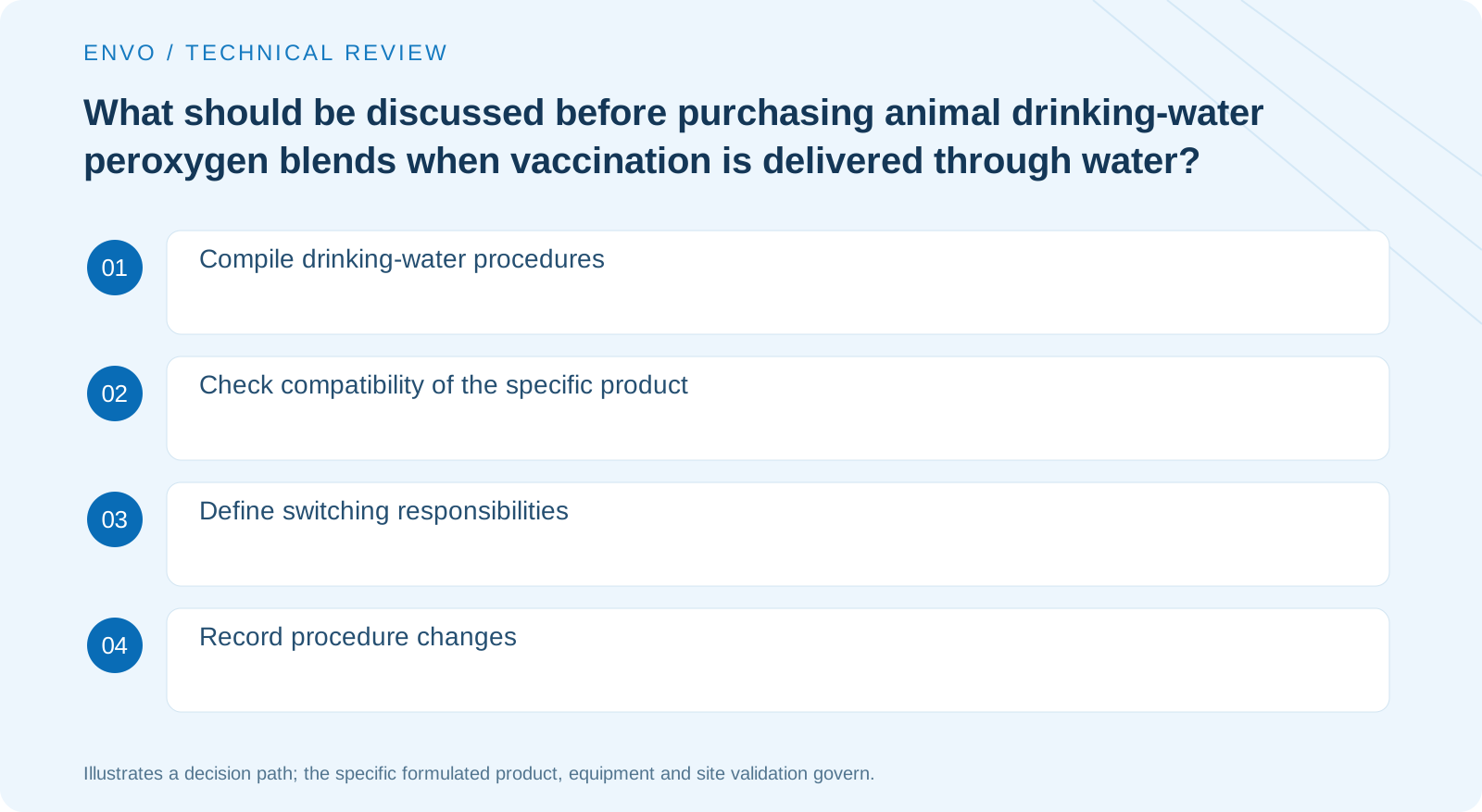
Collect existing drinking-water procedures
List planned drinking-water vaccination, medicines, acidification and other additives with their instructions. Different tasks may share piping while having different requirements. Purchasing must accurately communicate conditions rather than independently decide which procedures can run simultaneously.
Check the scope of the formulated-product documentation
Even an animal drinking-water blend’s label may not cover every vaccine and medicine. Ask the supplier what compatibility evidence exists, and have the veterinarian and relevant product suppliers verify it. ‘Multifunctional’ in brand marketing does not establish compatibility with every vaccination program.
Define responsibility for procedure changes
Site management documents should identify who confirms suspension or restart, how water-line condition is checked and which tests are required. No universal waiting time is specified here because animals, products and equipment differ. Operators should not know only a customary dilution ratio without understanding when procedures must change.
Retain change records for repeat purchasing
Recheck previous compatibility conclusions whenever vaccines, medicines or drinking-water additives change. Attach the formulated-product code and confirmed procedure version to the purchasing file to reduce use of outdated information across teams. Cleaning efficacy and vaccination compatibility require separate validation; neither replaces the other.
Create a drinking-water task calendar rather than focusing only on chemical concentration
Map routine drinking, immunization, medication, acidification and waterline maintenance on one calendar, linked to instruction versions. This records management plans, not mixing sequences. Where tanks or pipes are shared, assess whether other areas’ tasks affect the same supply branch instead of reviewing one livestock building alone.
Animal-health personnel should assess conflicts. Preserve explicit exclusions on concurrent use; mark uncovered conditions pending; cleaning-performance data cannot replace vaccine or medication compatibility evidence. General terms such as oxidizing or low-residue cannot establish suitability during immunization.
Supplier requirements should state intended tasks, drinking-water procedures needing coordination and documentation gaps, requesting product-specific answers rather than generic ingredient descriptions. Handover should record who confirmed the approach, which animals and procedures it covers and who reviews changes. This reduces post-purchase clarification and keeps veterinary decisions from being delegated to generic website content.
Explore further
Does effective drinking-water disinfection mean vaccines are unaffected?
No. Check the specific product and immunization program separately.
Can the website specify a universal out-of-service interval?
No. Follow veterinary guidance and the corresponding product instructions.
References
This article draws on publicly available technical information. Third-party sources do not establish ENVO product approvals, field testing or project experience. Confirm each use against actual supply documents and site conditions.