

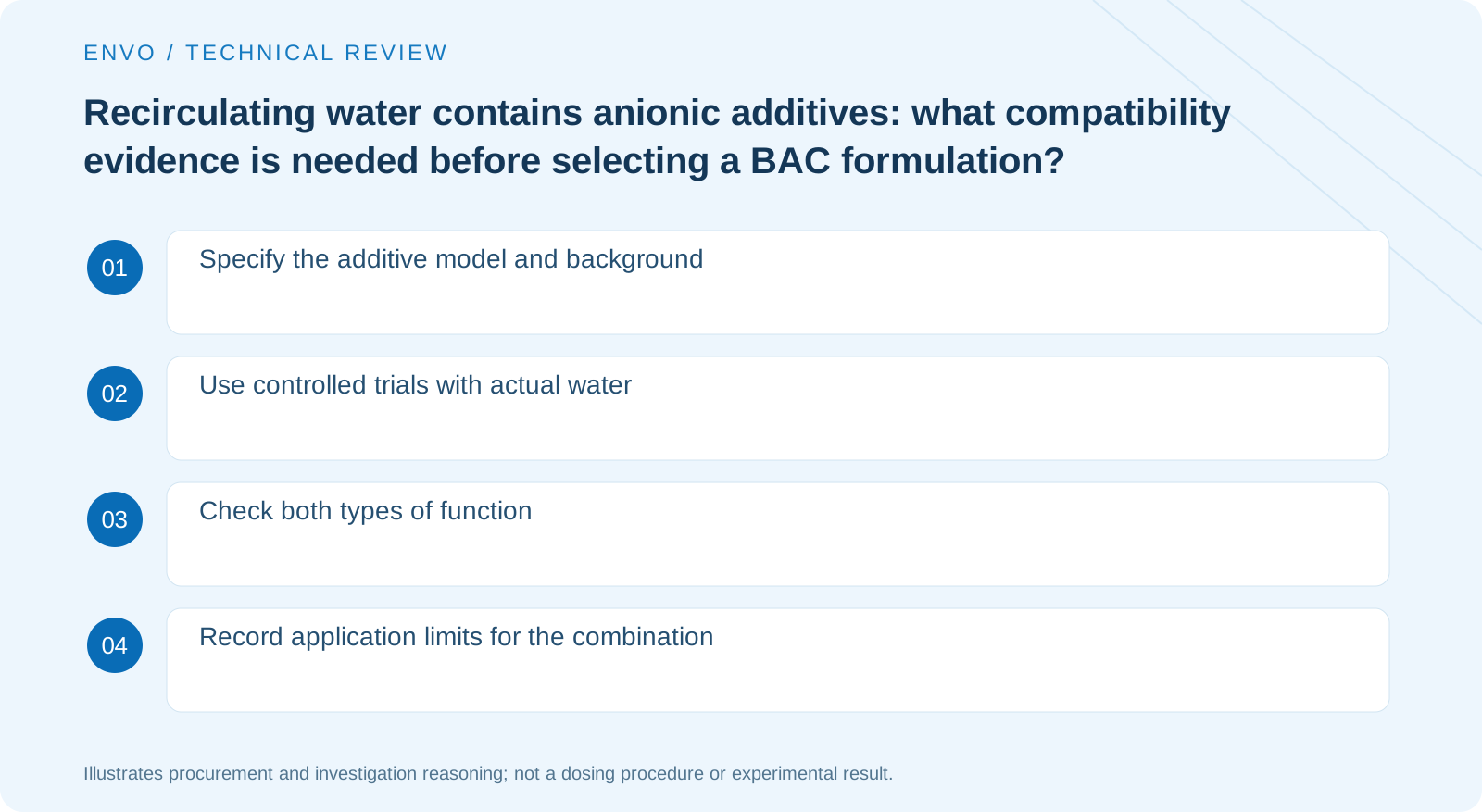
Specify the additive by model rather than name alone
Recirculating water may contain scale-control dispersants, corrosion inhibitors, cleaners and other treatment products. Functional categories do not fully describe ionic characteristics or composition. Collect shareable model details, technical descriptions and use conditions, then have professionals determine which interactions warrant review. LANXESS energy literature highlights the need to assess interactions between surface-active biocidal treatments and associated polymers. This is a review principle, not a universal prohibition on mixing every anionic product.
Compatibility assessment requires more than a bottle-mixing test
Directly mixing concentrates does not represent operating-water conditions and may create risks; the webpage should not recommend improvised mixing. Qualified personnel should perform compatibility trials under defined conditions, specifying water sample, concentration basis, temperature and observations. Visible flocculation or turbidity is useful evidence, but no visible change does not establish preservation of all functions. Include process-relevant performance and microbial assessments.
Check the objectives of both chemical types
Testing only biocidal performance may miss changes in scale inhibition, dispersion or other process functions; clear water alone may conceal inadequate microbial control. Comparisons with existing programs should use consistent water quality and test conditions and record actual formulation batches. Determine effects of constituent changes progressively from evidence. The words cationic and anionic alone do not prove a particular reaction occurred on site.
Consider site residues and carryover pathways
Even after a new proposal passes small-scale trials, existing cleaners or treatment residues may make startup different from steady operation. Project staff should review actual circuits and change procedures rather than replace products without understanding the original system. Complete missing information first; this page gives no generic switching formula or mixing sequence. Follow the specific product and equipment instructions.
State compatibility limits in supply discussions
Attach major additives, actual water descriptions, existing problems and process properties to preserve, asking the supplier to identify validated combinations and gaps. Validation should trace to specific models rather than broad wording such as compatibility with most chemicals. Review conclusions when any additive version or water source changes, establishing technical evidence usable for repeat purchasing.
Set compatibility-test acceptance conditions in advance; do not wait for results and then choose only unaffected parameters as pass criteria. If filtration or deposition is a particular concern, include those checks. If the objective is to preserve existing scale-inhibition function, assess that separately; a microbial reduction cannot substitute for confirmation of process function.
Explore further
Are cationic and anionic products always entirely incompatible within the same system?
No general conclusion applies. Verify the specific product and operating conditions.
Does the absence of precipitation eliminate the need to verify performance?
Actual functions and microbiological objectives still need evaluation individually.
References
This article draws on publicly available technical information. Third-party sources do not establish ENVO product approvals, field testing or project experience. Confirm each use against actual supply documents and site conditions.