

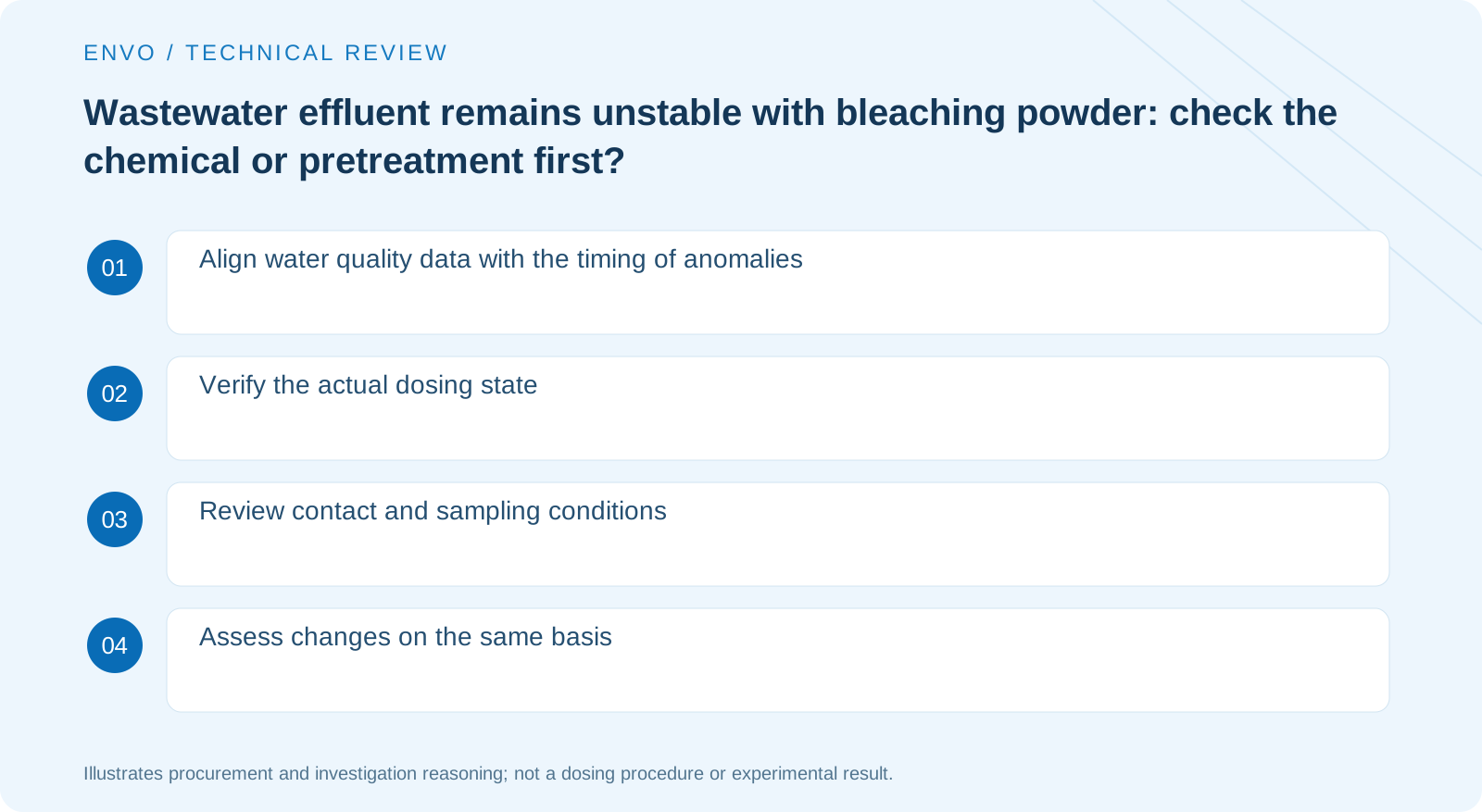
First separate water quality anomalies from chemical-feed anomalies
Record the time relationship among influent flow, pretreatment changes, suspended-solids indicators, dosing-equipment condition and disinfection results. If anomalies consistently accompany deteriorating upstream effluent, changing chemical batches alone may not solve them. EPA small-wastewater-system technical information notes effects of suspended solids and organic matter on disinfection. This is technical background, not the current local discharge standard or evidence of performance for any bleaching-powder product.
Check whether dosing is actually continuous
Purchase quantities and warehouse issue records establish consumption, not uniform chemical delivery into treatment water at every interval. Check operating logs, material condition, maintenance and fault alarms under equipment-approved procedures, confirming product compatibility with the unit. A webpage cannot provide universal dissolution or preparation instructions because materials and equipment differ. Without equipment information, do not remotely direct site work using an empirical ratio alone.
Confirm that contact conditions represent the worst-case operating conditions
Performance at average flow does not automatically represent peaks, bypasses or equipment failures. The site manager should confirm design and actual flow paths, effective contact arrangements and sampling locations, avoiding sampling only where compliance is easiest. Obvious short-circuiting or contact-facility problems require engineering assessment first. Increasing product use cannot replace hydraulic review or guarantee every target simultaneously.
Create a complete record of endpoint testing
Each result should specify sampling location, time, target parameter, method and sample-handling conditions, with residual and microbial indicators managed separately. One high residual does not establish compliance with every discharge requirement. Include receiving-water and downstream-treatment residual requirements in review, following local requirements and approved procedures. Do not copy a universal limit or acceptance standard from an external case.
Establish a comparable sequence of corrective actions
First rule out mismatches between documents and product identity, then verify dosing continuity, pretreatment water quality and contact facilities. Specialists can then decide whether the chemical program needs adjustment. An inquiry containing these verified facts is more useful than simply demanding a stronger product. If a change is implemented, retain comparable before-and-after data so improvements from restored pretreatment are not attributed entirely to the new supplier, and the original product is not rejected without evidence.
A review table can separately identify restoration of pretreatment, dosing-equipment repairs and chemical batch changes. If several occur together, report honestly that their effects cannot be attributed independently rather than crediting all final compliance to a new batch of bleaching powder. A reliable corrective-action conclusion explains the process and reduces unnecessary repeat purchases during the next abnormal event.
Explore further
Does unstable disinfection mean buying a product with higher available chlorine?
Not necessarily. Check water quality, equipment and contact conditions first.
Is chlorine residual the only parameter needed for effluent testing?
Not enough. Verify microorganisms, residuals and other applicable parameters separately under project requirements.
References
This article draws on publicly available technical information. Third-party sources do not establish ENVO product approvals, field testing or project experience. Confirm each use against actual supply documents and site conditions.