

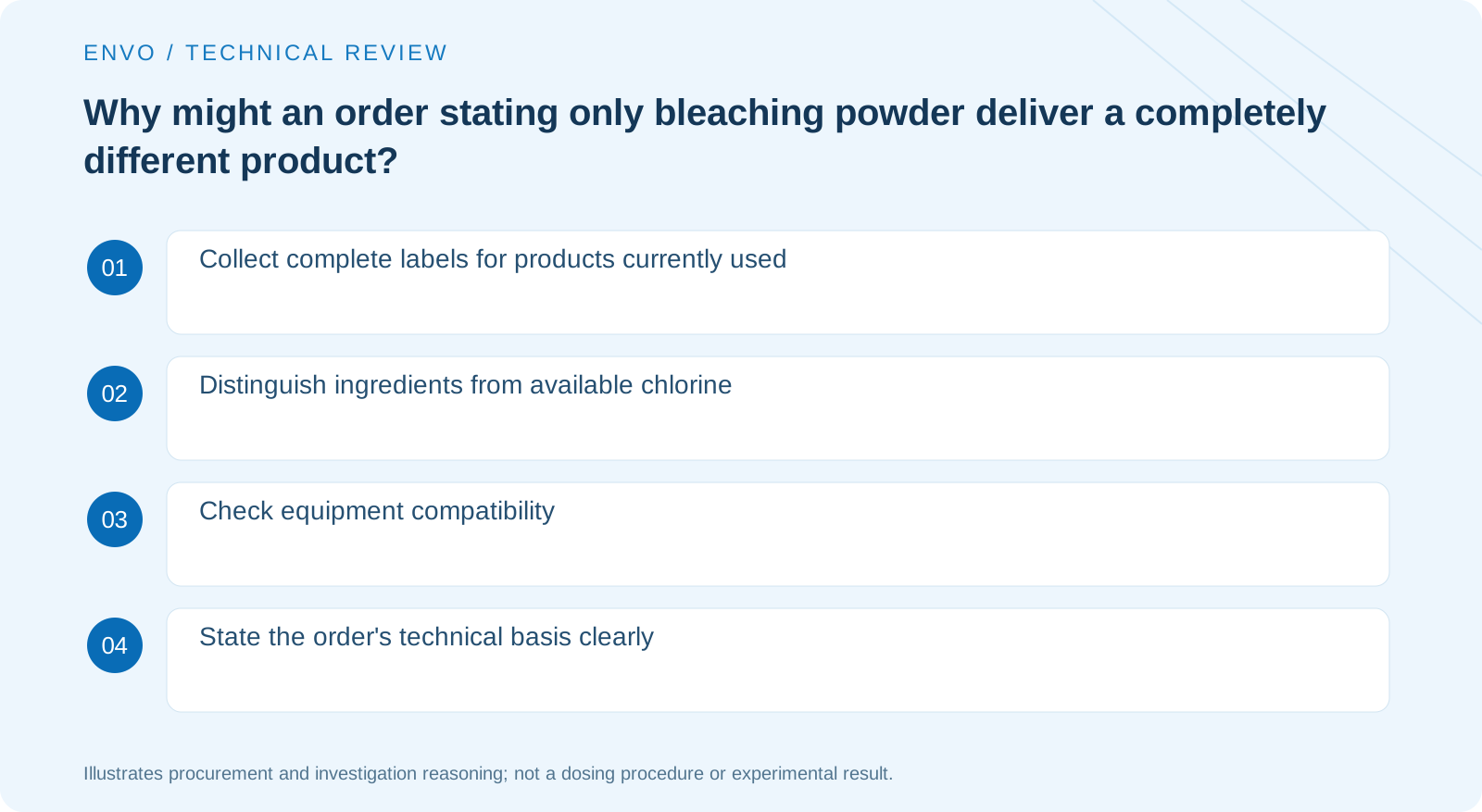
Move from informal names to the actual supplied item
Collect the current label, technical information, batch test report and actual dosing-equipment requirements to establish the composition intended by the original order. Market terminology may blur traditional bleaching powder and high-content calcium hypochlorite products. Avoid relying only on a Chinese common name or one English translation. EPA calcium hypochlorite information helps identify the chemical but does not justify registering every product called bleaching powder as the same pure substance.
List available chlorine separately from product purity
Available chlorine is a technical purchasing measure and should not be equated without explanation to the purity of one ingredient. Quotation requests should retain the test parameter, method, reporting unit and acceptance stage rather than merely asking for the highest content. For formulations or mixtures, assess how other constituents affect dosing, deposits and storage. Establish equivalent specifications and delivery conditions before comparing prices; price per tonne cannot replace process-suitability assessment.
Check suitability for the existing installation
Equipment may specify granules, powder, tablets or particular products; similar available-chlorine values do not justify substitution. Check feeder model, wetted components, cleaning procedures and product-manufacturer instructions. Responsible personnel should establish a change process when switching chemicals. In particular, equipment previously using another chlorine product cannot be converted simply by topping up or mixing products. Verify product identity before use.
Do not base receipt acceptance on appearance
White or off-white appearance is only one observation against documentation; it does not establish available chlorine, impurities or intended use. If deliveries differ visibly from photographs, record package batch numbers, seals, appearance and document versions, then arrange agreed verification. Odor intensity or immediate clear dissolution cannot establish conformity. Do not mix other reagents into samples for unapproved identification experiments.
Turn an ambiguous order into an actionable order
Order descriptions should include full product name, use, dosage form, key test criteria, packaging and acceptance documents. Explicitly question unverified items instead of inventing specifications. Upload complete existing-product labels and request item-by-item correspondence rather than sending half a brand photograph. Establishing this before supply arrangements reduces returns and site-suitability risks arising from misunderstood names.
To prevent renewed translation ambiguity in international purchasing, retain full Chinese and English names, the actual product label and the agreed specification version in contract attachments, using common names only as search aids. If the supplier uses a different English name, it should explain the correspondence rather than letting translation software automatically choose a seemingly similar chemical.
Explore further
Can bleaching powder and high-test bleaching powder be distinguished by common names alone?
Do not rely on a common name alone. Check actual composition, specifications and product documents.
Can white powders be substituted because they look alike?
No. Check identity, parameters, use and equipment compatibility.
References
This article draws on publicly available technical information. Third-party sources do not establish ENVO product approvals, field testing or project experience. Confirm each use against actual supply documents and site conditions.