

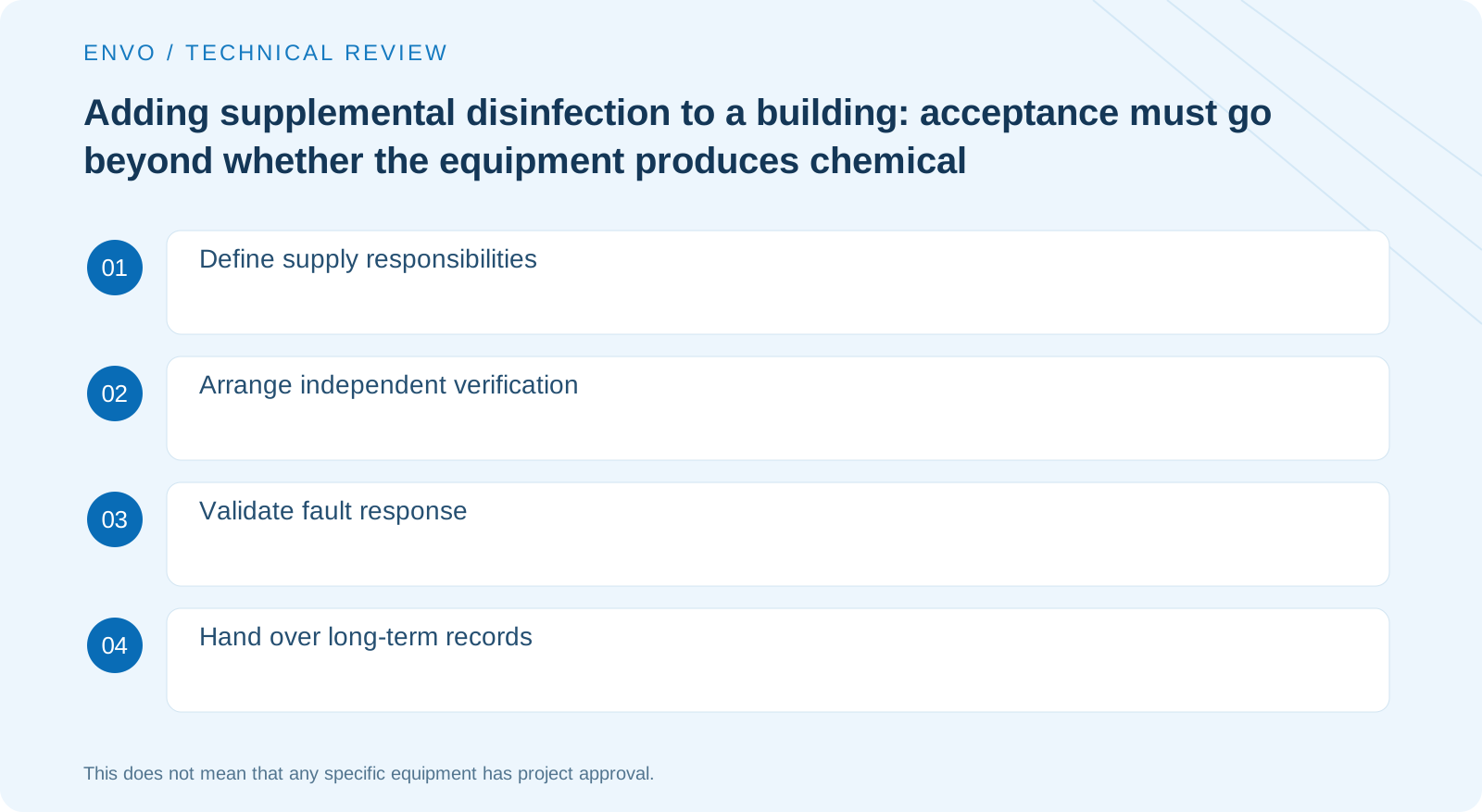
List supply scope and management scope separately
Equipment scope includes metering, generation, sensors, connections and controls; management scope includes incoming-water changes, storage/distribution, outlet maintenance and records. Ask bidders to specify responsibilities and owner-supplied prerequisites item by item. If a critical condition is assigned to the user, establish before purchase who can maintain it continuously so responsibility does not disappear after delivery.
Confirm which location the control signal represents
Identify control sensors, independent verification points and the least favorable use points. An equipment-outlet reading describes a local condition but may not represent remote circuits. CDC explicitly cautions against assuming supplementary disinfection replaces a complete water-management plan. Acceptance should review approved objectives and monitoring design rather than applying another project’s efficacy percentage to the current building.
Include faults and maintenance in the demonstration
Use equipment-approved test procedures to validate states during power loss, insufficient consumables, sensor faults and communication failure. Confirm alarms reach actual duty staff and identify who authorizes recovery. Training should cover more than normal startup: incoming staff should locate maintenance documents, recognize incomplete calibration and know which tasks require professionals, preventing automation from becoming an unexplained black box.
Complete handover with ongoing records
Agree how commissioning data, tests and maintenance records will be retained and who reviews operating or equipment changes. Company photographs or certifications cannot replace project acceptance data, and generic technical information is not authorization for use in the building. Final acceptance should identify completed and condition-dependent items and assign follow-up service and consumable documents to named responsible personnel.
Define verification responsibilities after maintenance and formulation changes
Acceptance does not confirm every future condition once and for all. Handover documents can list changes requiring renewed checks, such as sensor replacement, control-software adjustments, product changes or expanded service scope, and identify who initiates review. Subsequent procurement will then not skip compatibility checks merely because a trade name is unchanged. The responsible team determines the extent of review and suppliers provide accurate supporting information. Initial acceptance data must not repeatedly support systems whose conditions have changed.
Explore further
Can equipment be accepted solely because its outlet water results are normal?
Also check the project’s agreed control scope, remote-point validation and fault response; do not examine only the equipment outlet.
Is the same system suitable for every building?
A blanket answer is inappropriate; piping, water users, incoming water and management capability all affect selection.
References
This article draws on publicly available technical information. Third-party sources do not establish ENVO product approvals, field testing or project experience. Confirm each use against actual supply documents and site conditions.