

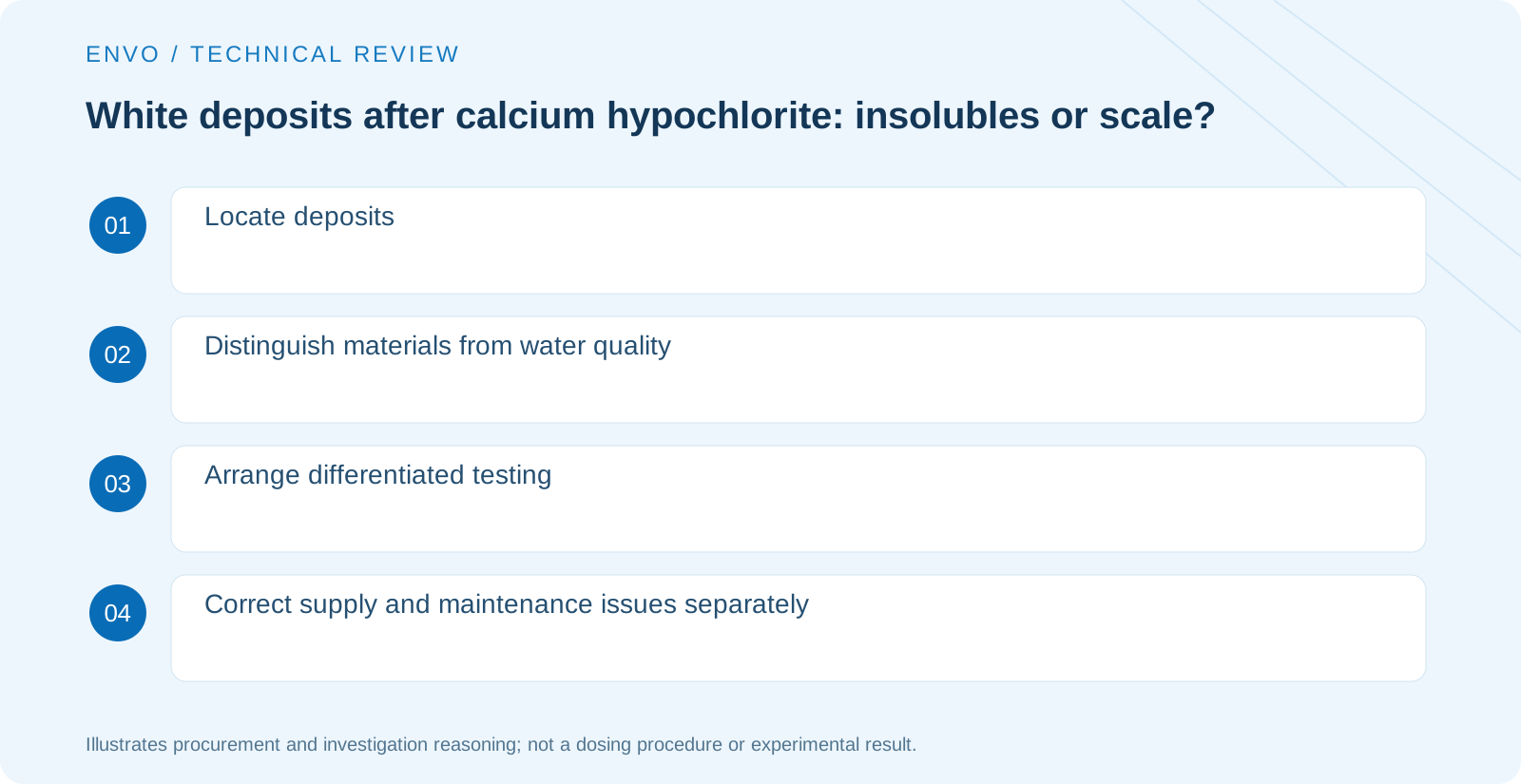
First record the locations instead of taking just one photograph
Record whether deposits occur in storage, feeders, piping or heated surfaces, noting timing and accompanying flow or differential-pressure changes. Identical color at different locations may reflect different formation processes. Qualified personnel should safely retain representative samples and original packaging batch information. Avoid site acid tests or mixing other chemicals to ‘verify’ deposit identity.
Separate product composition from water quality load
EPA information notes that commercial calcium hypochlorite may contain other salts, so procurement should consider insoluble matter as well as available chlorine. The contribution of calcium-containing components to water calcium load and scaling tendencies from concentration, pH and temperature are separate assessments. A batch report cannot guarantee no site scaling, and site scaling alone cannot prove raw-material nonconformity.
Arrange tests that can distinguish causes
Have analysts assess original-material quality and deposit samples separately, supported by influent, recirculating-water or effluent data from the same period. Deposits confined near dosing points require review of equipment suitability and local feed conditions. Widespread deposits on heated surfaces or highly concentrated sections require broader water-management investigation. Samples and process conditions determine analytical items; color alone cannot establish the conclusion.
Address corrective actions through both purchasing and maintenance
Product requirements can define permitted dosage forms, batch criteria and packaging integrity; equipment responsibilities should define residue removal, filtration, maintenance and water monitoring. Keep material and operating conditions fixed in the next validation to assess deposits, differential pressure and treatment indicators. Inquiries with deposit locations, equipment models, hardness and recent records help avoid blaming every problem on one available-chlorine number.
Link deposit samples to their operating locations
Qualified site personnel can separately record deposits at chemical receipt, in treated water and on equipment surfaces, avoiding a single sample that combines different sources. Deposits arising mainly during chemical handling require different investigative evidence from deposits forming in heat exchangers or at the end of a recirculating system. Retain makeup-water, chemical-batch and equipment-maintenance records for the same period so the laboratory can select appropriate identification tests. Photographs show location and appearance but cannot independently identify carbonates or insoluble matter. Unapproved identification methods, such as acid tests or mixing tests, should not be improvised on site. Once results are confirmed, determine whether supply specifications, pretreatment or equipment maintenance need adjustment. This sequence helps avoid reporting a water-quality problem as product nonconformity while also preventing genuine delivery anomalies from being overlooked.
Explore further
Does less white solid always indicate better quality?
Judge it against agreed test methods and the intended use. Site observations are affected by water quality, equipment and dosing conditions.
Can same-size TCCA tablets be substituted to avoid deposits?
Do not swap them directly. The two products differ in chemistry, equipment compatibility and water-quality management requirements.
References
This article draws on publicly available technical information. Third-party sources do not establish ENVO product approvals, field testing or project experience. Confirm each use against actual supply documents and site conditions.