

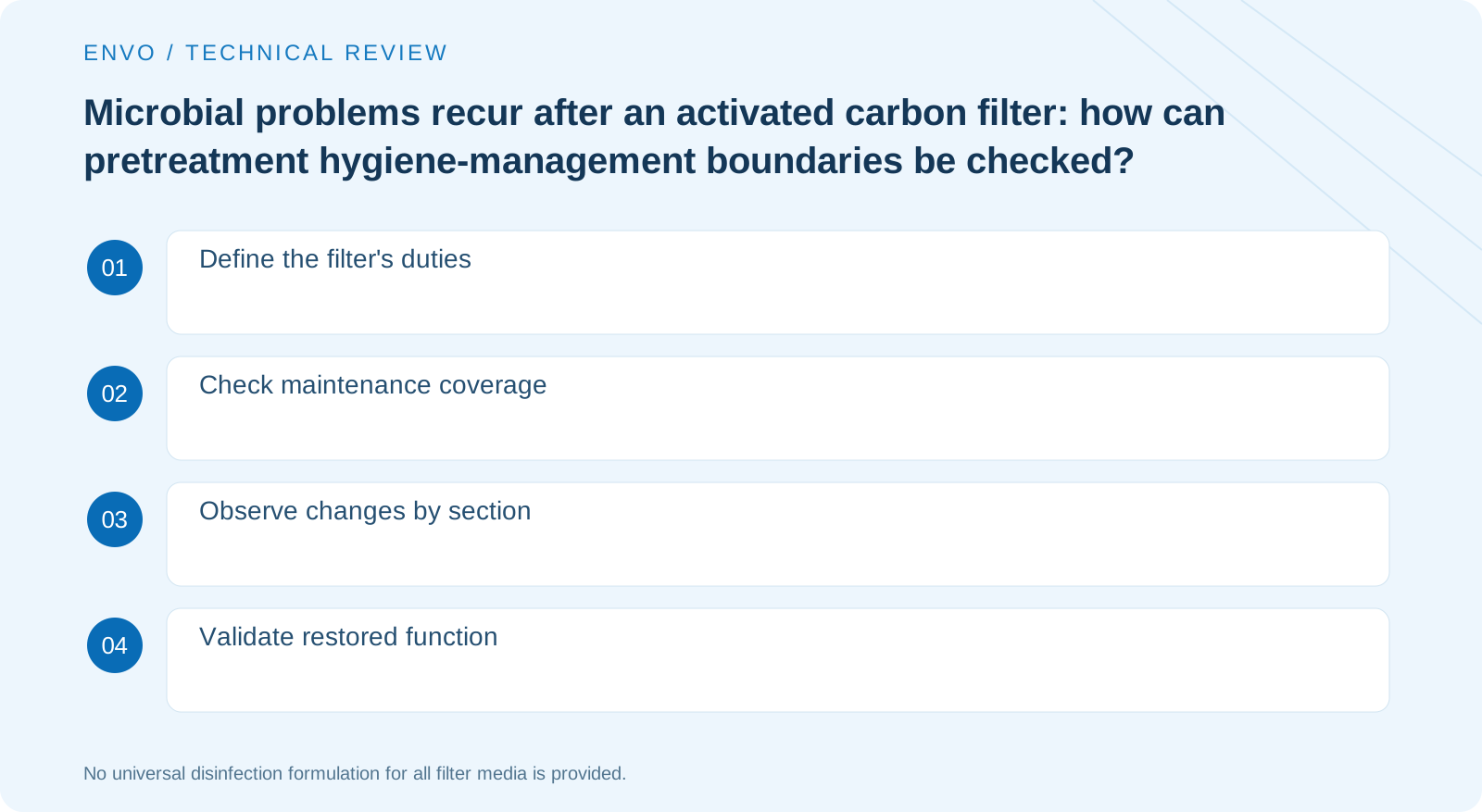
First list the carbon filter’s duties in this system
Confirm the substances removed, unit location and whether oxidant-residual removal is a design task. Map upstream and downstream circuits, backwashing, bypasses and standby filters. First define permissible downstream water quality to determine whether sanitation measures conflict with original process responsibilities.
Circuit diagrams should identify the activated-carbon unit’s specific role, such as controlling certain organics or removing upstream oxidants, and list downstream equipment limits. Tanks or idle branches between that outlet and endpoints mean endpoint anomalies cannot automatically be blamed on media. Define each stage’s intended function before discussing which functions a treatment change affects.
Compare maintenance coverage with the actual structure
Record filter-media use, backwashing, shutdowns and replacement, checking whether distribution, collection and sampling components are maintained. CDC building-water guidance notes that filtration and other components may affect residuals; specific industrial filters still require equipment documentation. One media replacement is not treatment of all piping, and another filter’s experience does not authorize unconfirmed cleaning methods.
Design observations that distinguish upstream and downstream stages
Under an approved plan, compare influent, post-filter and relevant downstream points under matched conditions and timing. Resolve method comparability first. Storage and piping between filtration and membranes may affect results, so a post-filter anomaly does not prove filter media are the sole source. A structured comparison is more useful than more random samples.
Confirm whether the hygiene procedure reaches every contact surface
Suppliers should define product conditions for media, linings and seals; equipment providers should confirm procedure coverage and restart requirements. General disinfection conclusions cannot replace media-performance assessment. If original treatment functions must remain, validate related process parameters so hygiene measures do not damage pretreatment’s primary purpose.
Include downstream protection in purchasing discussions
When replacing media, modifying equipment or adding monitoring, define downstream interfaces and responsibilities. Include flows, anomaly locations and maintenance records in inquiries and request controlled scope and limits. Retain subsequent operating observations despite short-term sample improvement; long-term suitability needs system evidence, not one demonstration.
Explore further
Do anomalies after activated carbon necessarily mean contaminated filter media?
This cannot be confirmed directly. Sampling, connecting pipes and subsequent storage conditions also require investigation.
Can an ordinary biocide be used directly in any carbon filter?
Confirm formulated-product uses, filter-media performance and equipment materials; do not generalize.
References
This article draws on publicly available technical information. Third-party sources do not establish ENVO product approvals, field testing or project experience. Confirm each use against actual supply documents and site conditions.