

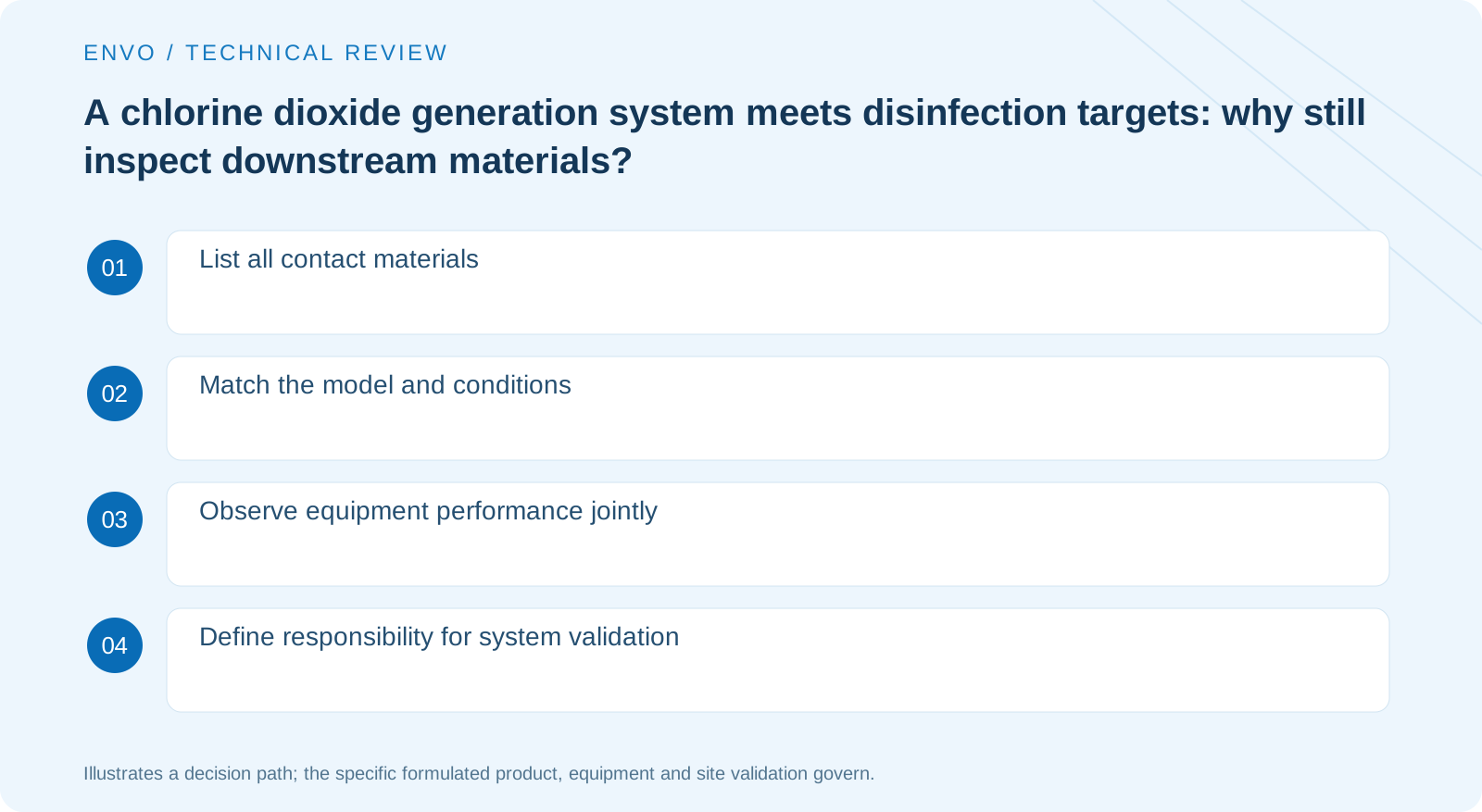
Create a list of actual contacts
List materials contacted by the generated concentrate and by treated water separately, distinguishing concentration and contact stage. Long-term circulation, short treatment and shutdown may differ. Suitability of generator-internal materials does not establish coverage for the customer’s entire system.
Match manufacturer instructions to specific conditions
Collect chemical-compatibility requirements for downstream equipment, membranes and seals, specifying models and document versions. Generic material tables provide leads but cannot replace actual instructions for proprietary components. Membrane systems especially require attention to accompanying components and the specific membrane type.
Include performance observations in validation
Monitor relevant operating parameters and material condition according to equipment requirements, retaining a pretreatment baseline. Assess disinfection performance and equipment integrity separately; neither can conceal abnormalities in the other. Specialists should investigate problems rather than users changing generation or dosing procedures based on a webpage.
State the scope clearly in the contract
Specify who checks the generator, dosing points and downstream equipment, and who provides trial and release evidence. If supply covers only the generating unit, clearly list the excluded system validation so customers do not assume that buying one machine guarantees every use.
Link material names to the actual wetted components
The information list should identify the exact models of pipes, pumps, valves, seals, tanks and monitoring components, together with the substances they contact. Knowing that the main equipment housing is stainless steel does not establish compatibility of every internal part. Contact conditions may differ between generation, storage and final treated-water sections; record each separately rather than applying one material grade across the entire water circuit.
Request equipment-provider compatibility statements for the relevant conditions, clarifying continuous contact, short procedures or other limited uses. Generic material tables are preliminary references, not complete-equipment approval. For corrosion or seal anomalies, retain location, time and operating context for assessment; photographs alone cannot establish cause.
Add new replacement-part or interface models to engineering change records and assess effects on original validation. Low price or identical dimensions do not establish equivalent material suitability. Mapping wetted parts to water sections reveals documentation gaps during inquiry and supports maintenance traceability. Retain replacement dates and models to connect later anomalies to the actual configuration.
Explore further
Does generator-material resistance establish downstream-material resistance?
No. Different contact components and conditions require separate confirmation.
Can material changes be ignored when disinfection performance is good?
No. Both hygiene and equipment compatibility requirements must be met.
References
This article draws on publicly available technical information. Third-party sources do not establish ENVO product approvals, field testing or project experience. Confirm each use against actual supply documents and site conditions.