

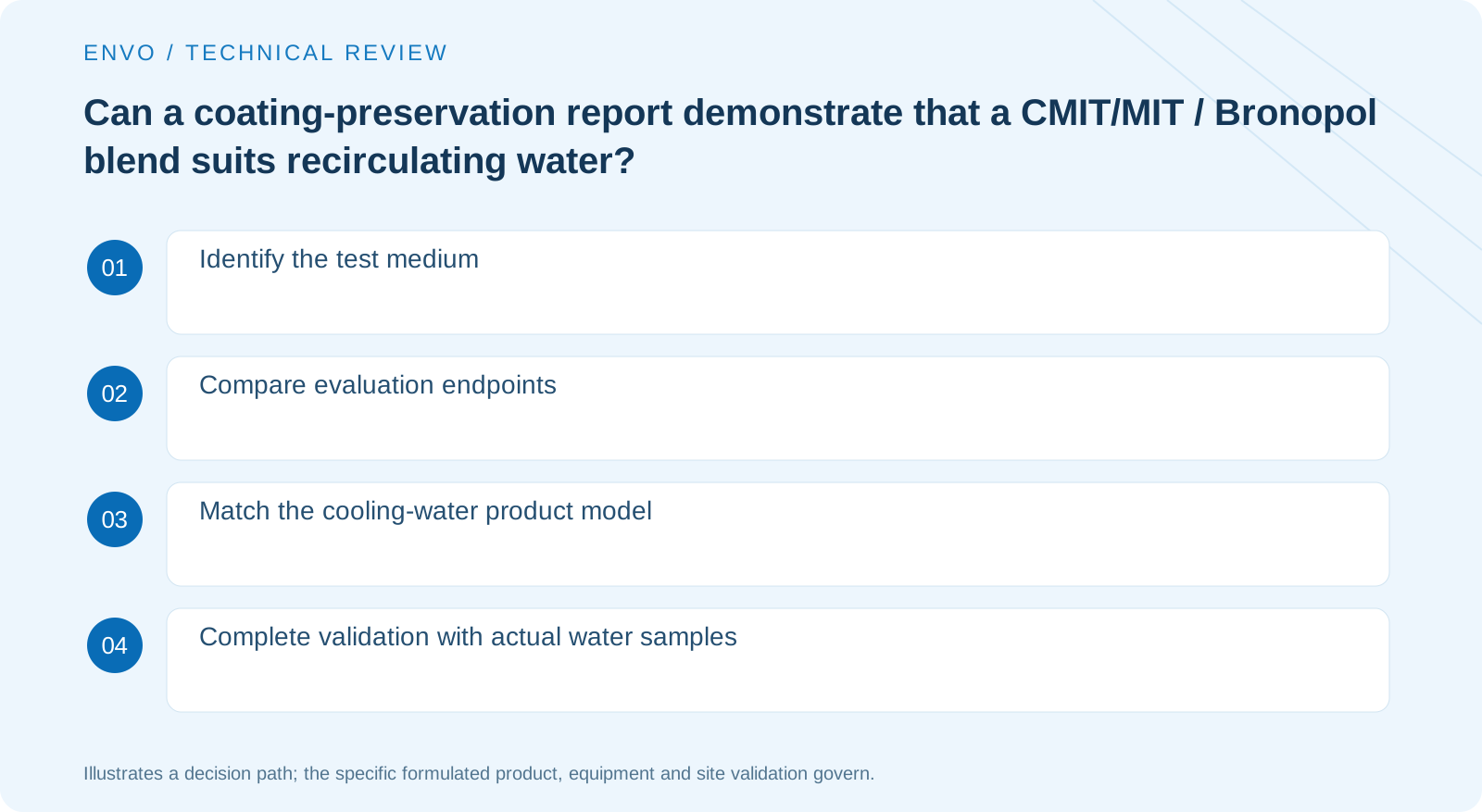
First identify the medium tested in the report
Check whether the sample is a coating, emulsion, stock solution or actual circulating water. A challenge test addressing material storage life does not directly establish efficacy in a dynamic water circuit. Record the test subject in the document register so a ‘broad-spectrum biocide’ heading does not obscure application limits.
Check whether the comparison endpoint addresses the current problem
Material preservation often focuses on storage stability, while circulating-water treatment may target microorganisms, slime and equipment operation. Even where test targets overlap, actual water quality, contact time, makeup and blowdown differ. Redefine assessment parameters around the current problem rather than comparing only one percentage in reports.
Request evidence for the corresponding cooling-water product
Manufacturers’ cooling-water catalogs help identify established commercial approaches, but documents and validation for the exact model being purchased are still required. Link the formulated-product code, applicable circuit and test conditions. If only generic raw material information is available, state that formulated-product evidence is missing.
Keep a practical route for obtaining missing evidence
Collect actual water samples, operating ranges and existing additives to define the validation request. First screen out clearly inapplicable reports, then compare candidates with relevant evidence. Conclusions should state ‘suitable for the conditions evaluated’; adding a cooling-tower photograph must not turn material-preservation information into a water-treatment case.
Complete the scope-of-application field before reviewing a report
Add medium, product state, target, test-duration range and sample model beside report summaries. In-can paint-preservation trials should retain that materials context; cooling-water trials require checks of water matrix and dynamic conditions. Scope prevents readers from extending one laboratory finding to every industrial-water use.
Use two-stage screening: exclude reports clearly concerning a different target, then compare evidence actually covering the current water environment. Mismatched evidence may still be valuable research but does not answer this question. Distinguish independently written selection analysis from source findings rather than present inferences as proven report conclusions.
If only material-preservation documentation is available, limit the next step to establishing cooling-water validation rather than promising suitability first and adding evidence later. Include current conditions, additives and targets in the test commission to obtain conclusions the customer can actually use.
Explore further
Can the same trial be used whenever active content is identical?
Check the complete formulation, medium and assessment objective; shared use cannot be assumed.
Does a catalog description count as a site case study?
No. It is only publicly available information about the product approach.
References
This article draws on publicly available technical information. Third-party sources do not establish ENVO product approvals, field testing or project experience. Confirm each use against actual supply documents and site conditions.