

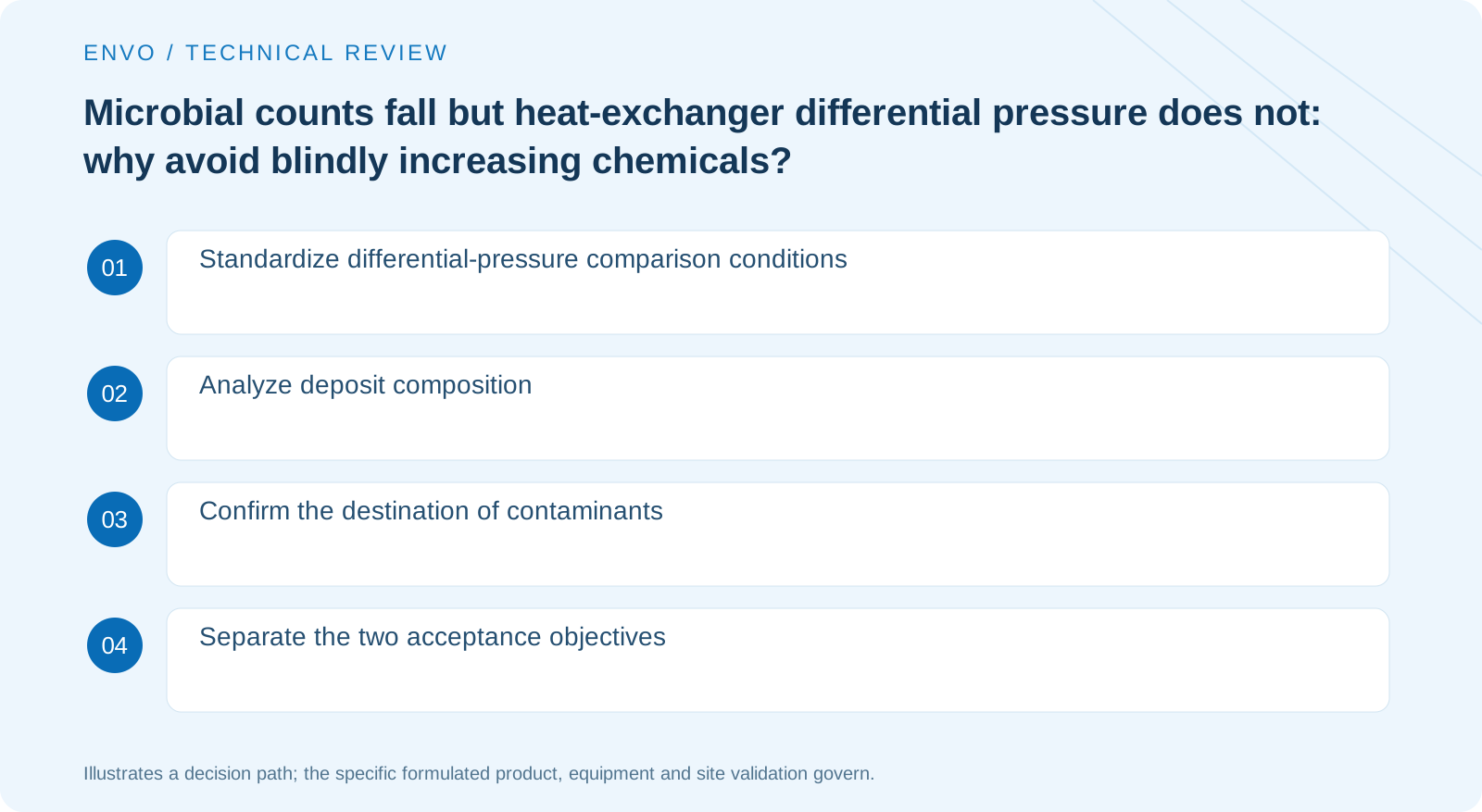
Check whether differential-pressure readings are directly comparable
Record flow, valve positions, temperature and equipment load, confirming comparable operating conditions before and after treatment. If flow changes, differential-pressure changes may not result from deposits. Excluding instrument and operating differences first prevents normal condition changes from being interpreted as chemical effects.
Identify deposits as well as measuring microbial counts
Use maintenance observations or sample analysis where feasible to distinguish biological deposits, inorganic scale and corrosion particles. Cooling-water manufacturers describe microbial control as part of comprehensive water management; this does not mean biocides perform every cleaning function. Microbial counts in water alone do not establish the composition of deposits on equipment surfaces.
Check whether removed contamination has an exit pathway
Even after biological activity declines, existing deposits may remain on surfaces or move to filters and low-flow areas. Assess existing filtration, blowdown and maintenance cleaning instead of assigning every problem to a stronger biocide formulation. Equipment suppliers and specialists should determine cleaning procedures.
Set two distinct improvement objectives
Record microbial control and recovery of heat-transfer performance separately, with distinct assessment periods and evidence. If microbial counts improve but performance does not, investigate deposits and hydraulics rather than rejecting the data or repeatedly changing chemicals. Stating whether procurement is for ‘ongoing control’ or ‘restoring fouled equipment’ helps obtain a more accurate proposal.
The minimum evidence package for a diagnostic meeting
Prepare four evidence groups: comparable before-and-after differential pressure and flow; available deposit or maintenance observations; microbial methods and locations; and cleaning and blowdown records. Without internal inspection, state that deposit composition remains unconfirmed rather than label it biofilm from water color. Incomplete information does not automatically require stopping use or changing chemicals; it identifies the next diagnostic gap.
Improved microbial counts with unchanged differential pressure call for deposit and hydraulic assessment. Pressure changes with substantial flow changes require a common comparison basis. Inspection finding mainly inorganic scale may indicate that biocides are not the principal performance-restoration tool. Each branch needs actual evidence, not remote conclusions from surface observations.
Purchasing can accordingly separate routine microbial control from restoration of fouled equipment, each with its own supply and acceptance scope. This avoids expecting one biocide to perform cleaning, filtration and all equipment maintenance.
Explore further
Does a reduction in microbial counts establish biofilm removal?
No. Waterborne microorganisms and surface deposits are different evidence categories.
Does unchanged differential pressure mean the biocide is completely ineffective?
Not necessarily. Assess microbial and equipment-performance objectives separately.
References
This article draws on publicly available technical information. Third-party sources do not establish ENVO product approvals, field testing or project experience. Confirm each use against actual supply documents and site conditions.