

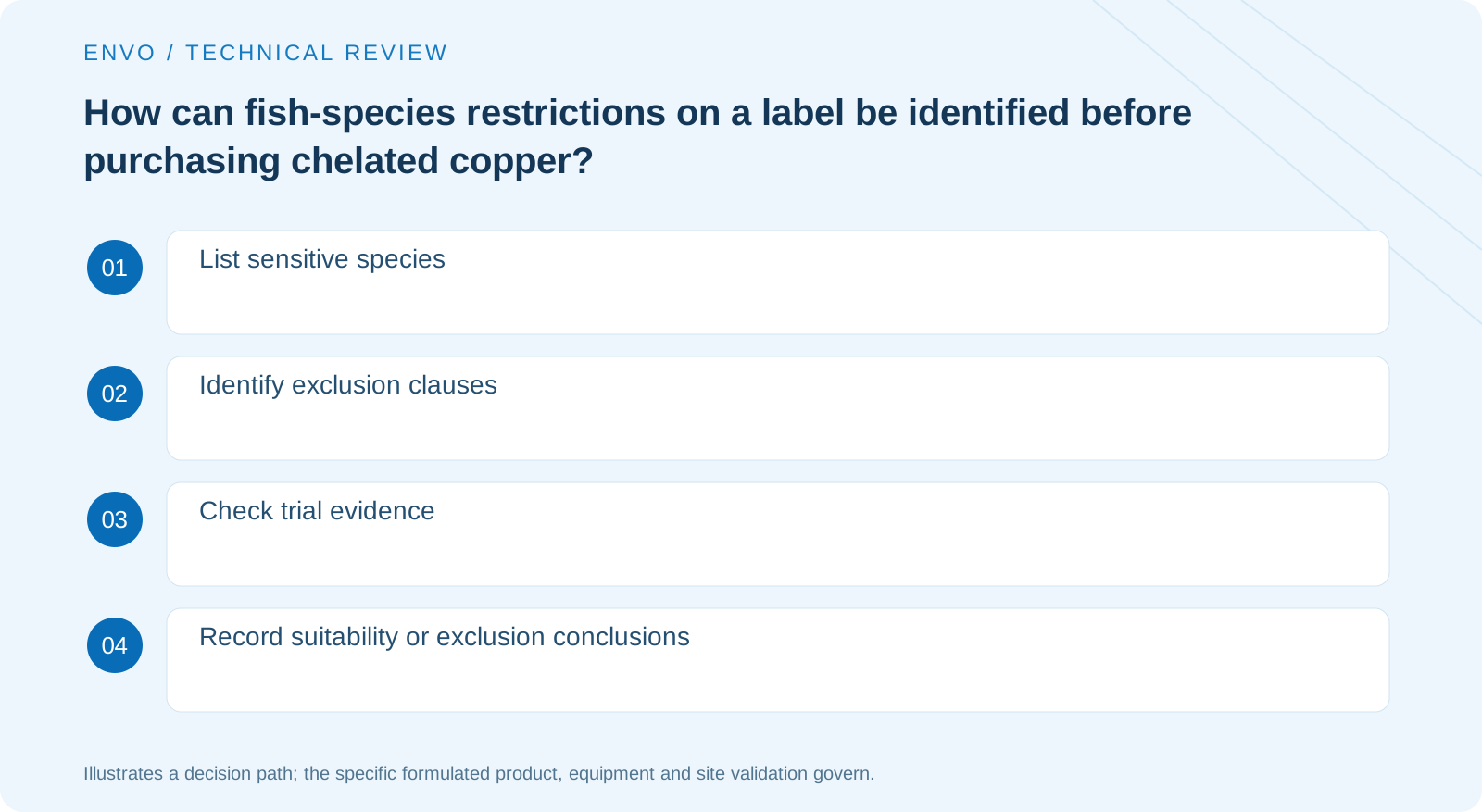
Include fish species in the requirements form
Do not write only ‘contains fish’ or ‘ecological pond.’ Provide fish species, aquaculture purpose, other aquatic organisms and breeding areas as far as possible. If species are unknown, ask the water-body manager to confirm them first. Omitting this information from purchasing discussions can produce generic recommendations that do not match the actual water body.
Read the limitations section in full
Public examples of complexed-copper labels include restrictions for particular ornamental fish and small garden ponds. Do not read only the front-label algaecide claim; also review environmental hazards, prohibited uses and water-quality conditions. Third-party examples illustrate which information to seek, not that every complexed-copper product has identical restrictions.
Identify the scope in which the evidence applies
If a supplier provides fish tests, check the species, life stage, water quality, exposure conditions and corresponding formulation. Reports for different ligands, copper equivalents or other ingredients are not interchangeable. If the name is the same but the model differs, first verify that the report covers the product actually being purchased.
Make findings of unsuitability actionable too
Add an ‘exclusion reason’ column to the selection table for species conflicts, unsuitable water-body scale or missing current documentation. Once unsuitability is clear, do not force a match because of price or lead time. When moving to another control method, reassess target algae, water use and non-target effects; a copper-free product still requires validation.
How to review fish-safety information supplied by a vendor
Review tables should record tested product code, species and life stage, water conditions, endpoints and study type. Different formulations belong in a separate reference category. If only sales summaries without conditions exist, request original or traceable explanations. No observed abnormalities must not become safe for every fish species.
Check whether evidence covers the current water-body scale and use. Large-water-body trials do not automatically establish small ornamental-pond suitability, and healthy adult-fish data do not represent every juvenile or sensitive organism. Explicit label exclusions and management requirements remain limits; broad promotional trials cannot bypass them.
Retain exclusion reasons and relevant document page numbers for unsuitable candidates so later purchasers understand the decision. When suppliers change, the team can continue checking the same critical conditions instead of starting again merely because the product name changes.
Explore further
What if my fish species is not mentioned on the label?
Safety cannot be assumed; obtain a targeted assessment or select a candidate with clearer evidence.
Are different versions of the same brand interchangeable?
Check the product, market and label version; they are not automatically interchangeable.
References
This article draws on publicly available technical information. Third-party sources do not establish ENVO product approvals, field testing or project experience. Confirm each use against actual supply documents and site conditions.