

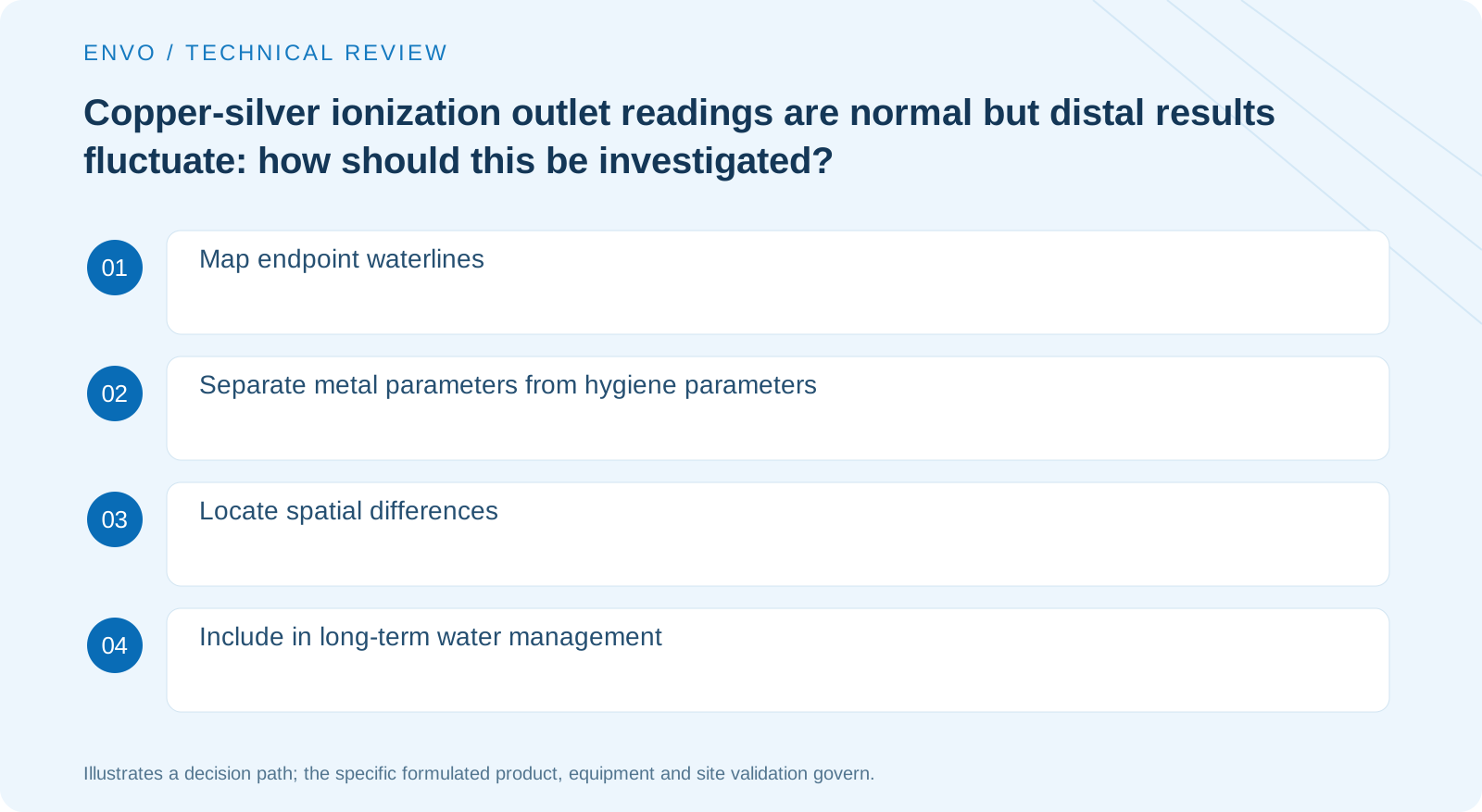
First map endpoint distribution and use
Mark hot-water circuits, returns, low-use areas and representative points of use, noting recent closures of building areas. Equipment location does not mean all water circuits receive the same treatment; check actual flow directions against drawings first.
Separate metal testing from hygiene testing
Record copper and silver results separately from microbiological results, identifying locations, methods and times. A normal result in one parameter does not establish that another objective is achieved. CDC lists copper-silver ionization as a supplemental approach requiring evaluation; this does not justify claiming suitability for every building.
Compare the outlet, loop and endpoints
Use consistent methods under representative conditions to identify where differences arise. If remote-end abnormalities concentrate in low-use areas, investigate water age and local conditions instead of merely increasing equipment output. Engineering and water-management teams should be responsible for specific operating adjustments.
Include validation in ongoing management
Request support for monitoring, maintenance and long-term assessment during procurement, checking against local water-quality requirements for metals. Another hospital’s case does not establish effectiveness in the current building. Limit conclusions to the actual system and validated conditions and continue tracking changes.
Distinguish generation, testing and water-use locations
Flow diagrams should show equipment, recirculation paths, tanks, endpoints and low-use branches, with actual connections confirmed. Main-unit logs describe equipment status, while endpoint samples describe water at their locations; neither automatically replaces the other. Different sampling objectives may require different designs, determined by the management team rather than using one fixed tap to represent an entire building.
If one endpoint differs from other locations, first check how that branch is used and its hydraulic conditions. If several locations change together, review conditions shared across the system. If differences appear only after a test method changes, first verify the analytical basis. These clues help organize an investigation; a single reading does not support remotely diagnosing equipment failure or promising that an adjustment will resolve it.
Retain operating, relevant metal-analysis and microbial-management evidence separately; none can replace a missing category. CDC’s discussion of supplementary treatments highlights long-term management, so a main-unit panel alone cannot establish continuing performance. Procurement handover should assign endpoint validation and maintenance responsibilities, making equipment selection part of water management.
Explore further
Do normal outlet copper and silver levels prove efficacy at endpoints?
No. Distribution and hygiene results must be assessed together.
Can output simply be increased to improve conditions at remote endpoints?
Diagnose first and respond under engineering and water-quality requirements rather than adjusting blindly.
References
This article draws on publicly available technical information. Third-party sources do not establish ENVO product approvals, field testing or project experience. Confirm each use against actual supply documents and site conditions.