

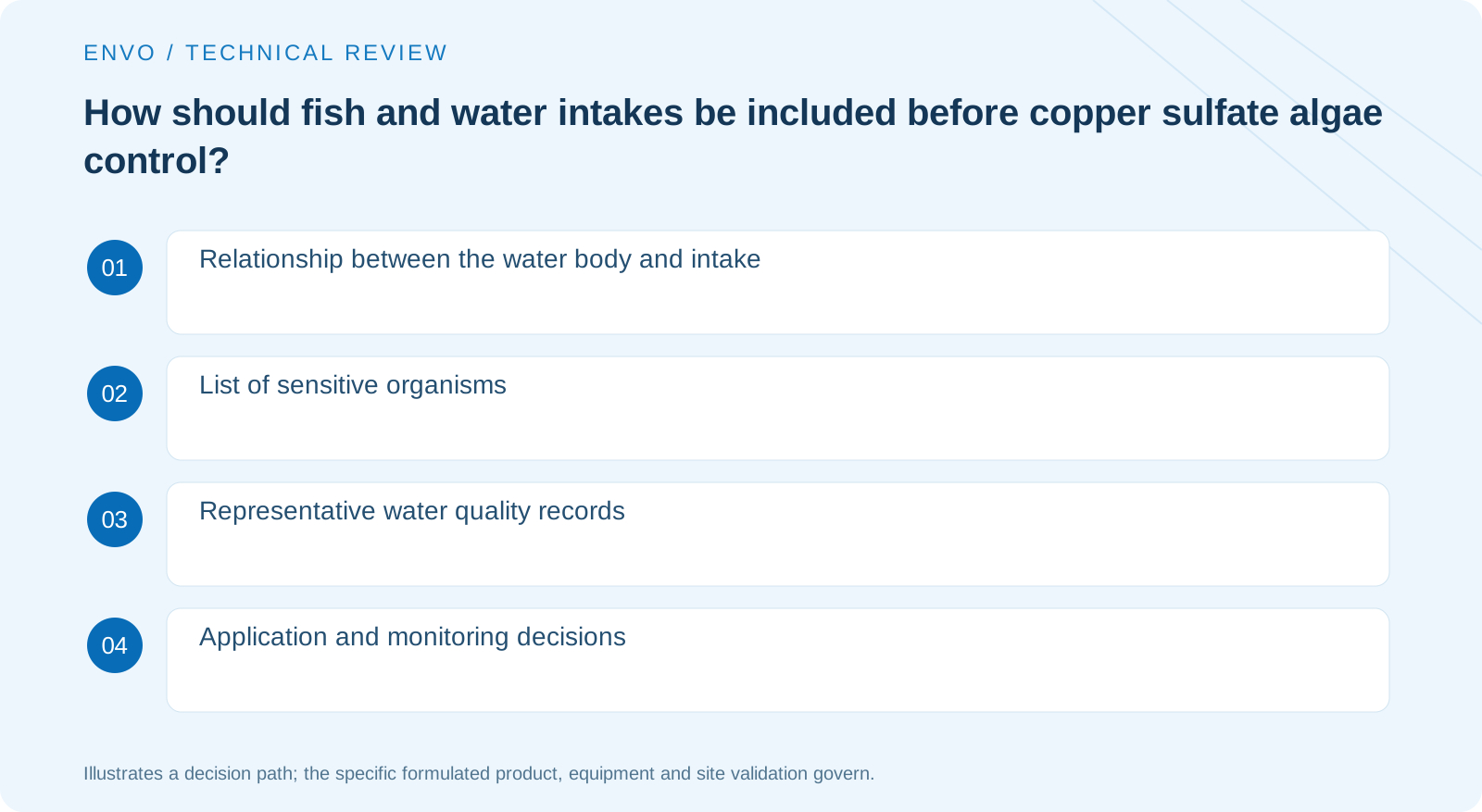
First identify targets that cannot be overlooked
Mark aquaculture areas, drinking-water intakes, makeup points, outlets and public activity areas on a plan, and add a list of fish and other sensitive organisms. ‘Landscape water’ cannot replace these details. Even localized pond treatment may affect untreated areas through circulation and overflow.
Water quality reports must represent site conditions
Collect relevant pH, hardness, alkalinity and organic-matter information, recording location, date and weather. NHMRC highlights ecological impacts and regional requirements for copper algaecides. More useful than another reservoir’s success story is explaining whether current samples cover the least favorable conditions and whether recent makeup has changed water quality.
Distinguish copper effects from effects of algal die-off
Fish abnormalities after treatment cannot immediately be attributed to one factor. Retain dissolved oxygen, water temperature, copper measurements and algal-load records from before and after treatment for interpretation by qualified personnel. Algal biomass and oxygen conditions may change together; a single surface photograph cannot establish causation. Do not replace diagnosis with further chemical dosing.
Develop an assessment conclusion that allows the process to be paused
Use explicit decision branches: investigate unknown species or intake uses; stop evaluating a candidate whose label excludes the water body; and have professionals design trials and monitoring when a valid assessment basis exists. Define restoration of abstraction, communication and incident responsibilities so successful algae control is not mistaken for restoration of every use.
An investigation form for the water-body manager
Divide surveys into water pathways, ecology and uses. Record makeup sources, outlet routes and circulation under pathways; known fish, plants and observed anomalies under ecology; and drinking-water abstraction, irrigation, recreation or aquaculture under uses. Mark missing information unknown instead of absent merely because procurement staff have not seen it. Management can complete the record before deciding whether specialist testing is needed.
Distinguish two cases: complete water data with a product label excluding the fish species means use incompatibility, which cannot be bypassed by reducing an advertised dose; no explicit label conflict but unclear water conditions means insufficient evidence requiring investigation. Neither conclusion means confirmed safe suitability, nor authorizes arbitrary trials with another copper product.
If fish abnormalities have already been recorded, retain the time, area and related water samples for specialist analysis. This website provides a way to organize information before purchasing, not a substitute for ecological identification or emergency judgment. Clear information reduces incorrect attribution in later discussions.
Explore further
Does the absence of immediate abnormalities in fish establish suitability?
No. Ongoing water-quality changes and non-target effects require assessment.
Can a product be selected using only the water surface area?
Water use, volume or depth, flow and sensitive-organism information are also missing.
References
This article draws on publicly available technical information. Third-party sources do not establish ENVO product approvals, field testing or project experience. Confirm each use against actual supply documents and site conditions.