

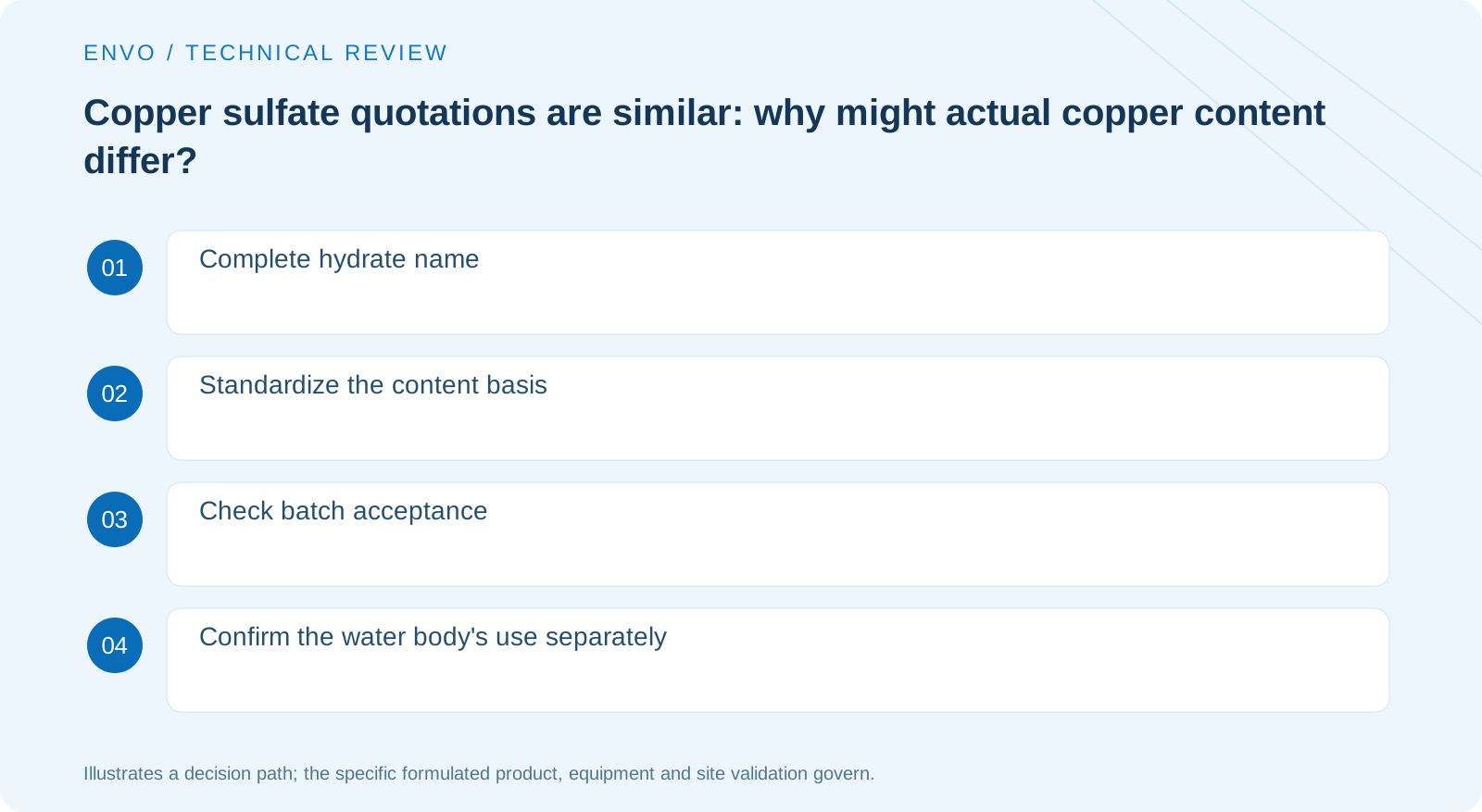
Write the chemical name in full
If a supply document states only ‘copper sulfate,’ request the hydration state. NHMRC chemical guidance lists the anhydrous form and the commonly used pentahydrate separately; their copper mass fractions differ. Blue appearance on the packaging may suggest identity but cannot replace an analytical report. Moisture exposure, crystallization state and formulation can all affect visual assessment.
Align the three percentage bases
Separate copper sulfate purity, copper content and formulated-product active percentage, identifying dry, as-received or solution-mass bases. Compound purity and metallic-copper percentages cannot be ranked directly. Request traceable conversions and test parameters before aligning them to a common basis.
Turn weight comparisons into acceptance checks
The inquiry form should record product mass, guaranteed copper content, impurity requirements and test methods together. Typical values in a sample report do not automatically become guarantees for every batch. If copper content is critical to purchasing, include it in the order and batch acceptance requirements. For liquid blends, also consider the actual delivered concentration and packaging; do not estimate on the assumption that one liter equals one kilogram.
Separate purchasing compliance from suitability for the water body
After cost calculations, still check water-product labels, target algae, water uses and ecological constraints. High-purity raw material does not automatically qualify for aquatic use, and equal copper equivalents do not establish equal-dose substitution. Retain both chemical identity and use evidence alongside price to avoid a merely attractive number.
Place both quotations on one comparable sheet
Retain suppliers’ original expressions in the comparison table and add a separate common-basis column rather than rewriting reports. Start with chemical identity and hydration form, then define main content, guaranteed or typical attributes, method, actual delivered quality, packaging and logistics scope. If a conversion later proves incorrect, the original documents remain available; a single normalized number should not erase its source.
For example, pentahydrate purity and metallic-copper content in liquid complexed copper differ in both basis and product type. First mark them as not directly comparable and confirm uses and formulations separately. Calculated copper cost does not prove equal-quantity substitutability. Rank prices among suitable candidates rather than choosing the cheapest first and then finding a justification to use it.
Even if both suppliers offer the same hydrate form, verify that reports cover the current model and batch and that methods address order-relevant impurities. Purchasing personnel can send missing items back for individual responses, making the final quotation attachments usable for subsequent receipt inspection.
Explore further
Does a deeper blue color indicate higher copper content?
Color cannot replace testing; first establish hydration state and analytical basis.
Can materials be substituted directly after aligning their copper equivalents?
Formulation, water-body conditions and formulated-product uses still require checking; do not derive dosage from this.
References
This article draws on publicly available technical information. Third-party sources do not establish ENVO product approvals, field testing or project experience. Confirm each use against actual supply documents and site conditions.