

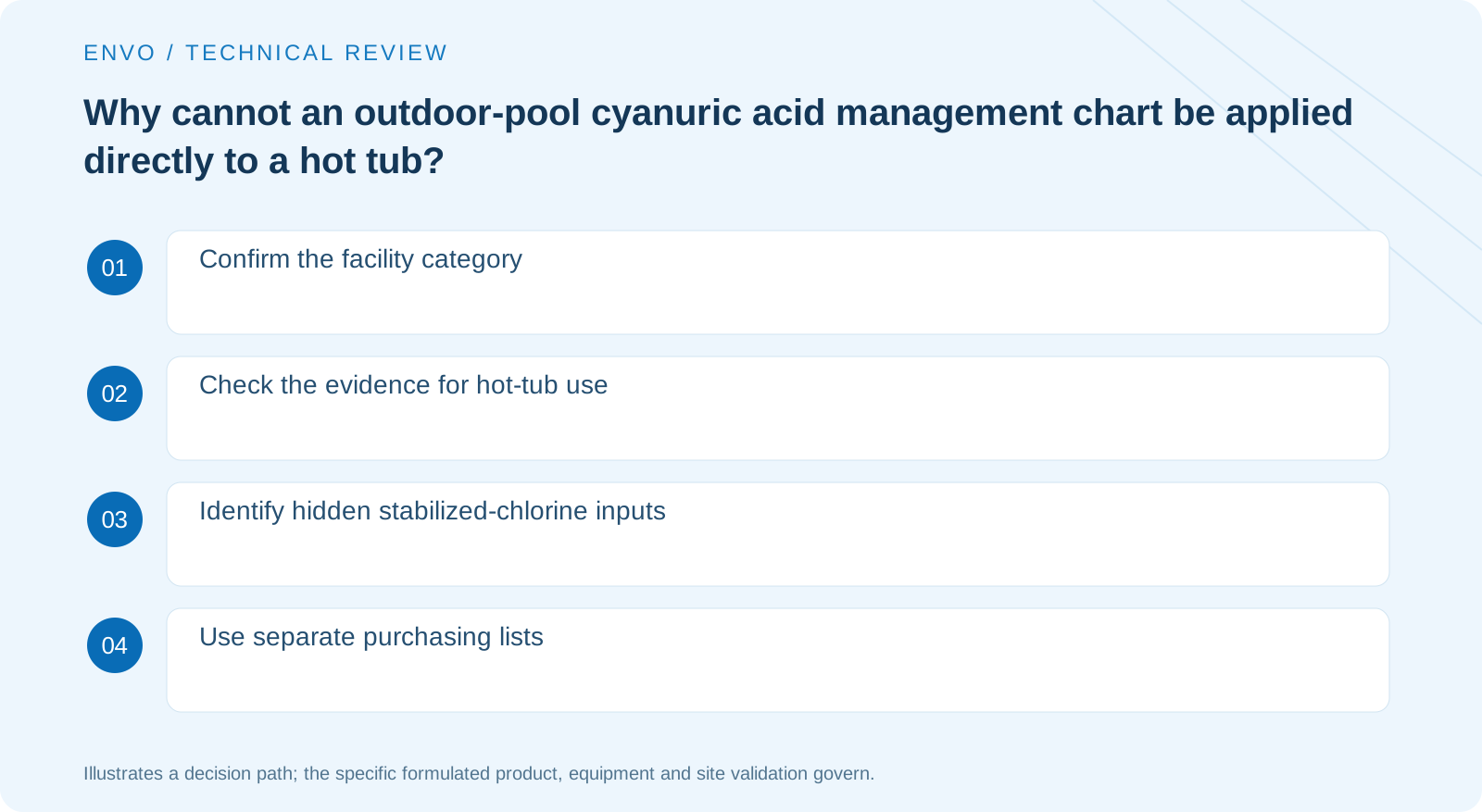
First identify the facility type accurately
Confirm whether the facility is a conventional pool, a warm-water training pool, a spa or a hot tub; do not combine them merely because all circulate water. Facility type determines which management guidance to consult and whether the selected product has a corresponding label.
Read recommendations specifically for hot tubs
CDC recommends not using cyanuric acid or chlorine products containing cyanuric acid in hot tubs. Conventional outdoor-pool experience should not override this during purchasing. Actual facilities must also consider local rules and formulated-product labels; the main ingredient content alone does not determine suitability.
Investigate hidden stabilizer sources
Check tablets, granules and combination products for trichlor, dichlor or a separate stabilizer. The product name may not include the Chinese term for cyanuric acid, so examine ingredients rather than packaging color. Candidates unsuitable for the facility can be explicitly excluded in the purchasing system.
Rebuild the facility-specific list
Maintain separate product, testing and operating records for hot tubs so staff do not reuse conventional swimming-pool forms. This does not provide an alternative disinfection procedure; it emphasizes choosing the correct basis for applicability first. If an existing system already uses the products concerned, facility managers and specialists should assess adjustments rather than independently trying to counteract them with other chemicals.
Different facilities require more than copying the original pool’s shopping list
List the actual water environments at the new facility, such as conventional swimming pools, hot tubs or other facilities, and specify indoor or outdoor conditions, circulation arrangements, users and management requirements. The original facility’s product list is only a historical record and does not automatically establish suitability for the new facility. In particular, widespread market use of products containing stabilizers does not mean they suit every type of facility.
Check each formulated-product label against facility requirements and mark which conditions are explicitly covered, excluded or still unknown. If a product introduces a stabilizer that the current use does not require, compare suitable approaches again rather than continuing to use it because stock remains in the old warehouse. This article does not prescribe a universal replacement chemical or dose based on the facility name.
Create a separate handover version for the new facility’s approved products, analytes and documents so operators do not copy old forms. Record who confirmed the water environment and operations, reviewing again when hot tubs or circulation modifications are added. Procurement use distinctions reveal mismatches earlier than chlorine-content comparison alone.
Explore further
Can the same cyanuric acid program be used at similar temperatures?
Accurate facility classification and corresponding requirements are also needed; temperature alone is insufficient.
Can a commercial name rule out stabilized chlorine?
Check the ingredients rather than relying only on the marketing name.
References
This article draws on publicly available technical information. Third-party sources do not establish ENVO product approvals, field testing or project experience. Confirm each use against actual supply documents and site conditions.