

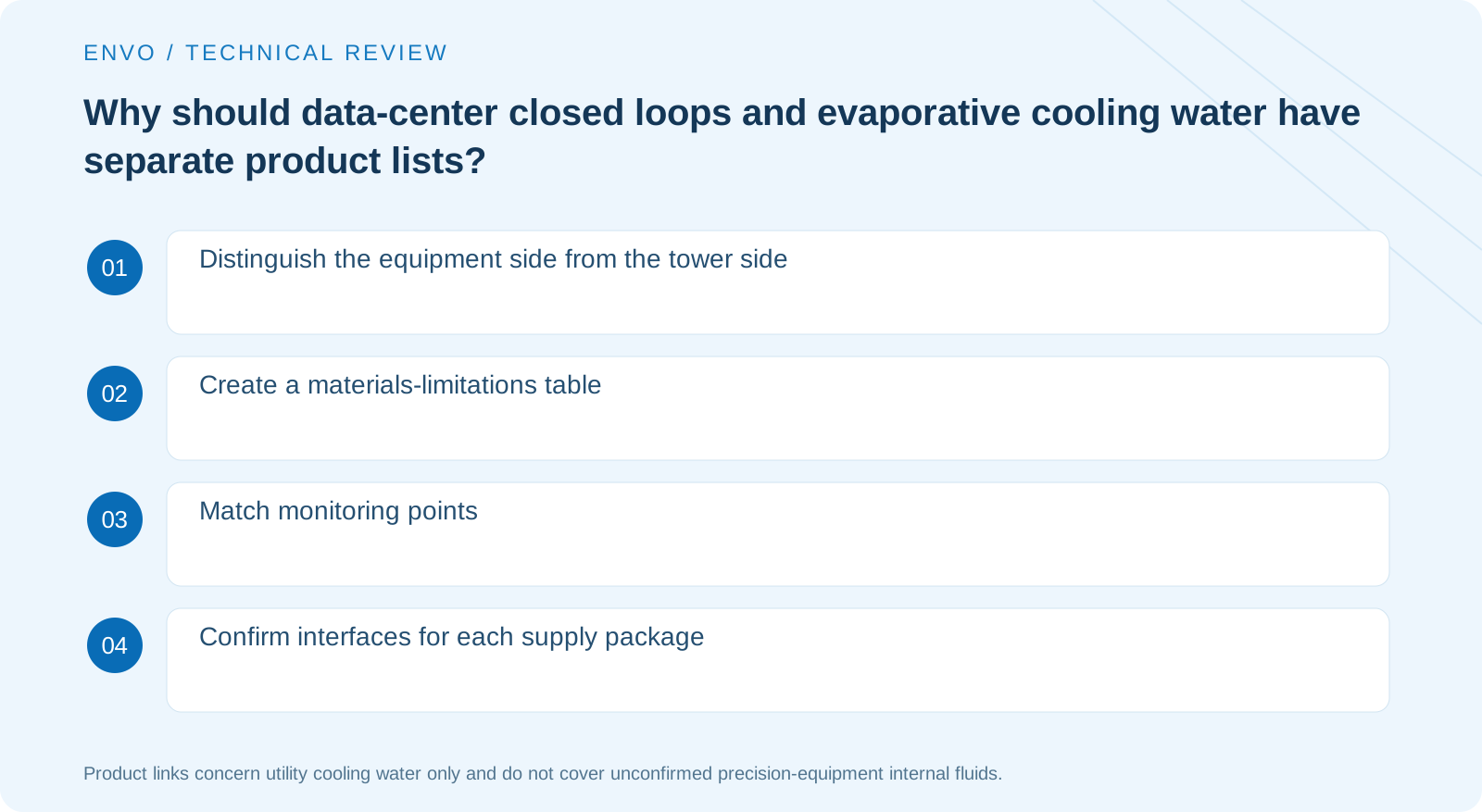
Map boundaries along the medium’s actual flow path
Map equipment-side liquid circuits, both exchanger sides, tower sprays or basins, makeup and blowdown. The name closed-circuit cooling tower does not mean no water contacts air. CDC descriptions of open and closed towers note that closed equipment may still contain an external evaporative circuit. Classify actual flows, not names alone.
System names should include building, equipment identifier and fluid purpose, such as a machine-room secondary circuit and roof-level external heat-rejection circuit. A work order saying only cooling-water chemical change conceals the distinction. Shared identifiers across purchasing, storage and operating diagrams reduce misdelivery of similar packages and support material-scope checks.
Collect material and equipment limitations separately
Servers, cold plates, pumps, seals and external towers may come from different manufacturers, with model-specific permitted fluids and maintenance. Create a component/circuit/permitted-treatment table naming the source of written evidence. Low-corrosion marketing does not qualify ordinary tower-water chemicals for precision circuits, and internal clean-fluid rules do not replace external-water management.
Ensure monitoring points belong to the correct system
Mark flow, temperature, relevant quality and sampling points for each circuit and identify which side generated an alarm. Heat-transfer changes have multiple possible causes and do not directly establish microbial problems. Equipment teams should locate the affected circuit before using relevant testing or maintenance records. Suspected exchanger relationships need engineering diagnosis, not an assumption of mixing between sides.
Distinguish planned maintenance from continuous operating needs
Define stoppable sections, redundancy, maintenance windows and restart checks. Continuous-business facilities need plans explaining transitions and faults, not just standard dosing tables. Changes to internal-loop fluids require equipment compatibility and operations change procedures rather than ordinary purchasing decisions.
Divide quotation requests into comparable packages
Utility evaporative circuits can have separate packages for microbial control, corrosion/scale control and monitoring; precision closed circuits require equipment-specific review. State interfaces, documents and service responsibilities for each package. Customers can coordinate procurement without merging different materials incorrectly. Retain unconfirmed specialized-fluid conditions for review rather than fill them with general industrial experience.
Explore further
Does a closed-circuit cooling tower eliminate spray-water risks?
The name alone is insufficient. Distinguish internal closed-circuit fluid from the external evaporative-water circuit.
Can communication be coordinated through one supplier?
Coordination is possible, but products, equipment constraints and acceptance evidence for each circuit should remain separate.
References
This article draws on publicly available technical information. Third-party sources do not establish ENVO product approvals, field testing or project experience. Confirm each use against actual supply documents and site conditions.