

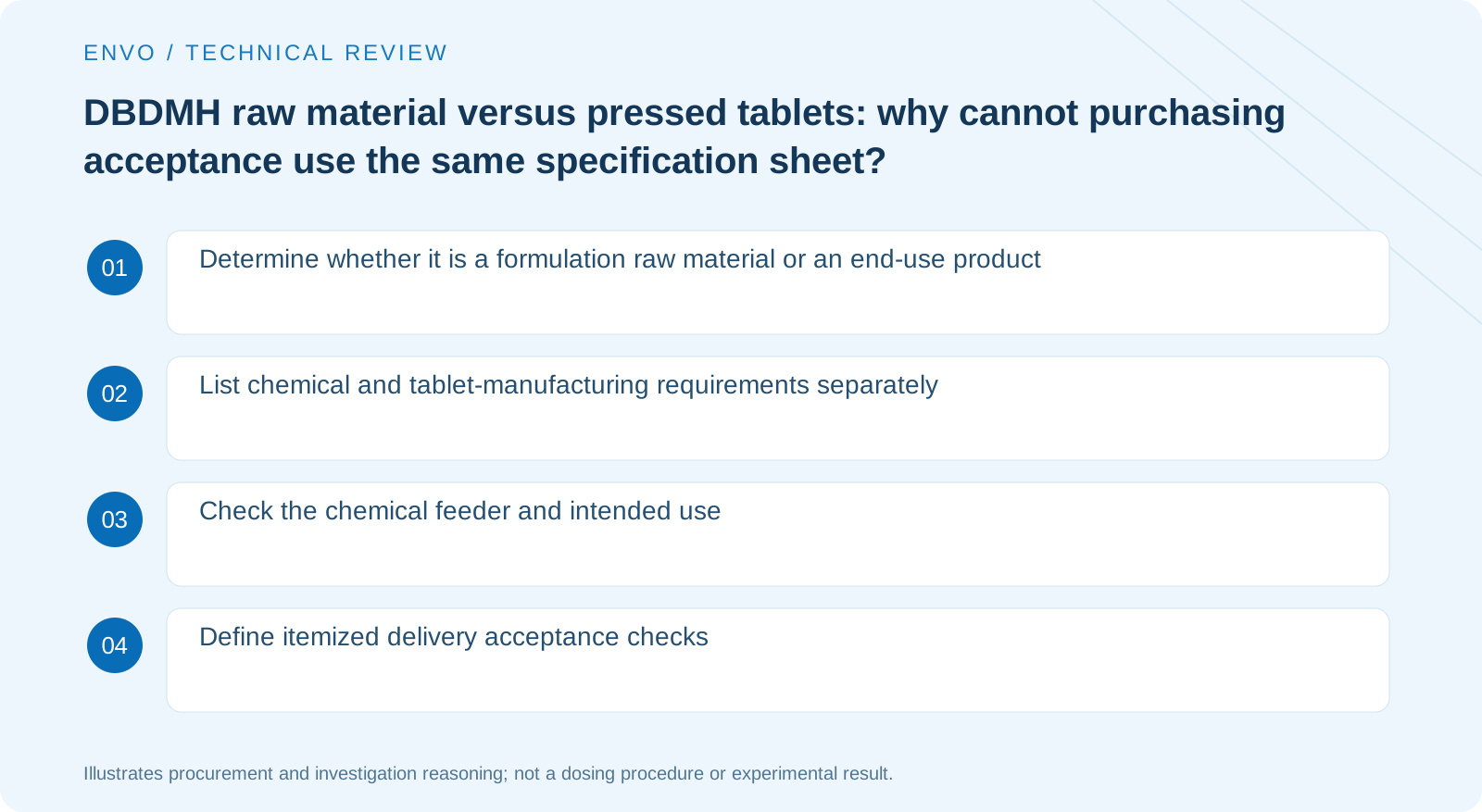
First identify the intended recipient and user
Raw-material buyers may need further formulation or processing, whereas end users require products meeting equipment and operating requirements. State this distinction before requesting quotations to avoid a raw-material offer when the user expects equipment-ready tablets. Public DBDMH information provides chemical identity background but cannot automatically establish tableted-product dimensions, composition or use. Raw-material reports support raw-material acceptance; they do not replace complete delivery documentation for the processed product.
List tablet-manufacturing requirements separately
When purchasing formulated tablets, check tablet weight, shape, dimensions and integrity requirements against equipment limits, using actual product and equipment documentation to define specifications. Explain other tableting ingredients and formulation identity according to real documentation; do not place raw-material purity directly on a formulated-product label. Retain corresponding model and batch information when comparing samples with commercial batches. Two white tablets should not be assumed to perform equivalently in the same feeder.
Retain differences in dosage form and composition
Raw-material granules, pressed tablets and formulated blends cannot be fully described by one chemical name. Formulated products may contain other ingredients affecting processing and use; check labels, uses and specific specifications. A quotation for DBDMH raw material and one for a DBDMH-containing formulation concern different deliverables. Comparing only price per tonne or one active-content value hides differences in equipment and site management.
Do not substitute a higher numerical value for suitability
A higher analytical result does not automatically establish more stable dosing, better site performance or lower total cost. Assess permitted uses, dosage form, equipment conditions, batch consistency and required documentation separately. Customers already using another halogenated hydantoin may also need to review test methods and control bases. Existing instrument settings should not become acceptance criteria for the new product before confirmation.
Attach an itemized raw-material and formulated-product list to the inquiry
Separate requirements into chemical specifications, physical tableting requirements, equipment confirmation and finished-product use, identifying evidence and outstanding checks for each. Raw-material buyers should not be asked for nonexistent feeder conditions, and end users should not receive only a raw-material purity table. Ask suppliers to respond for the actual item supplied and retain original documents and versions. This supports joint decisions by procurement, quality and site personnel and avoids discovering after receipt that acceptable chemical specifications do not fit the equipment.
The procurement table can retain one column for the original parameter name and another stating whether comparability has been confirmed. Do not calculate price rankings while numerical differences remain unexplained, as this creates apparently precise conclusions from inconsistent bases. Update the table when suppliers provide methods and retain the change history instead of overwriting original reports and losing traceability.
Explore further
Can a raw-material COA serve directly as the COA for the finished tablets?
No. Confirm the actual processed formulation and agreed parameters.
Does the same tablet diameter mean two formulated products are equivalent?
No. Composition, other physical requirements, equipment and use still require confirmation.
References
This article draws on publicly available technical information. Third-party sources do not establish ENVO product approvals, field testing or project experience. Confirm each use against actual supply documents and site conditions.