

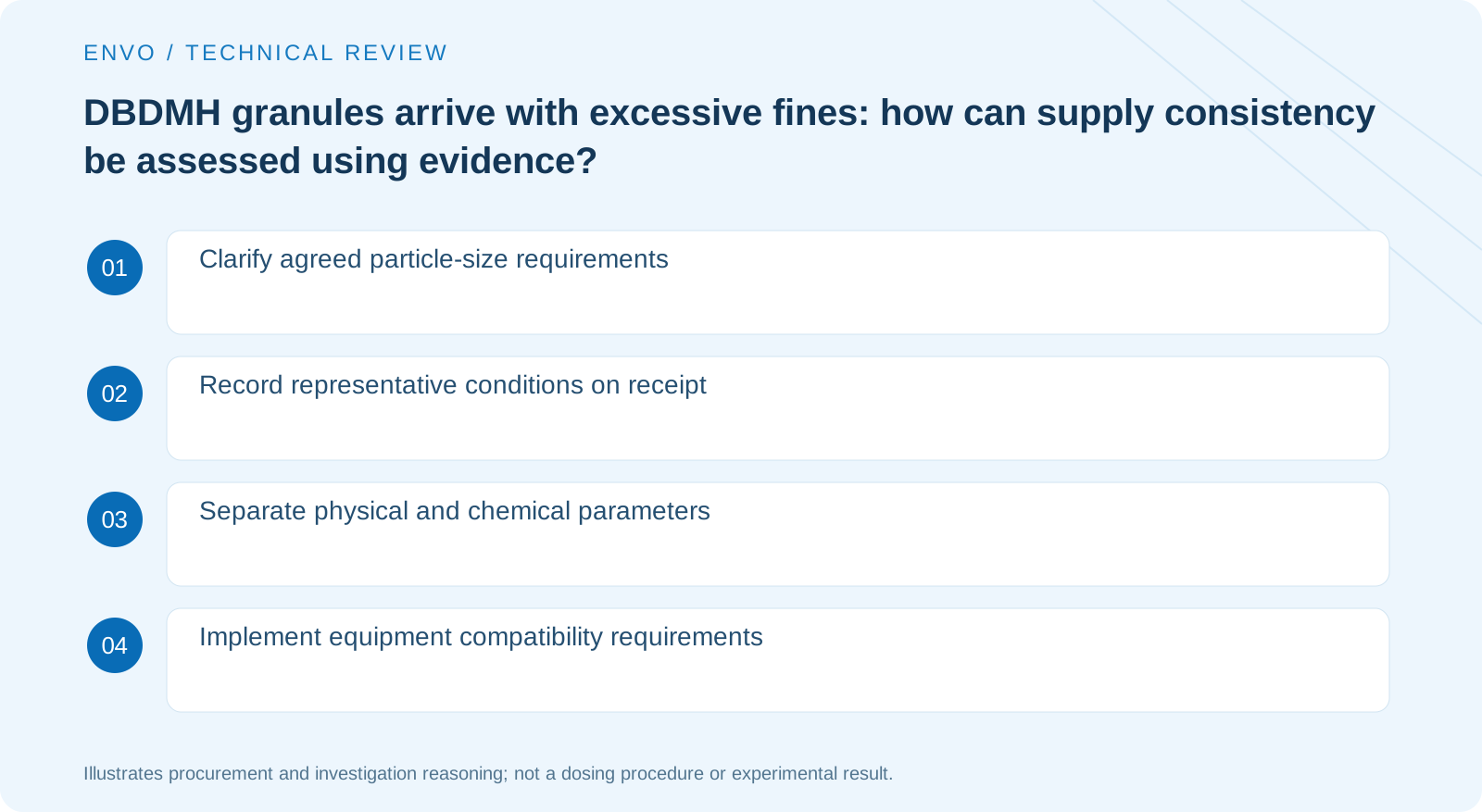
Clarify whether the order specifies particle size
If an order specifies only dibromodimethylhydantoin granules without a particle-size method or permitted range, the site’s meaning of ‘too fine’ may differ from the supplier’s. Review signed specifications and sample-approval records rather than introducing another supplier’s product photograph as a retrospective acceptance criterion. Reference appearance in public application documents is not every supplier’s commercial particle-size specification, and website images cannot replace mutually agreed measurable delivery requirements.
Record facts about packaging and transport
Retain seal, batch, packaging-integrity and arrival-condition records; one observation at an opened bag does not characterize a whole batch. Trained personnel should sample under approved methods for representativeness and safety, rather than follow webpage instructions for improvised screening or repacking of halogen solids. Handle dampness, torn packaging and other anomalies under site procedures and contact the supplier instead of guessing causes from photographs or continuing use independently.
Separate physical distribution from chemical parameters
Record particle size, appearance and active components separately so one anomaly does not merge every conclusion. Chemically conforming material may still have a physical distribution unsuitable for a specific feeder; uniformly appearing granules do not establish identity or active-content conformity. Assess each item under agreed methods rather than replacing actual tests with one subjective overall score.
Validate the actual stage affected by the equipment
Ask equipment or site personnel which stage fines affect: loading, steady transfer, maintenance frequency or another observable issue, with supporting records. More fines do not establish a fixed change in dissolution or release rate. Manufacturer compatibility requirements are more reliable than generic experience for solid feeders. Recheck suitability when particle size or dosage form changes rather than automatically retaining old procedures.
Turn one discrepancy into future delivery requirements
After investigation, orders should specify applicable physical characteristics, sampling and acceptance methods, protective packaging and anomaly-reporting procedures. If the cause remains unknown, retain the uncertainty rather than inventing a transport-vibration or aging explanation. Equipment requirements, current-product documents and specific site problems in an inquiry support targeted supply advice instead of another quotation containing only chemical content.
If an approved pre-use sample differs markedly from commercial batches, verify its origin and whether it represents production deliveries rather than assuming it is always equivalent to every subsequent product. Contracts may require physical specifications to remain consistent with the approved documentation, with abnormalities rechecked by both parties using agreed methods. Photo comparisons provide clues, not a substitute for measurements.
Explore further
Does a higher proportion of fines necessarily indicate a counterfeit product?
This cannot be judged that way; verify identity, physical specifications and transport packaging separately.
Can a picture serve as a particle-size acceptance standard?
This is generally insufficient for quantitative acceptance; clear methods and specifications are required.
References
This article draws on publicly available technical information. Third-party sources do not establish ENVO product approvals, field testing or project experience. Confirm each use against actual supply documents and site conditions.