

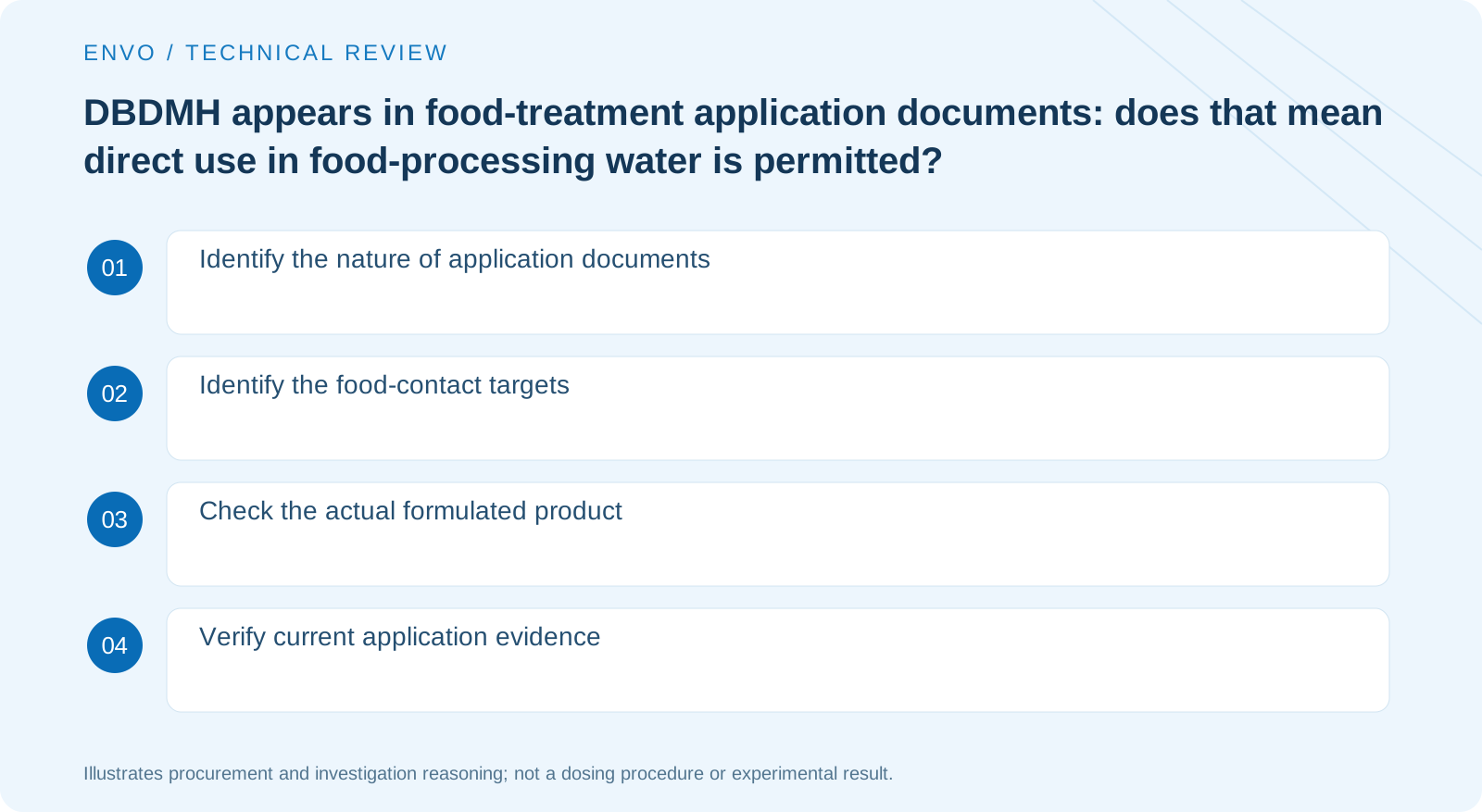
First identify the stage from which the documentation originates
The DBDMH application documents retained on the USDA website are specific application materials. They help identify the applicant’s subject and proposed uses but do not prove approval for every food-water application. Read document title, applicant, date and requested action first. Hosting on an official domain does not mean official endorsement of every statement. Preserving the document’s nature when citing it is more accurate than emphasizing an authority’s logo alone.
Divide food-processing water into specific uses and contact targets
Raw-material washing, direct food contact, equipment cleaning, non-contact cooling and site water treatment have different boundaries. Food-factory use alone does not identify required documents. Specify contact target, location, subsequent processing and destination market, then obtain labels or applicable documents covering that target. Evidence for one limited location cannot extend to an entire production line or every food category.
Verify whether the chemical and the commercial product are the same
DBDMH’s chemical identity does not establish other ingredients, manufacturing controls or supply specifications of an actual formulation. If substances or products in an application differ from the current model, review them again rather than copying their descriptions onto a product page. Images, white granules or identical abbreviations do not prove equivalence. Technical information, packaging labels and necessary tests should identify one traceable product.
Review efficacy separately from permitted use
Even a trial showing microbial change cannot independently establish suitability for a particular food-contact environment. Conversely, use documentation does not remove the need to validate site-process compatibility. The team should separately review permitted scope, performance under actual conditions, relevant residual or subsequent requirements and equipment materials. Clearly record missing data rather than filling gaps with unsupported ‘broad-spectrum’ or ‘residue-free’ claims.
Advance purchasing with a complete question package
Submit the use, destination country, process location, proposed model and sources already identified, asking the supplier what each document supports. If only application documents are available, seek current corresponding product information and formal decisions before determining purchase volumes. The final webpage may explain DBDMH’s technical background and review process but cannot make unconditional food-use suitability claims without sufficient evidence.
File multiple food-related documents by raw material, formulated product, equipment or specific processing use and check for complete correspondence. Discussion of an ingredient does not establish full review of the ordered product. Explicitly identify missing current decisions or labels; an official domain cannot replace verification.
Explore further
Is an application posted on an official website an approval document?
No. Establish the formal decision and currently applicable documentation.
Can cooling-water use in a food factory establish suitability for food contact?
No. The contact targets and points of use differ.
References
This article draws on publicly available technical information. Third-party sources do not establish ENVO product approvals, field testing or project experience. Confirm each use against actual supply documents and site conditions.