

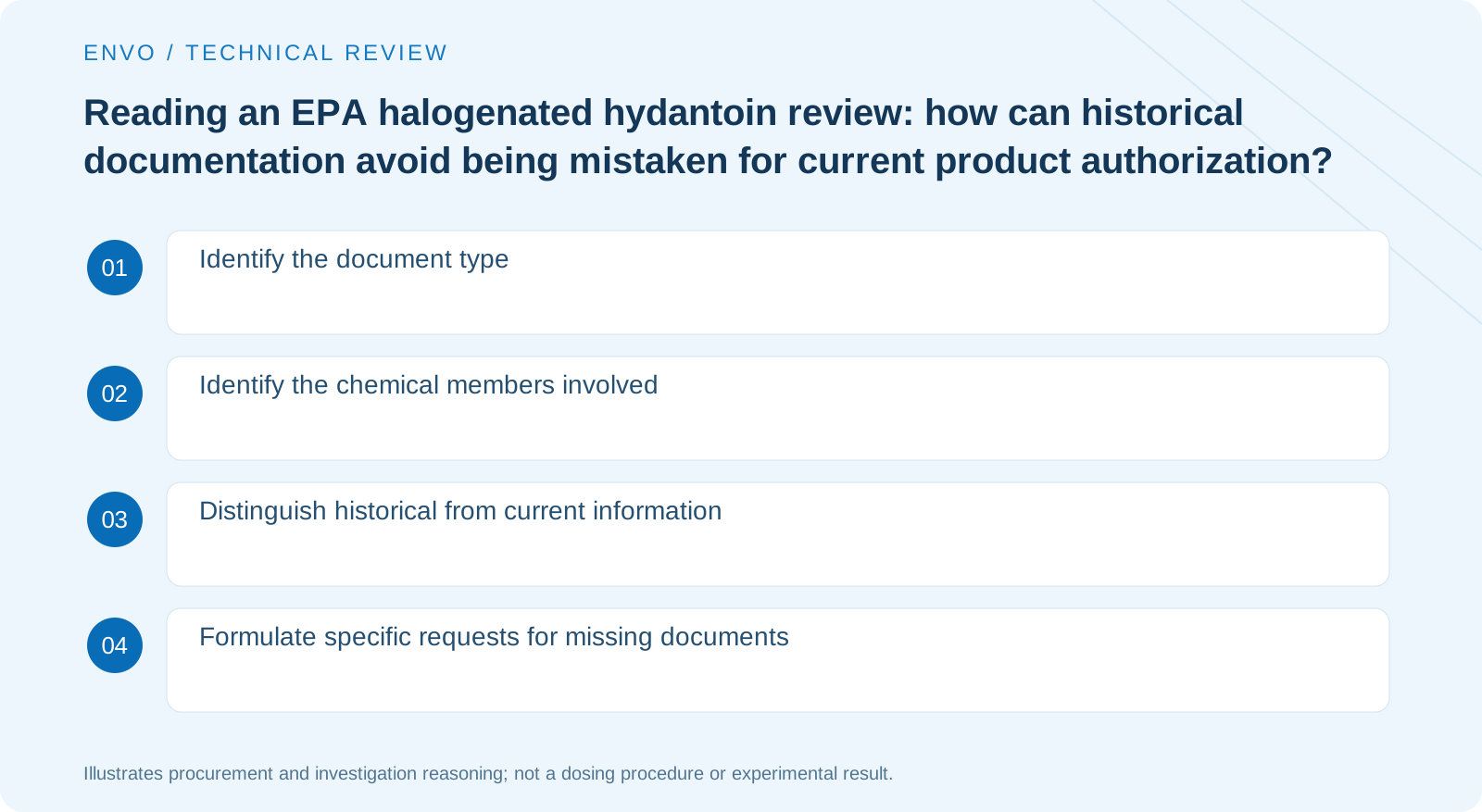
First identify the question the document should answer
Technical reviews, registration-review plans, label approval letters and specific product labels serve different purposes. When reading EPA halogenated-hydantoin information, first check title, year, chemical members and review purpose. A passage describing use background is not a sales authorization. For long documents, retaining exact pages and sections helps procurement verify citations far more than a link to an organization’s homepage alone.
Check whether the conclusion applies to a family or an individual product
Family-level documents may discuss DCDMH, BCDMH, DBDMH and related combinations; not every statement applies to every member. Check context for descriptions of physical form, uses and environmental fate. Procurement teams should especially confirm that substance names match the actual order. The word ‘hydantoin’ in a report does not bring every tablet or blended product within the same conclusion.
Separate historical background from current status
Historical information describes understanding or review scope at that time but does not establish that registrations, labels or uses remain unchanged. Actual procurement requires current product information for the target market, confirming holder, model and applicable conditions. Articles citing historical sources should preserve the year and document nature; historical discussion is not a current worldwide regulatory requirement or commercial supply fact.
Prevent evidence from being distorted through retelling
A common error occurs when a promotional page cites a technical report and procurement retains only a screenshot of the promotional page, losing the original subject and limitations. Keep the original link, exact cited location and current review question together in the information package. Preserve applicant statements as such and do not rewrite review recommendations as approvals. Accurate citation reduces misjudgment; it is not decorative endorsement.
Define practical follow-up verification
After reading, list confirmed identity information, unconfirmed current uses and additional product documents needed. Tell suppliers exactly what a historical source establishes and which current product still lacks evidence. The project lead can then continue assessment or change direction. Website articles are not legal compliance opinions, but older publication dates do not invalidate all useful basic chemical information.
Readers should also check whether documents contain applicant-submitted data and the agency’s review findings; each must retain its distinct status. Quoting a passage without surrounding qualifications can turn a genuine source into an incorrect conclusion. Internal citation records should retain the page and original question to support future updates and rechecking.
Explore further
Can historical review documents still be cited?
It may support the technical background it addresses, with its year and scope clearly identified.
Do product-family documents cover all similar formulated products?
That interpretation is not valid. The specific compound, formulation and use still need to correspond.
References
This article draws on publicly available technical information. Third-party sources do not establish ENVO product approvals, field testing or project experience. Confirm each use against actual supply documents and site conditions.