

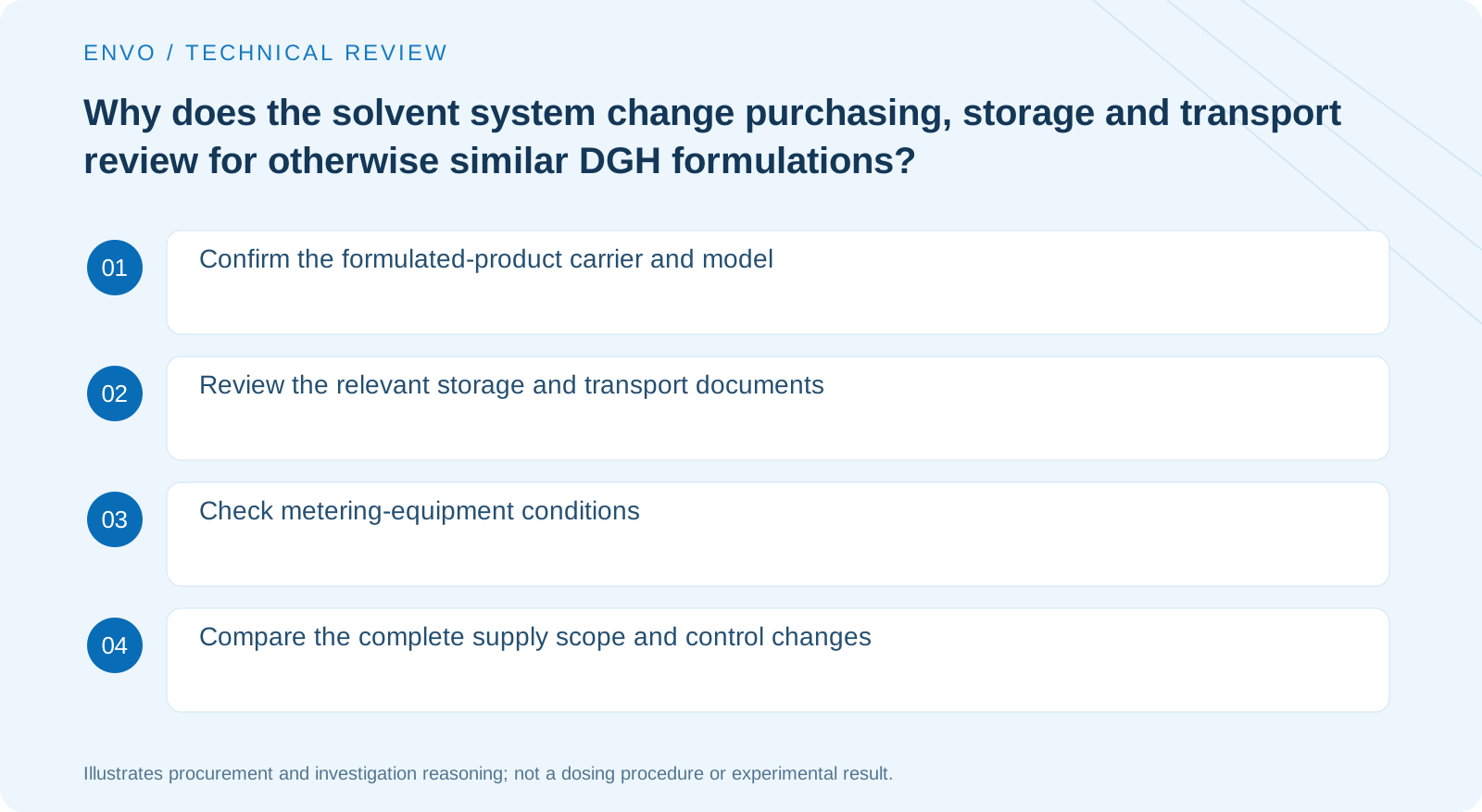
Identify the actual carrier and formulated-product model
LANXESS’s DGH pages list commercial products with different carriers and combinations and differing technical information. These examples support independent formulation-level review, but specific values belong only to the named products and cannot become ENVO default specifications. Request the actual supplied model, complete SDS and technical description; information on the pure active alone is not a complete finished-product dossier.
Check the actual storage and transport documents
Responsible personnel should determine storage, packaging, transport and site-management requirements from the formulated-product SDS and transport documentation. ‘Aqueous solution’ does not remove the need for review. Different carriers may produce different relevant physical properties; classification must follow valid documentation and requirements. Buyers should not alter flash points or shipping names or substitute another formulation’s documents, which would create a mismatch between logistics and site acceptance.
Include physical properties in the metering-system assessment
Whether density, temperature behavior and material compatibility are critical depends on equipment and operating conditions. Provide pump, connection and storage details and request the current product’s compatibility scope. One formulation working in similar equipment does not exempt another carrier system from review. Conversely, a different carrier does not automatically prevent substitution; design proportionate validation around actual differences.
Assess price differences within the complete supply scope
Comparing only price per tonne or per unit of active ingredient may omit packaging, logistics, storage and site-management differences. Quotations should include packaging, delivery terms, required documents and confirmed limitations. The aim is not to predict that one solvent is necessarily cheaper, but to compare equivalent scopes. If the project lacks conditions required by a formulation, low price cannot resolve that suitability gap.
Manage formulation versions and subsequent changes
Link reviewed carrier information to the model version and ensure relevant changes trigger reassessment. If a similarly named product later changes composition or packaging, site checks should extend beyond whether the active remains the same. Retain actual product identity and conditions in procurement documents to support quality control and reduce unexpected discrepancies for transport or equipment teams. Confidential details can be verified through controlled documents without publishing the complete commercial formulation online.
Logistics and site teams should receive the same product-document version rather than order one formulation while shipping documents describe another carrier. Qualified responsible parties must confirm classification or property changes; the website does not invent transport conclusions. Explicit gaps are more reliable than complete-looking unsupported data.
Explore further
Can products with the same active content share one formulated-product SDS?
No. The actual formulation must correspond to the subject of the documentation.
Do different carriers always rule out substitution?
Not necessarily. Check specific physical properties, conditions and necessary validation.
References
This article draws on publicly available technical information. Third-party sources do not establish ENVO product approvals, field testing or project experience. Confirm each use against actual supply documents and site conditions.