

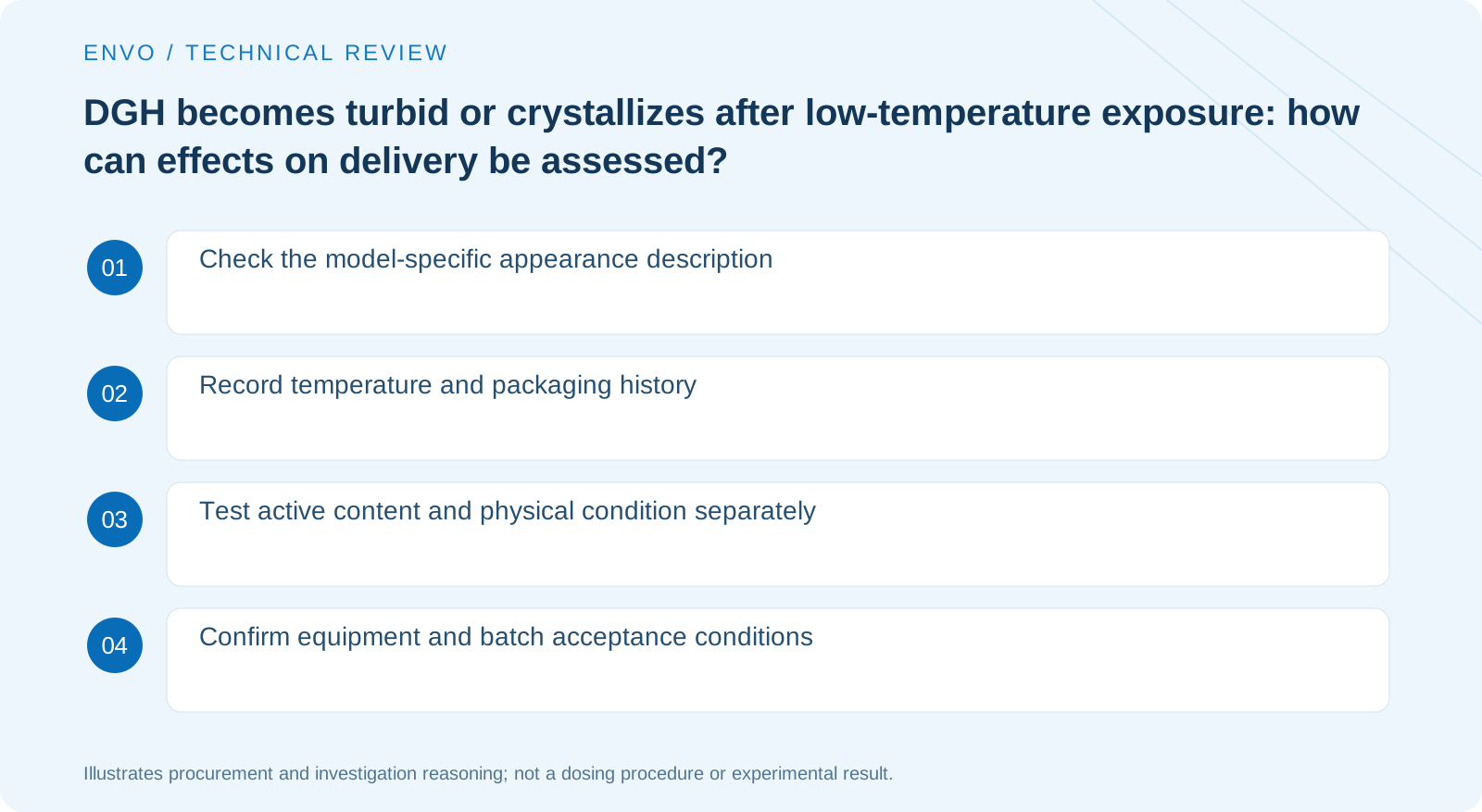
First check the appearance description for the specific formulation
LANXESS describes flocculation, turbidity and low-temperature phenomena for specified formulated DGH products and provides product-specific explanations. This illustrates why appearance must be interpreted by formulation; it does not establish that any precipitate in every DGH product is normal. Obtain current model documentation and check whether it defines possible conditions, circumstances and handling responsibilities. Without documentation, accurately record the condition as an anomaly awaiting verification.
Record temperature history and packaging condition
At receipt, retain batch, transport and storage information and record observation temperature and packaging integrity rather than sending only a close-up of sediment. If historical conditions are unknown, do not invent a low-temperature explanation. Qualified personnel can arrange further checks under product documentation; the webpage provides no heating, stirring or transfer instructions. Never apply another product’s recovery conditions to an unknown formulation.
List appearance and active-content tests separately
A product may change appearance under certain conditions while its active content still meets specification, but this requires product-specific evidence and testing; it cannot be inferred from the category name. Confirm representative sampling and method suitability rather than testing only the supernatant and reporting the result as the whole package’s composition. Alongside active content, check equipment and process requirements: acceptable chemical results do not make every physical condition suitable for transfer.
Focus on process-liquid clarity and metering-equipment requirements
If a customer’s process requires clarity or equipment requires uniform material, an appearance change may require further compatibility review even when an active-content parameter remains acceptable. State these practical requirements in purchasing documents rather than using a generic clear-liquid template. For products permitting certain physical states, suppliers should explain their relevance to actual use so technical and procurement teams share the same understanding of conformity.
Ensure conclusions correspond to the actual batch
After investigation, record supporting documents, tests and site confirmations, specifying whether the batch meets agreed requirements and subsequent actions. One explanation cannot extend permanently to every batch, and absolute website claims such as ‘never crystallizes’ should be avoided. Inquiries identifying the actual product and abnormal conditions keep technical discussion grounded and reduce returns or misuse caused by appearance-based judgments.
Delivery acceptance records can include both the observation temperature and material condition, providing context for comparing photographs from different seasons. A photograph labeled only ‘cloudy,’ without the conditions, makes it difficult for later reviewers to assess whether the supplier’s explanation applies. Quality conclusions must still rely on the actual formulation and testing; restored appearance alone does not establish conformity of every specification.
Explore further
Does cloudiness in DGH necessarily mean loss of efficacy?
Appearance alone is insufficient; consult the corresponding formulation information and verify it.
Can another brand’s heating method be used to restore the product?
No. Follow the actual product requirements and approved site procedures.
References
This article draws on publicly available technical information. Third-party sources do not establish ENVO product approvals, field testing or project experience. Confirm each use against actual supply documents and site conditions.