

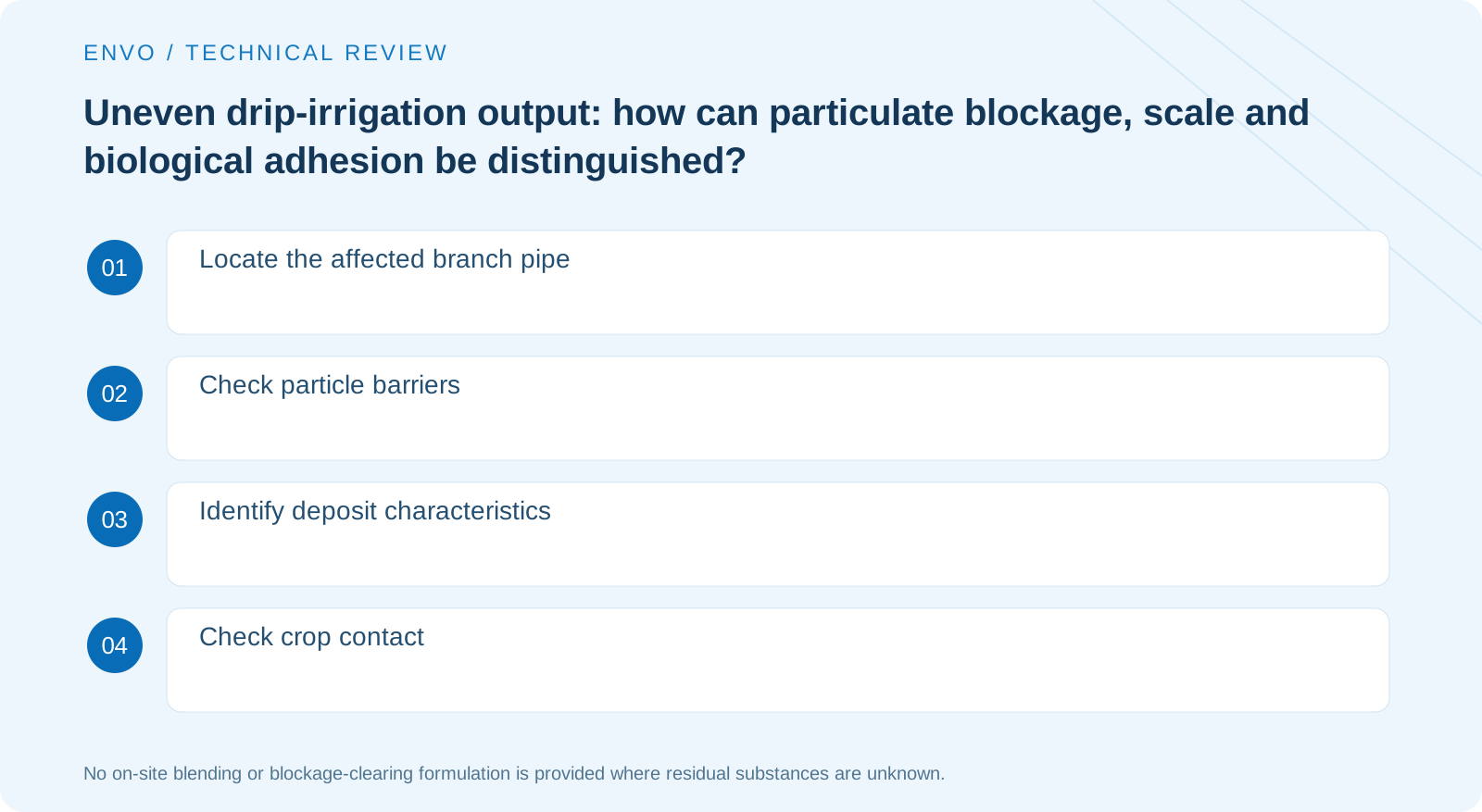
Record outlet-water differences by location
Map performance at initial and final outlets, branches and crop areas against pressure, operating periods and maintenance. Use suitable existing checks to confirm repeatability rather than infer whole-site condition from one emitter. Hydraulic and blockage issues may coexist and require joint equipment and irrigation assessment.
Map blockage-related discharge changes at the beginning, middle and end of lines, noting terrain, pressure and recent maintenance. An isolated branch problem warrants review of its filtration and hydraulics; simultaneous changes across zones warrant comparison of shared sources. Removed deposit appearance can assist discussion but cannot replace compositional or biological assessment, and photographs alone should not determine cleaning chemicals.
Check filtration and incoming particles
University extension irrigation guidance identifies suspended solids and prefiltration as important conditions. Check filter models, maintenance, bypasses and source changes against equipment water requirements. Persistent particle entry needs interception and maintenance, not only a different biocide. Appropriate personnel should arrange purpose-specific deposit sampling and analysis.
Separate deposit identification from treatment selection
Photographs or tactile descriptions characterize observations but cannot alone identify mineral scale or biofilm. Collect water quality, fertilizer use and maintenance history, arranging analyses where needed. Do not mix acids and oxidants under unknown residue and material conditions for diagnosis. Once the principal problem is established, separately assess physical maintenance, process changes or confirmed hygiene treatment.
Identify what or who the water contacts during treatment
Water in an irrigation system may still reach crop roots or other sensitive parts, so shutdown maintenance and normal irrigation cannot be treated as the same state. Confirm formulated-product use, equipment materials and post-treatment return-to-service conditions together. A treatment route that improves pipe condition is not thereby proven suitable for continuous use on every crop at every growth stage.
Include diagnostic information rather than a presumed answer in the inquiry
Provide source, filtration, branch diagrams, anomaly distribution and analyses, explaining actual impacts. Ask proposals to define targets and limits instead of prescribing a universal unblocker first. Assess discharge uniformity, equipment state and relevant quality as well as internal appearance before declaring resolution.
Explore further
Does emitter blockage mean biofilm is present?
No direct conclusion is possible; distinguish particles, minerals, biological factors and other causes.
Can filtration maintenance be reduced when disinfectant is used?
This cannot replace necessary filtration and equipment management.
References
This article draws on publicly available technical information. Third-party sources do not establish ENVO product approvals, field testing or project experience. Confirm each use against actual supply documents and site conditions.