

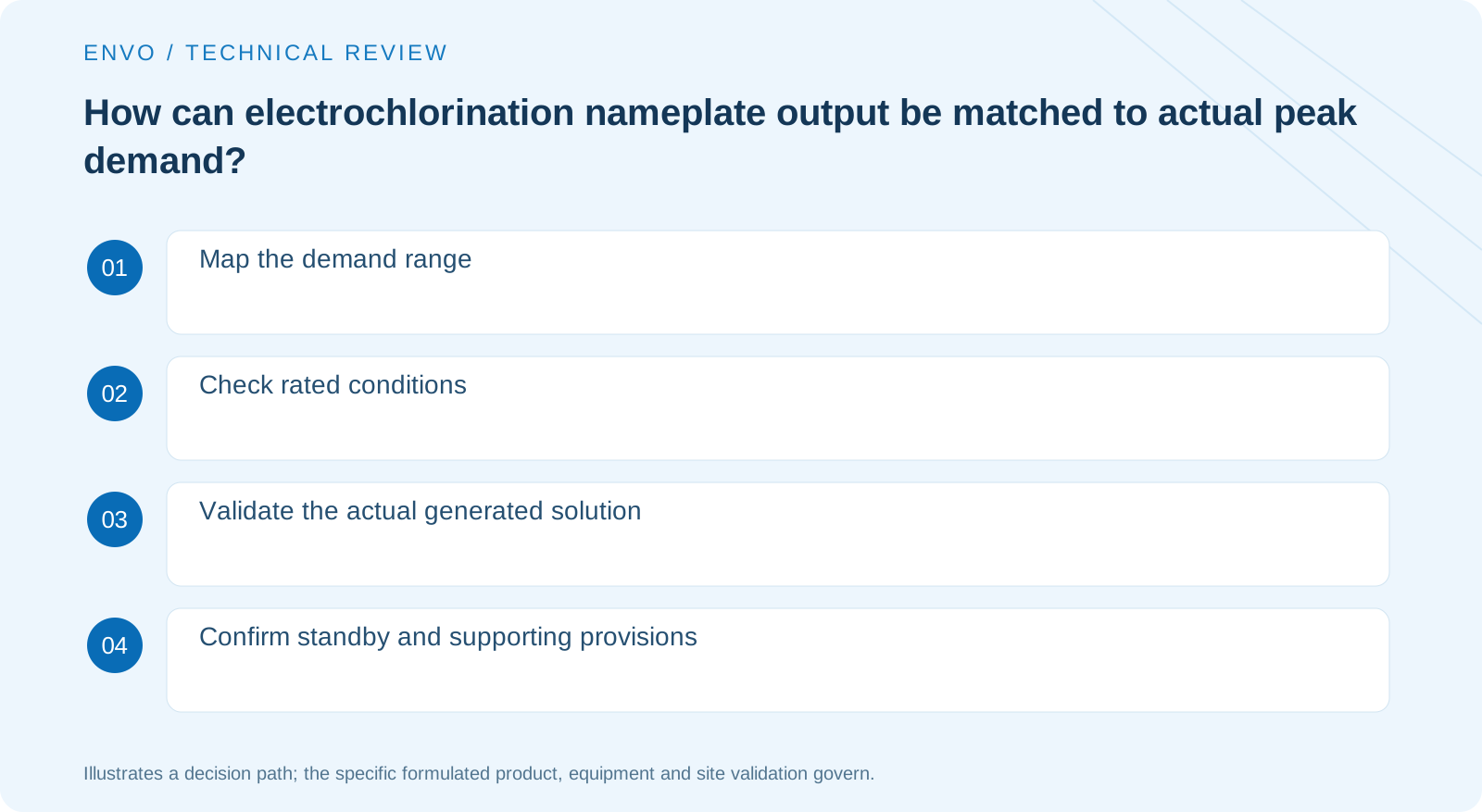
Express demand as a range of variation
Provide normal, low-load and peak flows and actual chlorine-demand context, rather than daily average throughput alone. Record continuous-operation needs, shutdown windows and supply fluctuations. Two projects with the same daily demand may need different adjustment ranges and backup configurations.
Check the test conditions behind rated values
Ask which brine or seawater conditions, equipment configuration and operating environment support the stated output. De Nora describes seawater and on-site sodium hypochlorite generation systems separately, reflecting their distinct design boundaries. Output under standard conditions for one unit cannot be transferred directly to another water source.
Assess generated-solution quality as well as output
Include actual generated-product quality, storage and downstream use in the program. Continuous liquid production does not mean effective treatment capacity continuously meets requirements, and equipment signals cannot replace every chemical analysis. Acceptance should identify analytes and sampling locations.
Define low-load and standby conditions
Engineering design should explain turndown range and treatment arrangements during maintenance and failures, with necessary monitoring and safety facilities included in delivery. This webpage does not replace design or provide hydrogen-venting procedures. Compare prices for complete operable systems to avoid artificially low quotations caused by omitted ancillary equipment.
Define all input conditions for site capability
Obtain actual salt or seawater sources, pretreatment, environment and load before matching equipment capacities to stated conditions. Unqualified ratings cannot be applied directly. Equipment providers should explain differing capacity expressions based on product concentration or test state rather than have procurement equate the numbers independently.
Group operating records into raw material inputs, equipment status, generated-solution testing and final use, linking them by time. Raw material conformity cannot replace generated-solution analysis, and satisfactory generated solution does not establish that every point of use meets its target. Especially where storage and intermittent use occur, engineers should explain how these enter capacity and quality verification.
Acceptance reports should identify covered operating ranges and untested conditions, with reassessment for demands beyond that scope. Equipment-supplier information may explain technology but does not prove that ENVO built that system. Inquiries based on complete circuits and tasks help distinguish the need for more capacity, engineering support or additional water-quality information.
Explore further
Is capacity sufficient whenever average daily demand is below the nameplate output?
Peak demand, adjustment range and actual conditions also require checking.
Can seawater equipment use brine at the same settings?
Confirm the specific equipment design; interchangeability is not automatic.
References
This article draws on publicly available technical information. Third-party sources do not establish ENVO product approvals, field testing or project experience. Confirm each use against actual supply documents and site conditions.