

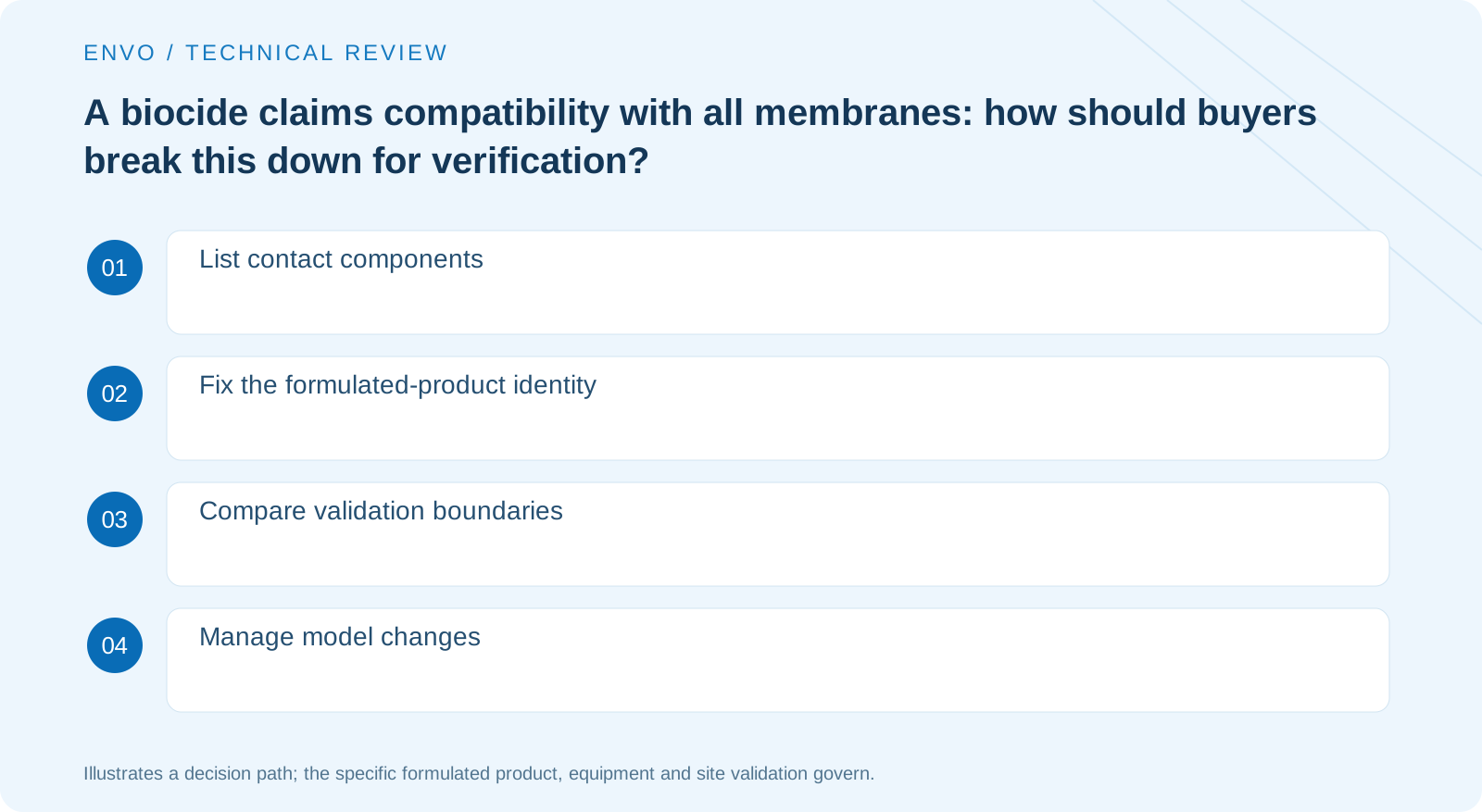
Create a complete list of contact components
In addition to membrane elements, record contact components such as O-rings, adhesives, pipes, instruments and pumps. Actual systems may contain several materials, so checking only the membrane material can miss other restrictions. Existing equipment manuals should provide exact models; ‘RO system’ cannot stand in for the entire configuration.
Fix the formulation’s identity
Require the sample, TDS, SDS and compatibility report to refer to the same formulated product. DuPont manuals give specific conditions for chemical treatments, illustrating that technical conclusions have defined applicability. Discussion of an active ingredient does not make every commercial solvent system or blend containing it automatically suitable.
Check the contact scope in the report
Check whether test temperature, pH, treatment mode and contact conditions cover actual use. Offline validation does not directly establish suitability for online dosing, and a short material test does not automatically represent repeated long-term use. When comparing reports, list matching, differing and missing conditions rather than looking only at ‘pass’ on the conclusion page.
Translate confirmed findings into change control
Store the confirmed formulated-product model and operating conditions with the equipment documentation. Reassess after changes to the formulation, membrane model or cleaning procedure to avoid indefinitely extending an old approval. If the supplier cannot provide clearly scoped evidence, retain the product as a candidate pending further evidence; marketing language cannot replace technical acceptance.
Review compatibility documentation item by item
Create a document-matching table covering actual membrane brand/model, validated sample code, contact temperature and state, related parts, criteria and observation scope. Mark full, partial and absent matches separately. If a report names only generic membrane material, ask the equipment or membrane manufacturer to confirm scope instead of inserting the current model into its conclusions.
If the formulated-product model is unchanged but the use temperature is higher, review the operating-condition limits. If the membrane model is unchanged but solvents or other formulation ingredients change, review the formulation limits. Even replacement of a contact seal requires checking component restrictions. These changes do not necessarily make the product unsuitable, but an unchanged sales name does not establish that no review is needed.
For candidates supported only by verbal assurances, first request a written applicability statement identifying its supporting documents and validation. Then decide whether sample testing is required. This lets customers focus on actual equipment instead of debating in meetings what ‘all membranes’ is supposed to include.
Explore further
Can conclusions be reused directly if the membrane material is the same?
Membrane model, construction and other contact components still need checking.
Does non-oxidizing mean it cannot damage membranes?
A product category alone cannot establish compatibility of the complete formulation.
References
This article draws on publicly available technical information. Third-party sources do not establish ENVO product approvals, field testing or project experience. Confirm each use against actual supply documents and site conditions.