

Distinguish equal dimensions from identical materials
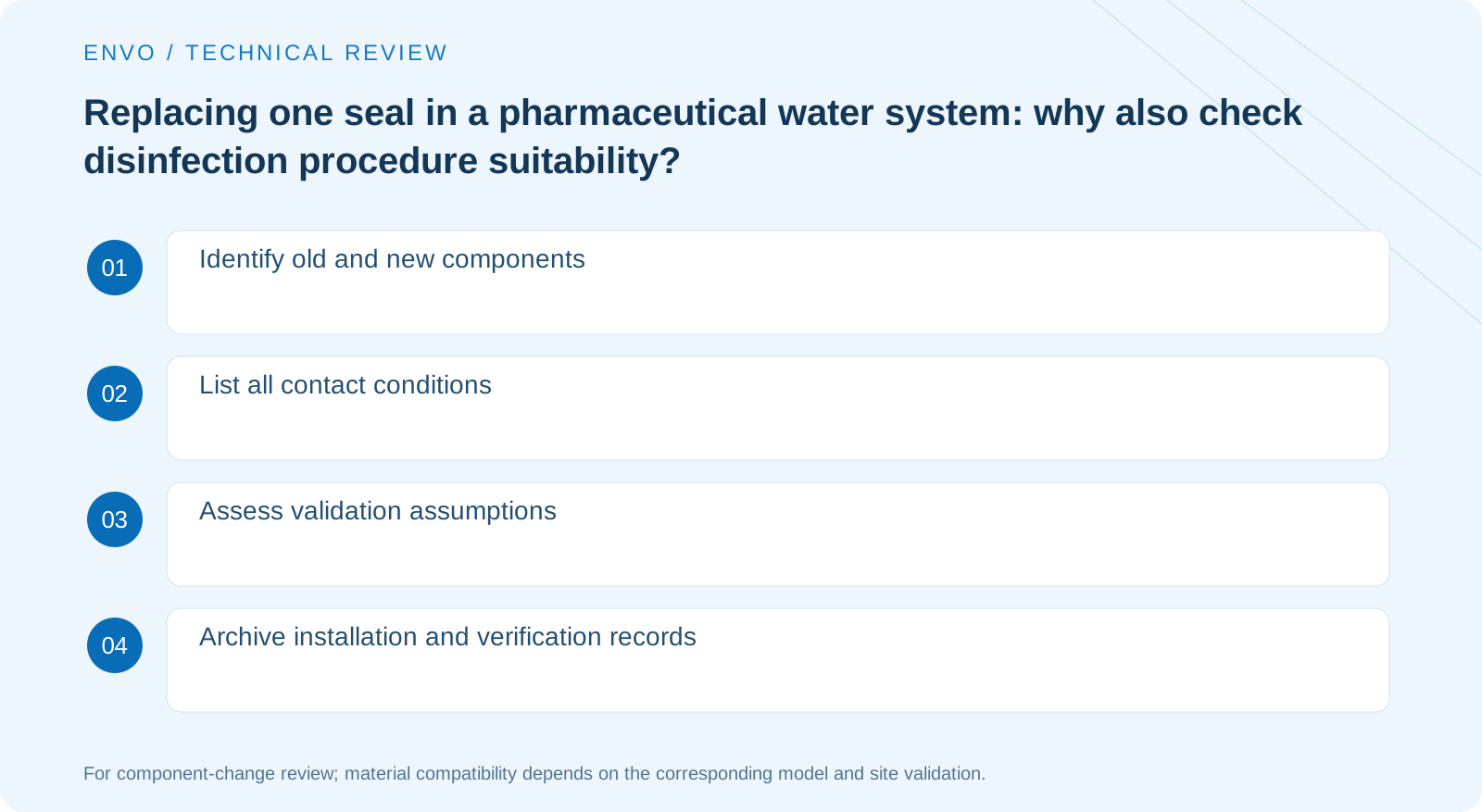
Record old and new component models, material declarations, suppliers and locations. Identical shape does not establish identical material formulation or tolerance, and ‘food grade’ alone does not establish system suitability. Retain identifying details for critical contact components in replacement lists so later traceability finds more than a generic repair expense.
Replacement lists can include old and new identifiers, contact materials and locations, noting changes to local geometry or instrument response. Physical fit does not establish identical hygiene or process performance. Obtain explanations of upgraded-model differences so change review has concrete evidence rather than a verbal claim of equivalence.
Check the complete procedure actually undergone
Components may experience operating water, cleaning, chemical treatment, thermal cycling and shutdown storage. List approved procedure limits and request matching evidence from equipment or material providers. Ambient-temperature immersion data cannot establish every condition, and a material name does not imply unlimited repeated tolerance. Specific suitability requires professional documentation and system confirmation.
Determine whether a change affects the assumptions of the original validation
WHO pharmaceutical-water guidance emphasizes relationships among equipment, operation and control. Where validation depends on a structure, material or maintenance approach, replacements must identify changed conditions. Quality teams determine assessment and validation scope. Suppliers can provide material or compatibility documents but cannot independently declare validation unnecessary. Assign responsibility for unresolved items before installation.
Retain comparable observations after maintenance
Under approved procedures, record equipment and quality at restart, checking resolution of the original problem and any new changes. Choose observations relevant to change impacts rather than add meaningless tests to fill a dossier. Verification, approvals and installed parts must correspond, avoiding documents for one model while another is installed.
Turn purchasing documents into future maintenance references
Specify the required models, materials and documentation in purchasing requirements, and require reconfirmation for substitutions. De-identified contact conditions and installation locations can be provided to the supplier to protect unnecessary commercial details. This prevents suitability from having to be guessed again at the next maintenance event and helps avoid arbitrary substitutions during urgent shortages that undermine the basis of existing hygiene controls.
Explore further
Can components of the same size be substituted directly?
Also check materials, contact conditions and system change procedures.
Can compatibility certification replace system confirmation?
It cannot replace it completely; it is one input to change review.
References
This article draws on publicly available technical information. Third-party sources do not establish ENVO product approvals, field testing or project experience. Confirm each use against actual supply documents and site conditions.